Google
 
Web Osi Speaks!

Tuesday, November 19, 2013

Read My Hero Abraham Lincoln's #GettysburgAddress.


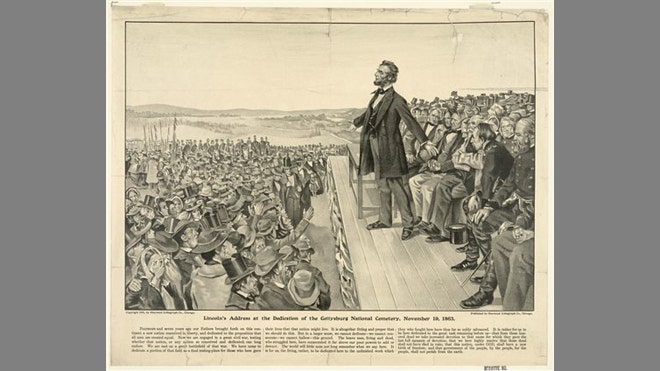
Four score and seven years ago our fathers brought forth on this continent, a new nation, conceived in Liberty, and dedicated to the proposition that all men are created equal.
Now we are engaged in a great civil war, testing whether that nation, or any nation so conceived and so dedicated, can long endure. We are met on a great battle-field of that war. We have come to dedicate a portion of that field, as a final resting place for those who here gave their lives that that nation might live. It is altogether fitting and proper that we should do this.
But, in a larger sense, we can not dedicate -- we can not consecrate -- we can not hallow -- this ground. The brave men, living and dead, who struggled here, have consecrated it, far above our poor power to add or detract. The world will little note, nor long remember what we say here, but it can never forget what they did here. It is for us the living, rather, to be dedicated here to the unfinished work which they who fought here have thus far so nobly advanced. It is rather for us to be here dedicated to the great task remaining before us -- that from these honored dead we take increased devotion to that cause for which they gave the last full measure of devotion -- that we here highly resolve that these dead shall not have died in vain -- that this nation, under God, shall have a new birth of freedom -- and that government of the people, by the people, for the people, shall not perish from the earth.
Abraham Lincoln
November 19, 1863

Labels:

Monday, February 25, 2013

If You Know About Kentucky, Then This News Will NOT Shock You: Kentucky Supported Abraham Lincoln's Efforts To Abolish Slavery — 111 Years Late!


Mae Jones Street Kidd (February 8, 1904 Ð October 20, 1999),
left, was an innovative businesswoman, a civic leader, and a skilled
 politician. She had a distinguished career in public relations, served
 in the Red Cross during World War II, and was a member of the
Kentucky House of Representatives from 1968 to 1984, representing
 Louisville's 41st state legislative district. In this photo she talked with
 Governor John Y. Brown sometime in the 1980's

Here's an OMG fact for you: The Kentucky legislature didn't go on record against slavery until 1976 — 111 years after the 13th Amendment prohibiting involuntary servitude became the law of the land.
Lincoln, with 12 nominations at Sunday's Academy Awards ceremony, tells of the president's struggle to have Congress pass the amendment.

What isn't told is that Kentucky, Lincoln's birthplace, refused to ratify the amendment. Mississippi was another; more on that later.
The movie depicts only the first step of the process to add an amendment to the U.S. Constitution. Moviegoers see passage of the amendment in the House of Representatives in 1865. But the amendment's story didn't end there.
Before an amendment can be added to the U.S. Constitution, three-fourths of the states must pass or ratify it. That process wasn't finished and verified until December 1865, eight months after Lincoln's assassination.

To understand why Kentucky rejected ratification, some context is necessary.
Slavery had existed in Kentucky since before it achieved statehood in 1792. In 1790, slaves were a little more than 6 percent of the population. By 1830, they were 24 percent of the population. By 1860, the year before the start of the Civil War, Kentucky had 225,000 slaves; most lived in the Bluegrass region and in the corridor between Lexington and Louisville.

Kentucky's first constitution, written in 1792, protected the right to own slaves. Slave labor was used to grow hemp in the 1800s, and tobacco in the central and western regions of the state. By 1850, 28 percent of white families owned slaves, but the average slaveholder owned five slaves or fewer.
At the start of the Civil War, Lincoln had hoped to encourage border states like Kentucky to take the initiative in abolishing slavery themselves, according to historians Lowell Harrison and James Klotter. Lincoln tried several times to get Kentucky to adopt a plan of compensated emancipation. It would work like this: If a state committed itself to a definite date to end slavery, then Lincoln would recommend to Congress that owners receive $400 for each slave. The plan didn't fly.

When Lincoln decided that ending slavery would help win the war, he declared slaves free only in those areas controlled by the Confederacy. His Emancipation Proclamation of 1863 did not affect Kentucky. Even so, the proclamation attracted protest in the Bluegrass.
"Most Kentuckians supported the Union with the understanding that a state had the right to deal with slavery as a matter of state's rights," wrote James Ramage, a professor of history at Northern Kentucky University, in an email. "When President Lincoln issued the Emancipation Proclamation, most Kentucky Unionists felt betrayed and declared that they would never accept freeing the slaves."
Kentucky Gov. James F. Robinson denounced the Emancipation Proclamation in his message to the legislature in early January 1863. The legislature also denounced the proclamation "as unwise, unconstitutional and void," and there was talk in the state of recalling Kentucky troops from the Union army. Some even advocated that Kentucky secede from the Union.

Such talk embarrassed those who supported emancipation. Samuel Lusk wrote to a friend on Feb. 4, 1863: "If the president is resolved on going to hell and destroying the best government on earth, let him place himself under the control of Kentucky politicians and he will soon have accomplished his purpose."

Meanwhile, the feds were doing little to win the hearts and minds of many Kentuckians. Federal troops resorted to abrasive measures that were illegal or unconstitutional to maintain military control of the state. This included military interference with elections, such as prohibiting "disloyal" persons from voting.

By 1864, the Union army's ill treatment of civilians and Lincoln's inclusion of black freedom as a war aim "caused many formerly loyal Kentuckians to turn their sympathies against the federal government," writes Anne E. Marshall in Creating a Confederate Kentucky: The Lost Cause and Civil War Memory in a Border State.

Among those opposing federal policies was Brutus Clay, a U.S. congressman from Bourbon County, who was steadfastly against abolition and the enlistment of slaves into the Union army. (Brutus was brother to Cassius Marcellus Clay, who argued for emancipation and published an anti-slavery newspaper, The Lexington True American.)

During the debate on the 13th Amendment, Brutus Clay said: "If you take away from a man that which he considers to be justly his own, you make him desperate, and he will retaliate upon you. You can never by oppression make a man obey willingly the laws of his country. Act justly toward him, let him see he has a government which will protect him and he will love that government. But oppress and rob him, and he will despise and hate you."

Without Clay's vote, the 13th Amendment passed the U.S. House of Representatives in January 1865 — the climatic finale in Steven Spielberg's movie. The next month, the Kentucky legislature voted to reject it: 56-18 in the House and 23-10 in the Senate.

Slavery was still legal and visible in the commonwealth in 1865. One visitor traveling through the South that year noted that Louisville was the only place on the trip where slaves waited on him.
Nevertheless, the 13th Amendment was ratified by the necessary three-fourths majority of states and was officially adopted in December 1865. Kentucky, meanwhile, came to identify itself more with the Confederacy after the war than it did during the war. Between 1867 and 1894, Kentucky elected six governors who had been Confederates or Confederate sympathizers.

Kentucky did not move to ratify the 13th Amendment until state Rep. Mae Street Kidd, D-Louisville, one of three blacks then in the Kentucky legislature, filed a resolution to do so in 1976.
The resolution passed the Kentucky House by a 77-0 vote, and it passed the Kentucky Senate by a voice vote on March 18, 1976. The vote was symbolic — Kentucky's ratification wasn't needed for the amendment to be added to the U.S. Constitution — but it was a symbol with power.

Now, back to Mississippi. The Magnolia State ratified the 13th Amendment on March 16, 1995, but because the ratification document was never presented to the U.S. archivist, it was never considered official.

On Jan. 30 of this year, Mississippi finally sent a copy of its 1995 resolution to adopt and pass the 13th Amendment to the Office of the Federal Register.
A week later, Federal Register Director Charles Barth confirmed that he had received the paperwork, the Clarion-Ledger newspaper of Jackson, Miss., reported.
"With this action, the state of Mississippi has ratified the 13th Amendment to the Constitution of the United States," he wrote.

Labels: , , ,

Thursday, January 03, 2013

The Emancipation Of Abe Lincoln.

The Emancipation of Abe Lincoln
By ERIC FONER

ONE hundred and fifty years ago, on Jan. 1, 1863, Abraham Lincoln presided over the annual White House New Year’s reception. Late that afternoon, he retired to his study to sign the Emancipation Proclamation. When he took up his pen, his hand was shaking from exhaustion. Briefly, he paused — “I do not want it to appear as if I hesitated,” he remarked. Then Lincoln affixed a firm signature to the document.

Like all great historical transformations, emancipation was a process, not a single event. It arose from many causes and was the work of many individuals. It began at the outset of the Civil War, when slaves sought refuge behind Union lines. It did not end until December 1865, with the ratification of the 13th Amendment, which irrevocably abolished slavery throughout the nation.

But the Emancipation Proclamation was the crucial turning point in this story. In a sense, it embodied a double emancipation: for the slaves, since it ensured that if the Union emerged victorious, slavery would perish, and for Lincoln himself, for whom it marked the abandonment of his previous assumptions about how to abolish slavery and the role blacks would play in post-emancipation American life.

There is no reason to doubt the sincerity of Lincoln’s statement in 1864 that he had always believed slavery to be wrong. During the first two years of the Civil War, despite insisting that the conflict’s aim was preservation of the Union, he devoted considerable energy to a plan for ending slavery inherited from prewar years. Emancipation would be undertaken by state governments, with national financing. It would be gradual, owners would receive monetary compensation and emancipated slaves would be encouraged to find a homeland outside the United States — this last idea known as “colonization.”

Lincoln’s plan sought to win the cooperation of slave holders in ending slavery. As early as November 1861, he proposed it to political leaders in Delaware, one of the four border states (along with Kentucky, Maryland and Missouri) that remained in the Union. Delaware had only 1,800 slaves; the institution was peripheral to the state’s economy. But Lincoln found that even there, slave holders did not wish to surrender their human property. Nonetheless, for most of 1862, he avidly promoted his plan to the border states and any Confederates who might be interested.

Lincoln also took his proposal to black Americans. In August 1862, he met with a group of black leaders from Washington. He seemed to blame the presence of blacks in America for the conflict: “but for your race among us there could not be war.” He issued a powerful indictment of slavery — “the greatest wrong inflicted on any people” — but added that, because of racism, blacks would never achieve equality in America. “It is better for us both, therefore, to be separated,” he said. But most blacks refused to contemplate emigration from the land of their birth.

In the summer of 1862, a combination of events propelled Lincoln in a new direction. Slavery was disintegrating in parts of the South as thousands of slaves ran away to Union lines. With the war a stalemate, more Northerners found themselves agreeing with the abolitionists, who had insisted from the outset that slavery must become a target. Enthusiasm for enlistment was waning in the North. The Army had long refused to accept black volunteers, but the reservoir of black manpower could no longer be ignored. In response, Congress moved ahead of Lincoln, abolishing slavery in the District of Columbia, authorizing the president to enroll blacks in the Army and freeing the slaves of pro-Confederate owners in areas under military control. Lincoln signed all these measures that summer.

The hallmark of Lincoln’s greatness was his combination of bedrock principle with open-mindedness and capacity for growth. That summer, with his preferred approach going nowhere, he moved in the direction of immediate emancipation. He first proposed this to his cabinet on July 22, but Secretary of State William H. Seward persuaded him to wait for a military victory, lest it seem an act of desperation.

Soon after the Union victory at Antietam in September, Lincoln issued the Preliminary Emancipation Proclamation, a warning to the Confederacy that if it did not lay down its arms by Jan. 1, he would declare the slaves “forever free.”

Lincoln did not immediately abandon his earlier plan. His annual message to Congress, released on Dec. 1, 1862, devoted a long passage to gradual, compensated abolition and colonization. But in the same document, without mentioning the impending proclamation, he indicated that a new approach was imperative: “The dogmas of the quiet past, are inadequate to the stormy present,” he wrote. “We must disenthrall our selves, and then we shall save our country.” Lincoln included himself in that “we.” On Jan. 1, he proclaimed the freedom of the vast majority of the nation’s slaves.

The Emancipation Proclamation is perhaps the most misunderstood of the documents that have shaped American history. Contrary to legend, Lincoln did not free the nearly four million slaves with a stroke of his pen. It had no bearing on slaves in the four border states, since they were not in rebellion. It also exempted certain parts of the Confederacy occupied by the Union. All told, it left perhaps 750,000 slaves in bondage. But the remaining 3.1 million, it declared, “are, and henceforward shall be free.”

The proclamation did not end slavery in the United States on the day it was issued. Indeed, it could not even be enforced in most of the areas where it applied, which were under Confederate control. But it ensured the eventual death of slavery — assuming the Union won the war. Were the Confederacy to emerge victorious, slavery, in one form or another, would undoubtedly have lasted a long time.

A military order, whose constitutional legitimacy rested on the president’s war powers, the proclamation often disappoints those who read it. It is dull and legalistic; it contains no soaring language enunciating the rights of man. Only at the last minute, at the urging of Treasury Secretary Salmon P. Chase, an abolitionist, did Lincoln add a conclusion declaring the proclamation an “act of justice.”

Nonetheless, the proclamation marked a dramatic transformation in the nature of the Civil War and in Lincoln’s own approach to the problem of slavery. No longer did he seek the consent of slave holders. The proclamation was immediate, not gradual, contained no mention of compensation for owners, and made no reference to colonization.

In it, Lincoln addressed blacks directly, not as property subject to the will of others but as men and women whose loyalty the Union must earn. For the first time, he welcomed black soldiers into the Union Army; over the next two years some 200,000 black men would serve in the Army and Navy, playing a critical role in achieving Union victory. And Lincoln urged freed slaves to go to work for “reasonable wages” — in the United States. He never again mentioned colonization in public.

Having made the decision, Lincoln did not look back. In 1864, with casualties mounting, there was talk of a compromise peace. Some urged Lincoln to rescind the proclamation, in which case, they believed, the South could be persuaded to return to the Union. Lincoln refused. Were he to do so, he told one visitor, “I should be damned in time and eternity.”

Wartime emancipation may have settled the fate of slavery, but it opened another vexing question: the role of former slaves in American life. Colonization had allowed its proponents to talk about abolition without having to confront this issue; after all, the black population would be gone. After Jan. 1, 1863, Lincoln for the first time began to think seriously of the United States as a biracial society.

While not burdened with the visceral racism of many of his white contemporaries, Lincoln shared some of their prejudices. He had long seen blacks as an alien people who had been unjustly uprooted from their homeland and were entitled to freedom, but were not an intrinsic part of American society. During his Senate campaign in Illinois, in 1858, he had insisted that blacks should enjoy the same natural rights as whites (life, liberty and the pursuit of happiness), but he opposed granting them legal equality or the right to vote.

By the end of his life, Lincoln’s outlook had changed dramatically. In his last public address, delivered in April 1865, he said that in reconstructing Louisiana, and by implication other Southern states, he would “prefer” that limited black suffrage be implemented. He singled out the “very intelligent” (educated free blacks) and “those who serve our cause as soldiers” as most worthy. Though hardly an unambiguous embrace of equality, this was the first time an American president had endorsed any political rights for blacks.

And then there was his magnificent second inaugural address of March 4, 1865, in which Lincoln ruminated on the deep meaning of the war. He now identified the institution of slavery — not the presence of blacks, as in 1862 — as its fundamental cause. The war, he said, might well be a divine punishment for the evil of slavery. And God might will it to continue until all the wealth the slaves had created had been destroyed, and “until every drop of blood drawn with the lash, shall be paid by another drawn with the sword.” Lincoln was reminding Americans that violence did not begin with the firing on Fort Sumter, S.C., in April 1861. What he called “this terrible war” had been preceded by 250 years of the terrible violence of slavery.

In essence, Lincoln asked the nation to confront unblinkingly the legacy of slavery. What were the requirements of justice in the face of this reality? What would be necessary to enable former slaves and their descendants to enjoy fully the pursuit of happiness? Lincoln did not live to provide an answer. A century and a half later, we have yet to do so.

Eric Foner is a professor of history at Columbia and the author, most recently, of “The Fiery Trial: Abraham Lincoln and American Slavery.” This article has been revised to reflect the following correction: Correction: January 1, 2013 An earlier version of this essay misquoted part of Lincoln's second inaugural address. He said the war, possibly divine punishment for slavery, might continue “until every drop of blood drawn with the lash, shall be paid by another drawn with the sword" — not "by the sword."

Labels: , ,

Wednesday, November 28, 2012

LESSONS IN POLITICS FROM STEVEN SPIELBERG'S "[ABRAHAM] LINCOLN. YOU OWE TO YOUR COUNTRY TO GO SEE THE MOVIE, AND READ "TEAM OF RIVALS", THE BOOK IT WAS BASED ON.


Lessons in politics from ‘Lincoln’

Steven Spielberg didn't want his new movie about Abraham Lincoln to open during the election campaign. It would have become a political football, its message distorted by speculation about the similarities between the two tall presidents from Illinois and their political circumstances.


Steven Spielberg didn't want his new movie about Abraham Lincoln to open during the election campaign. It would have become a political football, its message distorted by speculation about the similarities between the two tall presidents from Illinois and their political circumstances. Besides, “Lincoln” isn't about a campaign. It focuses on just a few weeks in Lincoln's life, as the newly re-elected president faces the challenge of getting a piece of critical legislation through a lame-duck Congress with the clock ticking. Sound familiar? Actually, it's coincidence that Speilberg's riveting story hits theaters just as a high-stakes congressional debate looms. Tony Kushner started working on the script years ago, long before Barack Obama's re-election was predictable or a fiscal cliff was added to the contemporary landscape. But it's a happy coincidence. It reminds us that what happens in Washington is important, that bitter partisanship can give birth to great changes, and that the exercise of political power is messy and ethically compromising, even in pursuit of a noble cause. Spielberg paints stunning pictures of Civil War battlefields, but “Lincoln” is a story of a piece of legislation, not of war. At issue is the 13th Amendment to the Constitution, which would forever prohibit human slavery in the U.S. Through his Emancipation Proclamation, Lincoln already had freed the slaves in Confederate states. But that was an exercise of emergency wartime powers, he explained to his cabinet. Like some other things he felt he had to do to win the war, it was possibly — no, probably — unconstitutional. In any event, the Emancipation Proclamation didn't apply to border states, where slavery had continued. Nor would it apply if states were no longer in rebellion. There was nothing in it to ensure that slavery wouldn't return at the end of the bloody war America had fought over it. With the closing acts of that war in sight, the window to write abolition into the Constitution was closing. The 13th Amendment had been passed by the Senate, but had fallen short in the House. As Grant's army chased Lee in a punishing retreat across Tidewater Virginia, Lincoln chased the dozen votes he needed in the House. Based on a small section in Doris Kearns Goodwin's “Team of Rivals,” Spielberg's story of the 13th Amendment carries her emphasis on Lincoln as a crafty politician as well as a visionary, courageous leader. “I am the president of the United States, clothed in immense power,” Lincoln says in both the book and the movie, and he uses that power. His agents trade appointments for the votes of House members who had lost their seats in the election. Lincoln plays fast-and-loose with the truth, promising one faction he'll meet with a peace commission from the Confederacy while reassuring another there would be no such talks. In Daniel Day-Lewis' riveting performance, Lincoln's ethical corner-cutting comes across as tragic, noble and, given the circumstances, necessary. Seven score and eight years later, another drama is about to unfold in a lame-duck Congress. Again, a president may have to scramble for enough votes in the House to navigate the fiscal cliff on his own terms. And how's this for historical coincidence: George Pendleton, leader of the House Democrats arguing against the 13th Amendment, had been, just weeks before, the vice-presidential candidate on the ticket Lincoln defeated. And who'll lead the House Republicans in negotiations over whatever bill Obama puts forth to avoid the fiscal cliff? The vice-presidential candidate he just defeated, Rep. Paul Ryan. Deals will be cut and loyalties tested in the weeks to come. Likely, they will involve the more than 80 members who'll be leaving Congress in January. Lame-duck sessions are always unpredictable, with the departing members tempted by revenge and self-interest, even as they are freed to rise above the political considerations that guided their careers. With so many moving parts at play in today's fiscal quandary — taxes, spending, budgets and economics — the narrative will be hard to follow and the compromises may seem petty and corrupt. But the moral choices facing Lincoln and his peers weren't nearly as simple as they seem from our historical distance. And the road toward what he and the Founders called “a more perfect union” was neither straight nor smooth. It was paved, then as now, with politics. Rick Holmes, opinion editor for the MetroWest, Mass., Daily News, blogs at Holmes & Co. He can be reached at rholmes@wickedlocal.com.

EDITOR'S COMMENT:THE AUTHOR OF THIS PIECE MAKES A VERY FALSE ACCUSATION AGAINST MY HERO, ABRAHAM LINCOLN, THUS:
"Lincoln plays fast-and-loose with the truth, promising one faction he'll meet with a peace commission from the Confederacy while reassuring another there would be no such talks."
THE TRUTH INSTEAD IS THAT "HONEST ABE" USED HIS SUPERIOR INTELLECT TO CONFOUND THE EVIL CONfederates by insisting that THE CONfederates WERE NOT IN WASHINGTON WITH PEACE OVERTURES THERE WAS NO PLANS FOR THEM TO BE THERE.
.
THIS ASSERTION WAS IN FACT FACTUAL, AS NO SUCH MEETING TOOK PLACE IN WASHINGTON.

RATHER, THE MEETING TOOK PLACE ON A BOOT MOORED IN WATERS AWAY FROM THE CITY.

Labels:

Monday, February 13, 2012

In Honor Of My Hero, Abraham "Honest Abe" Lincoln: Words To Live By, Words To Ponder And Words Of Wisdom.

Whenever I hear anyone arguing for slavery, I feel a strong impulse to see it tried on him personally.

Marriage is neither heaven nor hell, it is simply purgatory.

With Malice toward none, with charity for all, with firmness in the right, as God gives us to see the right, let us strive on to finish the work we are in, to bind up the nation's wounds.

You can fool all the people some of the time, and some of the people all the time, but you cannot fool all the people all the time.

Nearly all men can stand adversity, but if you want to test a man's character, give him power.

No matter how much cats fight, there always seem to be plenty of kittens.

Sir, my concern is not whether God is on our side; my greatest concern is to be on God's side, for God is always right.

Those who deny freedom to others deserve it not for themselves.

To sin by silence when they should protest makes cowards of men.

We the people are the rightful masters of both Congress and the courts, not to overthrow the Constitution but to overthrow the men who pervert the Constitution.

What kills a skunk is the publicity it gives itself.

When you have got an elephant by the hind legs and he is trying to run away, it's best to let him run.

You have to do your own growing no matter how tall your grandfather was.

The Emancipation Proclamation

And: The Gettysburg Address:

Four score and seven years ago our fathers brought forth on this continent, a new nation, conceived in Liberty, and dedicated to the proposition that all men are created equal.

Now we are engaged in a great civil war, testing whether that nation, or any nation so conceived and so dedicated, can long endure. We are met on a great battle-field of that war. We have come to dedicate a portion of that field, as a final resting place for those who here gave their lives that that nation might live. It is altogether fitting and proper that we should do this.

But, in a larger sense, we can not dedicate -- we can not consecrate -- we can not hallow -- this ground. The brave men, living and dead, who struggled here, have consecrated it, far above our poor power to add or detract. The world will little note, nor long remember what we say here, but it can never forget what they did here. It is for us the living, rather, to be dedicated here to the unfinished work which they who fought here have thus far so nobly advanced. It is rather for us to be here dedicated to the great task remaining before us -- that from these honored dead we take increased devotion to that cause for which they gave the last full measure of devotion -- that we here highly resolve that these dead shall not have died in vain -- that this nation, under God, shall have a new birth of freedom -- and that government of the people, by the people, for the people, shall not perish from the earth.

Labels: , , ,

Sunday, February 12, 2012

Happy Birthday To My Number One Hero And Father Of Our New Reborn Republic, Abraham "Honest Abe" Lincoln. Your Nation Mourns Your Untimely Death, As We Seek Another Abraham.

Happy birthday to my hero and Father of our new reborn Republic, Abraham "Honest Abe" Lincoln.

Your nation mourns your untimely death, as we ask God to send us another Abraham.

May you continue to rest in perfect peace. Amen.

Labels: ,

Monday, July 04, 2011

Lincoln’s Declaration.

Lincoln’s declaration
Declaration should remain today what Lincoln fought to establish it as

By RICH LOWRY

When Abraham Lincoln began his speech at the dedication of the Gettysburg cemetery in 1863 with those words redolent of the King James Bible, “four score and seven years ago,” he referred back to 1776, not 1787.

It was the Declaration of Independence, not the Constitution, that animated Lincoln’s project to return mid-19th-century America to our “ancient faith.” For Lincoln, the path of salvation for a country torn by contention over slavery ran through the past: “Our republican robe is soiled, and trailed in the dust. Let us re-purify it. Let us turn and wash it white, in the spirit, if not the blood, of the Revolution.”

In the prelude to and during the Civil War - the 150th anniversary of which we mark this year - Lincoln clung to the Declaration as the fundamental statement of the nation’s purpose. The Declaration, according to Lincoln, easily could have enunciated the practical reasons for our split from Britain, and left it at that. No ringing philosophical statements, no invocation of “unalienable rights.”

But Thomas Jefferson’s handiwork was meant for the ages. Lincoln praised him for possessing the foresight “to introduce into a merely revolutionary document, an abstract truth, applicable to all men and all times, and so to embalm it there, that to-day, and in all coming days, it shall be a rebuke and a stumbling-block to the very harbingers of re-appearing tyranny and oppression.”

Lincoln made precisely this use of the Declaration. Prior to the passage of the Kansas-Nebraska Act in 1854, overturning the Missouri Compromise and allowing slavery into all the territories if the people wanted it, he referred to the Declaration in public only twice. In the ensuing crisis, it became a staple of his rhetoric.

Lincoln’s historic debates with Illinois Sen. Stephen Douglas, the author of the Kansas-Nebraska Act, were at bottom an argument about the Declaration. Under his doctrine of “popular sovereignty,” Douglas wanted to allow the extension of slavery in blatant disregard of the belief that “all men are created equal.”

Douglas denied that the Declaration had universal meaning. The Founders merely meant to say that as British subjects in North America we were equal to British subjects in Britain. What appeared to be a ringing statement of eternal truth was in reality a dubious assertion that all men are British.

Worse, Douglas and his ilk - Chief Justice Roger Taney and all the apologists for the slave power - also fell back on the argument that blacks weren’t men. If so, Lincoln wondered, why did the country permit half a million blacks their freedom? “How comes this vast amount of property to be running about without owners? We do not see free horses or free cattle running at large.”

The popular sovereignty of Douglas depended, ultimately, on believing the Declaration a lie. One of the reasons Lincoln said he hated slavery was “that it forces really good men amongst ourselves into an open war with the very fundamental principles of civil liberty - criticizing the Declaration of Independence, and insisting that there is no right principle of action but self- interest.”

This view threatened the foundation of freedom. “A free people cannot disagree, or agree to disagree, on the relative merits of freedom and despotism,” the great Lincoln scholar Harry Jaffa writes. “If the majority favors despotism, it is no longer a free people, whether the form of government has already changed or not.”

Lincoln lost the 1858 Senate election, of course, but he succeeded ultimately in vindicating the Declaration. It should remain today what Lincoln fought to establish it as: the timeless object for our national aspiration. “They meant to set up a standard maxim for free society,” Lincoln said of the Founders, “which should be familiar to all, and revered by all; constantly looked to, constantly labored for, and even though never perfectly attained, constantly approximated, and thereby constantly spreading and deepening its influence, and augmenting the happiness and value of life to all people of all colors everywhere.”

Labels:

Saturday, February 12, 2011

Happy Birthday To My Hero, The One TRUE Conservative And TRUE Republican, Abraham "Honest Abe" Lincoln.


Your nation misses you, needs you now, and mourns your untimely passing.

Editor's note: Out of respect for my hero's birthday, I shall cease blog postings for the rest of the day. Come back tomorrow, guys and gals.

Labels: , ,

Tuesday, October 12, 2010

Eric Foner: Lincoln's Evolving Thoughts On Slavery, And Freedom.


Lincoln's Evolving Thoughts on Slavery, And Freedom
The Fiery Trial: Abraham Lincoln and American Slavery
By Eric Foner

In 1854, Sen. Stephen Douglas forced the Kansas-Nebraska Act through Congress. The bill, which repealed the Missouri Compromise of 1820, also opened up a good portion of the Midwest to the possible expansion of slavery.

Douglas' political rival, former Illinois Congressman Abraham Lincoln, was enraged by the bill. He scheduled three public speeches in the fall of 1854, as responses to Douglas. The longest of those speeches — known as the Peoria Speech — was three hours long. In it, Lincoln aired his grievances over Douglas' bill and outlined his moral, economic, political and legal arguments against slavery.

But like many Americans, Lincoln was unsure what to do once slavery ended.

"Lincoln said during the Civil War that he had always seen slavery as unjust. He said he couldn't remember when he didn't think that way — and there's no reason to doubt the accuracy or sincerity of that statement," explains historian Eric Foner. "The problem arises with the next question: what do you do with slavery, given that it's unjust? Lincoln took a very long time to try to figure out exactly what steps ought to be taken."

Foner traces the evolution of Lincoln's thoughts on slavery in The Fiery Trial: Abraham Lincoln and American Slavery. He explains how Lincoln's changing thoughts about slavery — and the role of freed slaves — mirrored America's own transformation.

In the Peoria speech, Lincoln said that slavery was wrong, Foner says, and then admitted that he didn't know what should be done about it, even contemplating "free[ing] all the slaves, and send[ing] them to Liberia — to their own native land."

"Lincoln is thinking through his own position on slavery," says Foner. "[This speech] really epitomizes his views into the Civil War. Slavery ought to be abolished — but he doesn't really know how to do it. He's not an abolitionist who criticizes Southerners. At this point, Lincoln does not really see black people as an intrinsic part of American society. They are kind of an alien group who have been uprooted from their own society and unjustly brought across the ocean. 'Send them back to Africa' he says. And this was not an unusual position at this time."

Foner traces how Lincoln first supported this kind of colonization — the idea that slaves should be freed and then encouraged or required to leave the United States — for well over a decade. Like Henry Clay, Lincoln also supported repealing slavery gradually — and possibly compensating slave owners for their loss after slaves were freed.

It was not until the Emancipation Proclamation, which declared the freedom of all slaves and then named 10 specific states where the law would take affect, that Lincoln publicly rejected his earlier views.

"The Emancipation Proclamation completely repudiates all of those previous ideas for Lincoln," says Foner. "[The abolishment of slavery is] immediate, not gradual. There is no mention of compensation and there is nothing in it about colonization. After the Emancipation Proclamation, Lincoln says nothing publicly about colonization."

Foner says many factors led to Lincoln's shift in his position regarding former slaves. Neither slave-owners nor slaves supported colonization. Slavery was beginning to disintegrate in the South. And the Union Army was looking for new soldiers to enlist — and they found willing African-American men waiting for them in the South.

"As soon as the Union Army went into the South, slaves began running away from plantations to Union lines," Foner says. And this forced the question of slavery onto the national agenda."

"Almost from the very beginning of the Civil War, the federal government had to start making policy and they said, 'Well, we're going to treat these people as free. We're not going to send them back into the slave holding regions,'" Foner says. "And the Army opened itself up to the enlistment of black men. And by the end of the Civil War, 200,000 black men have served in the Union Army and Navy. And envisioning blacks as soldiers is a very, very different idea of their future role in American society. It's the black soldiers and their role which really begins as the stimulus in Lincoln's change [with regard to] racial attitudes and attitudes towards America as an inter-racial society in the last two years of his life."

"I am naturally anti-slavery. If slavery is not wrong, nothing is wrong. I can not remember when I did not so think, and feel." There is no reason to doubt the sincerity of Abraham Lincoln's emphatic declaration, written in April 1864, three years into the American Civil War. But as with so much of his early life, the origins of his thoughts and feelings about slavery remain shrouded in mystery. Lincoln grew up in a world in which slavery was a living presence and where both deeply entrenched racism and various kinds of antislavery sentiment flourished. Until well into his life, he had only sporadic contact with black people, slave or free. In later years, he said almost nothing about his early encounters with slavery, slaves, and free African-Americans. Nonetheless, as he emerged in the 1830s as a prominent Illinois politician, the cumulative experiences of his early life led Lincoln to identify himself as an occasional critic of slavery. His early encounters with and responses to slavery were the starting point from which Lincoln's mature ideas and actions would later evolve.

********************

Abraham Lincoln was born in 1809 in a one-room Kentucky log cabin. When he was seven, his family moved across the Ohio River to southwestern Indiana, where Lincoln spent the remainder of his childhood. In 1830, when Lincoln was twenty-one years old and about to strike out on his own, his father moved the family to central Illinois. Here Lincoln lived until he assumed the presidency in 1861.

At the time of Lincoln's birth and for most of the antebellum era, about one-fifth of Kentucky's population consisted of slaves. Outside a few counties, however, Kentucky slaveholders were primarily small farmers and urban dwellers, not plantation owners. Substantial parts of the state lay outside the full grip of slave society, "tolerating slavery, but not dominated by it." Kentucky formed part of the Border South, the northernmost belt of slave states that would play so crucial a role in the early years of the Civil War. Hardin County, where the Lincolns lived, lay south of the Ohio River in west-central Kentucky. In 1811 its population of around 7,500 included over 1,000 slaves, most of whom labored either on small farms or on the Ohio River. Kentucky at this time was an important crossroads of the domestic slave trade. The Lincolns' farm on Knob Creek lay not far from the road connecting Louisville and Nashville, along which settlers, peddlers, and groups of shackled slaves regularly passed.

As an offshoot of Virginia, Kentucky recognized slavery from the earliest days of white settlement. The state's first constitution, written in 1792, prohibited the legislature from enacting laws for emancipation without the consent of the owners and full monetary compensation. In 1799, when a convention met to draft a new constitution (the first one being widely regarded as insufficiently democratic), a spirited debate over slavery took place. The young Henry Clay, just starting out on a career that would make him one of the nation's most prominent statesmen (and Lincoln's political idol), published a moving appeal asking white Kentuckians, "enthusiasts as they are for liberty," to consider the fate of "fellow beings, deprived of all rights that make life desirable." He urged the convention to adopt a plan of gradual emancipation. Clay's plea failed, but antislavery delegates did succeed in putting into the constitution a clause barring the introduction of slaves into the state for sale, although this soon became a dead letter. On one point, however, white Kentuckians, including emancipationists, agreed: they did not desire a free black population. In 1808, the year before Lincoln's birth, the legislature prohibited the migration of free blacks into Kentucky. When Lincoln was a boy, the state's population of 410,000 included only 1,700 free persons of color, 28 of whom lived in Hardin County.

By the early nineteenth century, emancipationist sentiment had waned, but in some parts of Kentucky, including Hardin, disputes about slavery continued. The first place to look for early influences on Lincoln is his own family. Some of Lincoln's relatives owned slaves—his father's uncle, Isaac, had forty-three when he died in 1834. But Lincoln's parents exhibited an aversion to the institution. The South Fork Baptist Church to which they belonged divided over slavery around the time of Lincoln's birth; the antislavery group formed its own congregation, which his parents joined. However, as strict Calvinist predestinarians who believed that one's actions had no bearing on eventual salvation, which had already been determined by God, Lincoln's parents were not prone to become involved in reform movements that aimed at bettering conditions in this world.

In a brief autobiography written in 1860, Lincoln recounted that his father moved the family to Indiana "partly on account of slavery." His main reason, however, Lincoln quickly added, was "land titles." Land surveys in Kentucky were notoriously unreliable and landownership often precarious. To purchase land in Kentucky, according to a visitor in the 1790s, was to buy a lawsuit. During Lincoln's boyhood, his father Thomas Lincoln owned three farms but lost two of them because of faulty titles. In Indiana, however, thanks to the federal land ordinances of the 1780s, the national government surveyed land prior to settlement and then sold it through the General Land Office, providing secure titles. When the War of 1812 destroyed Indians' power in much of the Old Northwest, their land, appropriated by the United States, became available for sale. Thousands of settlers from the Border South, among them Lincoln's family, moved across the Ohio River to occupy farms. "Kentucky," the saying went, "took Indiana without firing a shot."

In Indiana and Illinois, where Lincoln lived from ages seven to fifty-one, the Northwest Ordinance of 1787 had prohibited slavery. Throughout the pre–Civil War decades, intrepid slaves tried to make their way across the Ohio River in search of liberty. Nonetheless, the Ohio did not mark a hard and fast dividing line between North and South, slavery and freedom. For many years it was far easier for people and goods to travel between Kentucky and southern Indiana and Illinois than to the northern parts of these states. Slave-catchers, too, frequently crossed the river, searching for fugitives.

Before the War of 1812, the Old Northwest was a kind of borderland, a meeting-ground of Native Americans and various people of English, French, and American descent where geographical and cultural boundaries remained unstable. The defeat of the British and their ally Tecumseh, who had tried to organize pan-Indian resistance to American rule, erased any doubt over who would henceforth control the region. But a new borderland quickly emerged. When Lincoln lived there, the southern counties of Indiana and Illinois formed part of a large area that encompassed the lower parts of the free states and the northernmost slave states. This region retained much of the cultural flavor of the Upper South. Its food, speech, settlement patterns, architecture, family ties, and economic relations had much more in common with Kentucky and Tennessee than with the northern counties of their own states, soon to be settled by New Englanders. The large concentration of people of southern ancestry made Indiana and Illinois key battlegrounds in northern politics as the slavery controversy developed. Here, a distinctive politics of moderation developed. On the eve of the Civil War, a writer in far-off Maine described the southern Northwest as "a sort of belt or break-water between the extremes of the North and South."

In the decade before the Civil War, the population exploded in northern Illinois. But because they had been settled first, the southern counties long shaped the state's public life. Of the first seven governors, six had been born in a slave state. In 1848, more members of the Illinois legislature and constitutional convention hailed from Kentucky than from any other state. As late as 1858, during his campaign for the U.S. Senate, Lincoln made a point of affirming his geographical roots to voters in southern Illinois: "I was raised just a little east of here. I am a part of this people." By then, however, the southern counties had been eclipsed politically and economically by northern Illinois.

Many pioneer settlers in Indiana and Illinois, like the Lincoln family, carried with them an aversion to slavery. Richard Yates, the Kentucky-born Civil War governor of Illinois, spoke of his view of slavery in words much like Lincoln's: "The earliest impressions of my boyhood were that the institution of slavery was a grievous wrong." Peter Cartwright, a Methodist preacher and political leader whom Lincoln defeated for Congress in 1846, later wrote that he emigrated from Tennessee in 1824 to "get entirely clear of the evil of slavery." Such men viewed slavery less as a moral problem than as an institution that degraded white labor, created an unequal distribution of wealth and power, and made it impossible for nonslaveholding farmers to advance.

Since the eighteenth century, slavery had existed in the region. And despite the Northwest Ordinance, its death was long in coming. In Indiana, the territorial governor William Henry Harrison, the son of a Virginia planter, led an unsuccessful drive to have Congress suspend its ban on slavery, arguing that only in this way could the area's future economic growth be ensured. But antislavery settlers, organized as the Popular party and claiming to defend the interests of small farmers against "Virginia aristocrats," won control of the territorial legislature and foiled Harrison's plans. When Indiana drafted a constitution in 1816, the year the Lincoln family moved into the state, it prohibited slavery.

Even though slavery was theoretically illegal in Illinois under the Northwest Ordinance, Ninian Edwards, the territorial governor between 1809 and 1816 (whose son became Lincoln's brother-in-law), advertised for sale twenty-two slaves, along with "a full blooded horse" and "a very large English bull." The Illinois constitution of 1818 prohibited slaves from being "hereafter . . . introduced" but did not declare free those already living in the state. As late as 1840, the census counted 331 slaves in Illinois. Illinois allowed slaveowners to sign supposedly voluntary indentures with black laborers brought in from other states, effectively keeping them in bondage. For many years, newspapers carried notices for the buying and selling of these "servants."

In 1818, the Virginian Edward Coles brought his slaves to Illinois, freed them, and settled each family on 160 acres of land. Coles was elected governor of Illinois in 1822 and fought a determined battle against efforts to amend the state constitution to introduce slavery. After an electoral campaign in 1824, in which debate centered on the relative benefits of free and slave labor and charges that proslavery forces wished to substitute aristocracy for democracy, the voters of Illinois turned down a proposal for a new constitutional convention. Lincoln was not yet a resident of the state. But one thing that he concluded from this history was that direct political action against slavery, not simply an unfavorable soil or climate, had been necessary to keep the institution out of the Old Northwest.

Hostility to slavery did not preclude deep prejudices against blacks. The early settlers wanted Indiana and Illinois to be free of any black presence. John Woods, an English farmer who settled in Illinois, wrote in 1819 of his neighbors: "Though now living in a free state, they retain many of the prejudices they imbibed in infancy, and still hold negroes in the utmost contempt." Like Kentucky, Indiana and Illinois did everything they could to discourage the growth of a free black population. The constitutions under which they entered the Union offered liberal voting rights to whites but barred blacks from suffrage. Laws in both states prohibited blacks from marrying whites or testifying in court against them, and made it a crime to harbor a fugitive slave or servant or to bring black persons into the state with the intent of freeing them, as Governor Coles had done. The public schools excluded black children.

Before the Civil War, Illinois was notorious for its harsh Black Laws, "repugnant to our political institutions," said Governor Coles, who tried unsuccessfully to have the legislature modify them. One law declared that young apprentices must be taught reading, writing, and arithmetic "except when such apprentice is a negro or mulatto." Another required any black person who entered Illinois to post a $1,000 bond. "In consequence of these salutary arrangements," a periodical devoted to attracting investment and immigration to the state proudly declared, Illinois "has not become a retreat for runaway slaves, or free negroes." Later, the 1848 constitutional convention authorized a referendum on a provision empowering the legislature to bar all free black persons from entering the state. It received 70 percent of the vote, and five years later the lawmakers enacted a "Negro exclusion" law. Although the legislature eventually restricted the use of indentures, in the 1830s and 1840s it remained legal to bring blacks under the age of fifteen into Illinois as servants and then to sell them. "Illinois," declared the abolitionist weekly The Liberator in 1840, "is, to all intents and purposes, a slaveholding state."

The historical record contains very little information about Lincoln's early encounters with slavery or black persons. As a young child in Kentucky, he may have seen groups of chained slaves pass near his house on their way to the Lower South. He could not have had much direct contact with blacks in Indiana. In 1830, on the eve of the family's departure for Illinois, the census reported no slaves and only fourteen free blacks in Spencer County, where the Lincolns lived. When he settled in Sangamon County, Illinois, the population of around 12,000 included only thirty-eight blacks. When Lincoln moved to Springfield in 1837, the town's eighty-six blacks comprised less than 5 percent of its residents.

Lincoln's first real encounter with slavery — the heart of the institution, rather than its periphery — came on two journeys down the Ohio and Mississippi rivers in 1828 and 1831, when he helped transport farm goods for sale in New Orleans. Lincoln and his companions made the southbound voyage by flatboat and returned north by steamboat (although on the second occasion, Lincoln walked home from St. Louis). Their trip exemplified how the market revolution of the early nineteenth century was simultaneously consolidating the national economy and heightening the division between slave and free societies. In the North, the building of canals and the advent of steamboats and, later, railroads set in motion economic changes that created an integrated economy of commercial farms and growing urban and industrial centers. In the South, the market revolution, coupled with the military defeat and subsequent removal of the Native American population, made possible the westward expansion of the slave system and the rise of the great Cotton Kingdom of the Gulf states. Southern society reproduced itself as it moved westward, remaining slave-based and almost entirely agricultural, even as the North witnessed the emergence of a diversified, modernizing economy. Eventually, the clash between societies based on slave and free labor would come to dominate American life and shape the mature Lincoln's political career.

From This Fiery Trial: Abraham Lincoln and American Slavery by Eric Foner. Copyright 2010 by Eric Foner. Published with permission of W.W. Norton and Company. The book is a hardcover, 448 pages, by W.W. Norton and Company, List Price: $29.95

Editor's note: Eric Foner is a history professor at Columbia University. He has previously served as the president of the Organization of American Historians, the American Historical Association and the Society of American Historians. His books include Free Soil, Free Labor, Free Man: The Ideology of the Republican Party Before the Civil War and Reconstruction: America's Unfinished Revolution, 1863-1877. He also appeared as the on-camera historian for the 2003 PBS series Freedom: A History of Us. Eric Foner is also the author of several books about the history of American race relations.

For audio, click here.

Labels:

Saturday, March 20, 2010

POTUS Barack Obama Quotes My Hero Abraham Lincoln In Healthcare Reform Speech, Promises "I Am Not Bound To Win, But I'm Bound To Be True." Watch Video

Friday, February 12, 2010

Happy Birthday Abraham "HONEST ABE" Lincoln. Your Nation Mourns Your Untimely Death At The Hands Of A Cowardly "Brutus" Wannabe.

Thursday, November 26, 2009

On Today, Thanksgiving Day, We Can Be Thankful For My Hero, Abraham Lincoln.

Lincoln proclaims Thanksgiving

It was a son of Kentucky, leading the nation through the worst crisis of its life, who set aside an official day of Thanksgiving for America's people. Perhaps he had learned the leavening benefits of counting one's blessings, of stopping to note what gladdened the heart, when he and his family were carving an existence out of a veritable wilderness. A tough life can teach lessons of unlikely transformation. How else to explain the impulse to proclaim an official day of thanks for a suffering land, in the middle of a Civil War? That's what Abraham Lincoln did.

Spurred by magazine editor Sarah Josepha Hale to make an annually observed day of thanksgiving “a National and fixed Union festival,” President Lincoln did what he could in a few sentences to bring people together. Just several months after the battle of Gettysburg, and just one month after Chickamauga claimed his own brother-in-law, Lincoln on Oct. 3, 1863, issued a Proclamation of Thanksgiving.

In it, he noted the “unequaled magnitude and severity” of the Civil War and asked God's “tender care” for “those who have become widows, orphans, mourners or sufferers in the lamentable civil strife in which we are unavoidably engaged.” But he also enumerated the gifts visited upon the people and the land. In fact, he started the proclamation, a competing narrative to the ongoing anguish, “The year that is drawing towards its close, has been filled with the blessings of fruitful fields and healthful skies …”

If Abraham Lincoln could believe that, and declare that, in the middle of a real Civil War, then we certainly may find it in ourselves to follow his example in our own current, very trying, times. More — we must.

We need no cold comfort of numbers to support what we know about our times. So many Americans are out of work. Many more worry about losing jobs. We worry about making ends meet, and how to help our children realize their dreams.

So many uncertainties lead to so many incivilities, and we don't need the cold comfort of specific examples to know what we know about this, either. If we the people have not taken to fighting each other in Pennsylvania and Tennessee fields, as they did in Lincoln's day, we tear each other apart with words and images, and we attack each other over ideas, and we believe the worst about each other. We shout. We fume. We accuse. And maybe we are numb, or immune, or oblivious, to the goodness around us.

Lincoln's Thanksgiving proclamation delivered a land and a people from being defined by the worst of their times and their impulses. It created a special space for spoken grace, for shared grace.

From the depths of the Civil War, Lincoln reminded our forebears of the good in their midst in the Proclamation of Thanksgiving:

“… Population has steadily increased, notwithstanding the waste that has been made in the camp, the siege and the battlefield; and the country, rejoicing in the consciousness of augmented strength and vigor, is permitted to expect continuance of years with large increase of freedom. No human counsel hath devised nor hath any mortal hand worked out these great things. They are the gracious gifts of the Most High God, who, while dealing with us in anger for our sins, hath nevertheless remembered mercy. It has seemed to me fit and proper that they should be solemnly, reverently and gratefully acknowledged as with one heart and one voice by the whole American People.”

Every year since, good or bad or somewhere in between, that special space shows up for a day.

This year, for many of us, Thanksgiving comes just in time. Maybe we can again learn lessons of unlikely transformation during hard times, and be of one heart and one voice, and mindful of our shared fruitful fields and healthful skies, in this special space.

Labels: ,

Happy Thanksgiving From My Hero, Abraham Lincoln.

By the President of the United States of America.

A Proclamation.

The year that is drawing towards its close, has been filled with the blessings of fruitful fields and healthful skies. To these bounties, which are so constantly enjoyed that we are prone to forget the source from which they come, others have been added, which are of so extraordinary a nature, that they cannot fail to penetrate and soften even the heart which is habitually insensible to the ever watchful providence of Almighty God. In the midst of a civil war of unequaled magnitude and severity, which has sometimes seemed to foreign States to invite and to provoke their aggression, peace has been preserved with all nations, order has been maintained, the laws have been respected and obeyed, and harmony has prevailed everywhere except in the theatre of military conflict; while that theatre has been greatly contracted by the advancing armies and navies of the Union. Needful diversions of wealth and of strength from the fields of peaceful industry to the national defence, have not arrested the plough, the shuttle or the ship; the axe has enlarged the borders of our settlements, and the mines, as well of iron and coal as of the precious metals, have yielded even more abundantly than heretofore. Population has steadily increased, notwithstanding the waste that has been made in the camp, the siege and the battle-field; and the country, rejoicing in the consiousness of augmented strength and vigor, is permitted to expect continuance of years with large increase of freedom. No human counsel hath devised nor hath any mortal hand worked out these great things. They are the gracious gifts of the Most High God, who, while dealing with us in anger for our sins, hath nevertheless remembered mercy. It has seemed to me fit and proper that they should be solemnly, reverently and gratefully acknowledged as with one heart and one voice by the whole American People. I do therefore invite my fellow citizens in every part of the United States, and also those who are at sea and those who are sojourning in foreign lands, to set apart and observe the last Thursday of November next, as a day of Thanksgiving and Praise to our beneficent Father who dwelleth in the Heavens. And I recommend to them that while offering up the ascriptions justly due to Him for such singular deliverances and blessings, they do also, with humble penitence for our national perverseness and disobedience, commend to His tender care all those who have become widows, orphans, mourners or sufferers in the lamentable civil strife in which we are unavoidably engaged, and fervently implore the interposition of the Almighty Hand to heal the wounds of the nation and to restore it as soon as may be consistent with the Divine purposes to the full enjoyment of peace, harmony, tranquillity and Union.

In testimony whereof, I have hereunto set my hand and caused the Seal of the United States to be affixed.

Done at the City of Washington, this Third day of October, in the year of our Lord one thousand eight hundred and sixty-three, and of the Independence of the Unites States the Eighty-eighth.

By the President: Abraham Lincoln

William H. Seward,
Secretary of State

Labels: ,

Monday, August 31, 2009

Time for Jefferson Davis Statue to Leave KY Capitol Rotunda

The rotunda of the Kentucky State Capitol building in Frankfort is an impressive sight. Modeled after Napoleon’s tomb and completed, along with the rest of the capitol, in 1910, it currently houses five massive statues of important figures in Kentucky’s past.

The center statue, appropriately enough, is Abraham Lincoln. Born in Kentucky of a long time bluegrass family who initially came into Kentucky after crossing the Cumberland Gap with Daniel Boone, Lincoln is not only the state’s most famous sons, but is, in many ways, the father of our United States.

In Lincoln’s shadow stand four other towering historical figures. There’s Ephraim McDowell, the man who performed the world’s first success removal of a tumor from a woman’s ovary; in some ways the father of gynecology.

Henry Clay is there too. Clay, one of the leading statesmen in American history, served as the Speaker of the House of Representatives, in the Senate, and as Secretary of State. He was a crucial leader for the Whig Party in the 19th century and ran as their Presidential candidate three times.

Representing that acclaimed generation of progressive Kentuckians allied with Roosevelt in support of the New Deal is Alben Barkley. Barkley was Truman’s Vice President and, before that, FDR’s loyal Lieutenant in the U.S. Senate where he served as Senate Majority Leader. Given the role of Kentuckians such as Ed Pritchard and Fred Vinson in that important era, it is appropriate that Barkley, the most emminent of this group, is accorded a statue.

Then there’s the odd man out: Jefferson Davis. Davis is a complicated historical figure in American history. Born in KY, he bravely served the United States as a soldier in the Mexican American War. He twice served as a United States Senator from Mississippi. During President Franklin Pierce’s administration Davis was the country’s Secretary of War, the predecessor office to today’s Secretary of Defense. In that capacity, Jefferson strengthened America’s coastal defenses and directed several surveys for the Trans-Continental Railroad that would ultimately link America from coast to shining coast.

Sadly, however, despite his service to this great nation, Jefferson Davis will forever be known as the man who led the effort against it during the Civil War and the man who sat atop the cause of the slave states to keep millions of Americans in bondage. This history makes Davis’s inclusion in the rotunda both a historical oddity and a tragic reminder to the more than 300,000 African Americans who live in Kentucky that the cause to keep their ancestors in chains still enjoys some modicum of political acceptance in the bluegrass.

Davis’s statue arrived in the state capitol way back in 1934, nearly 60 years after the Confederacy’s surrender. A gift of the United Daughters of the Confederacy, the statue was accepted by then-Governor Happy Chandler and unveiled in 1936. It stands out today in both historical significance and aesthetics: it’s the only statue of the five that’s cast in 100% marble.

There are several reasons Jefferson Davis shouldn’t be accorded such prominence in our state’s capitol. Most importantly, Davis labored mightily to keep millions of African Americans in bondage for an indefinite amount of time. If he had succeeded in his war against his country, it’s impossible to know when slavery would have ended in America. Given how long after the Union victory it took for full Civil Rights to arrive in the United States, the potential consequences of such an outcome are staggering to imagine. In a related vein, much of what America has been able to accomplish for freedom over the past 100 years is directly related to the fact that Abraham Lincoln’s vision of America as a single, united nation, represented by a robust and powerful federal government, triumphed over Davis’s vision of country fractured in (at least) two. Consider: Would America have come to Britain’s defense in two world wars? Could it possibly have stared down the menace of the Soviet Union? Is it remotely possible our nation would be the economic and political powerhouse it is today had Davis succeeded? To celebrate Davis, the loser in the epic historical fight for the direction of America, in such a position in our state’s capitol is simply wrong.

For these reasons I believe it’s time that Kentucky’s Jefferson Davis statue find a new home. But where should he go and who should replace him? First up, where should Davis go? It would be naïve to assume that Davis will go anywhere without at least a small fight. The Daughters of the Confederacy and other sympathetic groups will doubtless combat any effort to remove the Davis statue. What’s more, a legitimate argument can be made that Davis, pre-Civil War, rendered much service to the United States and therefore deserves a vaunted place in Frankfort. Some will even make the argument, sure to persuade some if not this author, that Kentucky’s many Confederate veterans deserve the current recognition and that Davis’ statue accomplishes this.

Given these arguments, a special home for Davis should be found. Perhaps the Kentucky Military History Museum is the first place to look. The Kentucky History Museum and the old state capitol grounds would seemingly be other alternatives. Even a more secluded spot on the first floor of the capitol would be better than its current location.

It’s not enough, however, to simply move Davis out. A suitable replacement should also be found. Several names come to mind. Outside of government there are a few business and cultural icons who represent Kentucky well. Colonel Harland Sanders, though not a Kentucky native, spent several decades of his life here. He adopted the “Colonel” moniker after then Gov. Ruby Laffoon made him a Kentucky Colonel in 1935. Sanders’ innovative restaurant, Kentucky Fried Chicken, has become one of the most successful brands in the world, something that’s important to acknowledge in this ever flattening world of globalization, commerce, and sophisticated brands. Cassius Clay, or Mohammed Ali, is another. Born and raised in Louisville, the black boxer was certainly the most famous individual from Kentucky in the 20th century. Robert Penn Warren would be nice if Kentucky wanted to honor its most famous author. But neither name packs the punch or carries the stature to go toe-to-toe with Davis.

What about a military hero? Kentucky has long held respect as a martial state. From service with Andrew Jackson at the Battle of New Orleans to their high number of 21 Medal of Honor winners in the 20th century, the bluegrass has always stood ready to lend its hand to help America fight its wars. A statute of Willie Sandlin, one of the most famous medal winners in the 20th century would be one option. Zackary Taylor is another, though as a former slave owner, he would also pose problems.

John Marshall Harlan is the second best choice, in my mind. The former Kentucky Attorney General who eventually became a Supreme Court Justice is most known for his dissents from the court’s majority. A Republican, Harlan was nominated to the bench by President Rutherford B. Hayes. His views on the 14th amendment and its applicability to civil rights and his views in the so called Insular Cases were important additions to our nation’s jurisprudence as were his repeated dissents in cases like Berea College vs. the Commonwealth of Kentucky, and the peonage cases.

Most importantly, Justice Harlan is best remembered for standing firm, though alone in his dissent against the rest of the court in the infamous Plessy v. Ferguson case. He lost that battle, and because of his loss our nation in general and African Americans specifically, continue to pay a steep price. Nonetheless, Harlan’s words in that famous dissent would make a wonderful statue citation:

"… in view of the constitution, in the eye of the law, there is in this
countryno superior, dominant, ruling class of citizens. There is no caste here.
Ourconstitution is color-blind, and neither knows nor tolerates classes
amongcitizens. In respect of civil rights, all citizens are equal before the
law. Thehumblest is the peer of the most powerful. The law regards man as man,
and takesno account of his surroundings or of his color when his civil rights
asguaranteed by the supreme law of the land are involved…"


Harlan would probably be a better fit than any of the aforementioned historical personages to stand in our Commonwealth’s seat of government. Further, he’d have the added benefit of paying homage to the Judiciary in a gallery filled with statues of lawmakers.

Then there’s my favorite, Daniel Boone. Boone did more than any other Kentuckian to populate the eventual Commonwealth. He helped build the Wilderness Road, established Boonseborough, brought hundreds of families, including Lincoln’s ancestors across the Cumberland Gap, and, like hundreds of thousands of Kentuckians since, eventually moved on to perceived greener pastures. Boone was a businessman, a surveyor, and a warrior. Though a slave owner and an Indian fighter, he showed humanity to Native Americans, something that’s worth noting given the statue I’m proposing Boone’s replace. Boone also stands out in the cultural sense in a way that no other Kentuckian save Lincoln ever has. From Lord Byron to James Fennimore Cooper, from Audubon to Daffy Duck, Boone has inspired people throughout the world and would be a worthy foe to go head to head with a foe like Jefferson Davis who has, after all, always played a skilled defense.

Whether we ultimately choose Boone, or Harlan, or some other foe to do battle with Davis, its past time for the only President of the Confederacy to seek a home elsewhere. His presence in such a vaunted manner in our state’s capitol hardly does justice to a state seeking to move forward in the 21st century.

Originally Posted @ www.cyberhillbilly.com

Editor's comment: BRAVO, my esteemed friend, BRAVO.

I join in your analysis and conclusion, and I hold Justice Harlan to very HIGH esteem, though I am in agreement on Daniel Boone.

At this point, pretty much ANYONE -- other than Attila the Hun, Saddam Hussein, Adolph (Rupp or Hitler) or folks like those -- will do.

Labels: , , ,

Tuesday, February 17, 2009

"The Tug Has To Come And Better Now Than Later."

Why America Celebrates Lincoln
Liberty and union were the right, and difficult, choice.

By WALTER BERNS

Abraham Lincoln did great things, greater than anything done by Woodrow Wilson or Franklin Roosevelt. He freed the slaves and saved the Union, and because he saved the Union he was able to free the slaves. Beyond this, however, our extraordinary interest in him, and esteem for him, has to do with what he said and how he said it. And much of this had to do with the Union -- what it was and why it was worth the saving.

He saved it by fighting and winning the war, of course. But his initial step in this was the decision to go to war. Not a popular decision, and certainly not an easy one. His predecessor, the incompetent fool James Buchanan, believed that the states had no right to secede from the Union, but that there was nothing he could do about it if they did. Thus, by the time Lincoln took office, seven Southern states had seceded, and nothing had been done about it. Led by South Carolina, they claimed to be doing only what they and the other colonies had done in 1776. To oppose them might bring on the war, and Buchanan had no stomach for this.

Lincoln knew that the time had come when the only way to save the Union was to go to war. But could he say so and retain the support of the people who had voted for him? The abolitionists, for example. For them, slavery was a sin, and the slaveholders sinners. But their leading spokesman, William Lloyd Garrison, was no friend of the Union. He said the Constitution was "a covenant with death and an agreement with hell." During the Fort Sumter crisis, Garrison said "all Union saving efforts are simply idiotic."

The country's leading antislavery editor, Horace Greeley of the New York Tribune, said much the same thing. As he put it, "if the Cotton States shall become satisfied they can do better out of the Union than in it, we insist on letting them go." But suppose we had let them go. How, then, would Greeley free the slaves, except by going to war with them? The self-righteous journalist did not say -- perhaps he would have had us enter into "real" negotiations with the Confederates -- but it was his desire to avoid war that led him to say what he said.

Another problem facing Lincoln was that the people of the North were almost all antislavery, but they were also almost all anti-Negro.

Then -- I'm speaking here of the situation Lincoln faced before taking office -- there was the question of those slave states that had not yet seceded. What would they do if he used force against the others? Later on, he reportedly said, "I hope to have God on my side, but I must have Kentucky."

And, finally, there was the effort, a desperate or last-chance effort, to avoid the war by way of compromise. On Jan. 16, 1861, the Kentuckian John Crittenden, on behalf of a Senate committee that included the Democrats Stephen A. Douglas of Illinois and Jefferson Davis of Mississippi, as well as Republicans Benjamin Wade of Ohio and William Seward of New York, proposed a set of six constitutional amendments that, among other provisions, prohibited slavery in the territories north of the Missouri Compromise line but protected it south of the line "in all territories now held, or hereafter acquired."

Obviously, this was not much of a compromise, but it had the support even of some important Republicans. Lincoln, however, said no. "Let there be no compromise on the question of extending slavery," he wrote his Republican friends in Congress. "The tug has to come and better now than later." That tug came, and with it came the war.

Would Lincoln have taken so hard a line, or refused all compromise, had he anticipated that the war would take the lives of -- the number is appalling -- some 620,000 Americans? Probably not. (Nor, I suspect, would the Southern states have seceded had they anticipated the price they would pay.) Intransigent Lincoln surely was, but before blaming him for this, consider the alternative to war, or going to war. What was at stake?

In 1857, the Supreme Court of the United States handed down the decision in Dred Scott v. Sandford, holding that Congress, under the Constitution, could not prohibit slavery in any of the territories, thereby opening them all to slavery. But Chief Justice Roger Taney did more than that in his Dred Scott opinion. Although only dicta -- not part of the holding in the case -- Taney said this: "The right of property in a slave is distinctly and expressly affirmed in the Constitution."

If the right of property in a slave is distinctly and expressly affirmed in the Constitution of the United States, then nothing in the Constitution or laws of any state can destroy the right of property in a slave. Assuming Taney spoke for them, the Southerners wanted slavery nationalized. And beyond that, assuming Sens. Crittenden and Davis also spoke for them, they wanted slavery to be extended throughout the length and breadth of the Americas; the only limits being the slaveholders' appetite and the military power of the United States.

This, I suggest, is why Lincoln said no to the Crittenden compromise, or so-called compromise. And who can blame him?

Once again employing faint-hearted Horace Greeley as a foil, suppose Lincoln had heeded his advice and entered into peace negotiations with the Confederates in the spring or summer of 1864, without insisting, as he always did, that the Confederate states agree to abolish slavery. The Confederates would surely have jumped at the chance, and the Northern people were yearning for peace. They obviously had reason to think it a cruel war. In the six weeks beginning May 3, 1864, Gen. Ulysses S. Grant's Army of the Potomac had lost some 65,000 men, killed, wounded, or missing in action -- and 7,000 in one afternoon at Cold Harbor. As Greeley wrote to Lincoln, "Our bleeding, bankrupt, almost dying country, yearns for peace . . . I entreat you to submit overtures for peace to the Southern insurgents." But Lincoln refused to do so. By making abolition a condition for peace, Greeley said, Lincoln gave "new strength to the Democrats." So he did. The situation was such that Lincoln expected to be beaten (and, he said, "unless some great change takes place, badly beaten"). Even the abolitionists were against him.

It is not by chance that his best and most celebrated speech was delivered on a battlefield, on the occasion of dedicating a cemetery filled with the graves of patriots. I speak, of course, of the Gettysburg Address.

It is brief, a mere 272 words, and could not have taken much more than five minutes to deliver. In its central passage, Lincoln says, "The world will little note, nor long remember what we say here, but it can never forget what they did here." Well, what little do we remember?

We remember he said that this nation was founded in 1776 with the Declaration of Independence and its principles. We remember this because of the unusual way he said it. Not 87 years ago, but "four score and seven." His Bible-reading audience assembled there (and afterwards) would surely have remembered what he said because in what he said they would have heard echoes of the 90th Psalm, where the psalmist says, "three score and ten," our years on this earth. They might also have thought -- as they probably were expected to think -- that our founding, if not sacred, was surely not profane.

This, too, we remember: Lincoln goes on to say that the brave men, living and dead, who struggled on this ground, this battlefield, had "consecrated" it better than he or anyone else could. Consecrated? Had made it sacred, a battlefield? As if they -- presumably the Union soldiers -- were fighting for the Lord? No, but their cause was great and noble.

We also remember Lincoln saying that their work was "unfinished," and that we, the living, should highly resolve that these dead shall not have died in vain and that this nation, "under God, shall have a new birth of freedom," and that government of, by and for the people shall not perish from the earth.

What little do we remember? In a word, and despite what he said, we remember everything he said. And we remember it because he took great pains to say it beautifully.

We also remember his second inaugural address, especially the concluding paragraph -- the poignant beauty of it:

With malice toward none; with charity for all; with firmness in the right, as God gives us to see the right, let us strive on to finish the work we are in; to bind up the nation's wounds; to care for him who shall have borne the battle, and for his widow, and his orphan -- to do all which may achieve and cherish a just, and a lasting peace, among ourselves, and with all nations.

Six weeks later he was murdered. We say that a man can be known by the company he keeps. So I say that a nation, a people, can be known and be judged by its heroes, by whom it honors above all others. We pay ourselves the greatest compliment when we say that Abraham Lincoln is that man for us.

Mr. Berns is professor emeritus of government at Georgetown and a resident scholar at the American Enterprise Institute. This is adapted from a Bradley lecture given last week at AEI.

Labels:

Friday, February 13, 2009

POTUS Barack Obama Pays Homage To "Honest Abe" Lincoln, Jokes About Commerce Secretary Woes. Anyone Laughing?

Thursday, February 12, 2009

Happy Birthday, Abraham "Honest Abe" Lincoln. Your Country Cries Out To -- And For -- You.


In HONOR of Abraham Lincoln's birthday, I shall dispense with blogging today. Please check back tomorrow!

Labels: , , ,

Friday, November 28, 2008

Doris Kearns Goodwin Discusses Lincoln, Obama — And Their 'Rivals'.


Doris Kearns Goodwin discusses Lincoln, Obama — and their 'rivals'
By Margaret Talev

WASHINGTON — Thousands of Americans have bought Doris Kearns Goodwin's 2005 book, "Team of Rivals: The Political Genius of Abraham Lincoln," after hearing that it shaped President-elect Barack Obama's thinking.

"Rivals," which examines how Lincoln put three of his opponents in the 1860 election in his Cabinet, was No. 14 on Amazon.com's bestseller list the Friday before Thanksgiving, no small feat for three-year-old nonfiction. (Obama's "Audacity of Hope" and "Dreams From My Father" were No. 10 and 11 on that list, respectively.)

Goodwin spoke by phone with McClatchy recently about her take on Obama and the lessons Lincoln offers him:

Q. Barack Obama called you after reading "Team of Rivals" and you met. What did he ask you, and what did you tell him?

A. It was early in the primary process. He hadn't won any of the primaries yet. My husband (Richard Goodwin, an adviser to presidents Kennedy and Johnson) and I went down and visited him in his Senate office. It was very relaxed and fun. That was the first time I'd met him.

He just called me on my cell and said, "This is Barack Obama," and told me he'd read the book and how much he admired Lincoln and how much he thought he could learn from Lincoln. He seems to be a man who thinks about history, which is great.

(We talked about) the Progressive era, the New Deal, the 1960s, when it was ripe for leadership to take the country in a new direction. That was something that happened in Lincoln's time. He (Lincoln) worried that his generation didn't have the challenges that the Founding Fathers had, and that all that was left for his generation was modest ambitions.

Of course, that turned out not to be true. We (Goodwin and her husband) both came out of the meeting having the feeling we were in the presence of someone with a really spacious intellect. I think mostly what he (Obama) had absorbed, which is what he's talked about, was that Lincoln was willing to surround himself with who he thought were not necessarily the rivals — that's become a catchword — but the strongest and most able people even if they argued with him.

Q. When you wrote "Team of Rivals," who would you have predicted would be elected president in 2008, and did you have any thought that your book would be consulted?

A. No! I started writing the book way back in 1995. It took 10 years to write. At the time (of publication) one would have thought it would be Hillary Clinton. Barack Obama, I'd heard him speak at the convention in 2004 and I sat next to Michelle Obama at a luncheon that Teresa Heinz (Kerry, the wife of 2004 Democratic presidential nominee John Kerry) had put on, but there was no way in '05 that one would think he'd be the nominee, nor could I imagine that the concept that putting together a team in this way would be talked about in this way.

But if you're going to have a mentor, he's (Lincoln) the best. There are temperamental qualities of Lincoln that can help you. He just refused to dwell on past hurts. He didn't have any desire to retaliate on people who'd done things to him in the past. He thought if you let resentments fester, he said, it poisons a part of you.

Another part of his temperament: He had no trouble acknowledging errors when he made them. Whenever something went wrong, he had a tendency to write about it, (as in) after the battle of Bull Run. He shared credit for his success. When someone failed, he often shouldered the responsibility himself to protect the person.

Q. Do you see Obama's outreach to Hillary Clinton and John McCain, and the consideration of tapping Sen. Clinton as secretary of state, as embracing the "team of rivals" idea?

A. I think yes. Mostly what it embraces is the willingness to say, "I want to put around me the people I think are the strongest and most able people," which is exactly what Lincoln did. I think what it shows is he's going to cast as large a net as he can.

Labels: ,