Wednesday, March 25, 2009
Tuesday, March 24, 2009
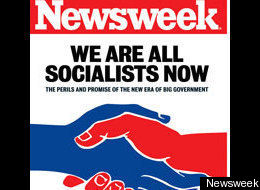
POTUS Barack Obama Seeks Power To Take Over Ailing Firms. SOCIALISM?
Read more here, and watch the video below:
Attempts at SOCIALISM?
You be the judge.
Attempts at SOCIALISM?
You be the judge.
Labels: Political economics, POTUS Barack Obama, Socialism
Friday, March 20, 2009
"Obama Is No Socialist".
Obama Is No Socialist
By ALAN S. BLINDER
Ever since President Barack Obama released the budget last month, we have been hearing a fusillade of criticism claiming that the president, contrary to previous advertising, is not a centrist, but a "leftie" intent on leading the country down the path of socialism.
Let's see. Socialism means public ownership and control of businesses, right? So which industries does the president propose to nationalize?
Banking? Well, no. Secretary of the Treasury Timothy Geithner has made it clear that he opposes nationalizing banks, despite much outcry from the political left -- and even some from the right -- to do just that. Yes, it's a valid criticism that we are still waiting for Mr. Geithner's banking plan. But the budget commits an outrageous act of accounting honesty by including a $750 billion allowance as "a reserve for further efforts to stabilize the financial system." Given the popularity of bank bailouts, that was a courageous thing to do.
What about health care? Doesn't Mr. Obama want "socialized medicine"? No. He wants to reform the current system so that it costs less and covers more people. Disgracefully, the United States is the only advanced nation in the world that fails to cover every citizen -- even though we spend vastly more on health care than other nations.
Some reformers want the U.S. to adopt a single-payer system like other countries, such as "socialist" Canada and England -- which run firmly capitalist economies, by the way. But regardless of whether single-payer is a good idea, it's not Mr. Obama's. His health-insurance reform plan emphasizes choice (keeping what you have if you like it), greater efficiency (partly by utilizing information technology), and portability (your health coverage will follow you from job to job). Which part of that is socialist?
And, once again, the Obama budget recognizes, rather than hides, the need to pay the bills. Half the cost of health reform would be covered by a tax provision that has really raised a ruckus: Capping itemized deductions at the 28% bracket rate. Let's consider how socialist that idea is.
As the law now stands, when a family that does not itemize deductions on its tax return donates $100 to its favorite charity, the donation costs the family $100. But when an itemizing family in the 25% bracket donates $100, it costs them only $75 after tax. And when an itemizer in the 35% bracket donates $100, the after-tax cost is only $65. Thus the richer you are, the less it costs. Is it socialistic to say that seems a little backwards?
If that tax treatment strikes you as fair, try another example. Suppose those same three families each pay $10,000 a year in interest on their home mortgages. The cost to the non-itemizer is the full $10,000. For the family in the 25% bracket that itemizes, the net cost after taxes is only $7,500. And for the upper-income family in the 35% bracket that itemizes, the net cost is a mere $6,500. Just imagine a member of Congress proposing a homeownership subsidy like that directly, rather than through the tax code: 35% to the rich, 25% to the middle class, and nothing to the poor. Would anyone support it?
Enter Mr. Obama, the alleged leftist. Does he propose to end this "class warfare" on the middle and lower classes? No. He only wants to mitigate it slightly. He would reduce the 35% subsidy rate to 28% -- which would still leave the costs of charitable giving, mortgage interest, and much else far lower for the rich than for the poor. That's hardly a radical proposal. Indeed, it has been under discussion since the 1980s.
It's true: The president would like to do a bit more. Elsewhere in the budget, he proposes letting the Bush upper-bracket tax cuts expire in 2011, meaning the top rate would revert to where it was during the Clinton years: 39.6%. And Mr. Obama would still cap deductibility at 28%.
Unsurprisingly, the president's proposal to let the top rate return to 39.6% has unleashed a firestorm of criticism from people who claim that such radical redistribution would prolong the recession, destroy entrepreneurship, and pretty much end capitalism as we know it -- just as it did during the Great Prosperity of the 1990s, I suppose. Some claims parody themselves.
So where does all this leave us on the road to socialism? If Mr. Obama is able to get all of these proposals through Congress, the U.S. will have a fully private banking system, propped up with temporary government support; a uniquely American health-care system that covers virtually everyone; and a somewhat more progressive income tax.
If this is socialism, then let's make the most of it.
Mr. Blinder is a professor of economics and public affairs at Princeton University and a former vice chairman of the Federal Reserve Board.
Labels: POTUS Barack Obama, Socialism
Monday, March 16, 2009
Are You MAD Yet? Read More.
A.I.G. Planning $165 Million in Bonuses After Huge Bailout
By EDMUND L. ANDREWS and PETER BAKER
WASHINGTON — The American International Group, which has received more than $170 billion in taxpayer bailout money from the Treasury and Federal Reserve, plans to pay about $165 million in bonuses by Sunday to executives in the same business unit that brought the company to the brink of collapse last year.
Skip to next paragraph
Word of the bonuses last week stirred such deep consternation inside the Obama administration that Treasury Secretary Timothy F. Geithner told the firm they were unacceptable and demanded they be renegotiated, a senior administration official said. But the bonuses will go forward because lawyers said the firm was contractually obligated to pay them.
The payments to A.I.G.’s financial products unit are in addition to $121 million in previously scheduled bonuses for the company’s senior executives and 6,400 employees across the sprawling corporation. Mr. Geithner last week pressured A.I.G. to cut the $9.6 million going to the top 50 executives in half and tie the rest to performance.
The payment of so much money at a company at the heart of the financial collapse that sent the broader economy into a tailspin almost certainly will fuel a popular backlash against the government’s efforts to prop up Wall Street. Past bonuses already have prompted President Obama and Congress to impose tough rules on corporate executive compensation at firms bailed out with taxpayer money.
A.I.G., nearly 80 percent of which is now owned by the government, defended its bonuses, arguing that they were promised last year before the crisis and cannot be legally canceled. In a letter to Mr. Geithner, Edward M. Liddy, the government-appointed chairman of A.I.G., said at least some bonuses were needed to keep the most skilled executives.
“We cannot attract and retain the best and the brightest talent to lead and staff the A.I.G. businesses — which are now being operated principally on behalf of American taxpayers — if employees believe their compensation is subject to continued and arbitrary adjustment by the U.S. Treasury,” he wrote Mr. Geithner on Saturday.
Still, Mr. Liddy seemed stung by his talk with Mr. Geithner, calling their conversation last Wednesday “a difficult one for me” and noting that he receives no bonus himself. “Needless to say, in the current circumstances,” Mr. Liddy wrote, “I do not like these arrangements and find it distasteful and difficult to recommend to you that we must proceed with them.”
Editor's comment: are you MAD yet? If not, follow the link above to read more.
Labels: Capitalism, Political economics, Socialism
Friday, February 27, 2009
Monday, February 16, 2009
Wednesday, February 11, 2009
Ann Coulter: Goodbye, America! It Was Fun While It Lasted.
Goodbye, America! It Was Fun While It Lasted
by Ann Coulter
It's bad enough when illiterate jurors issue damages awards in the billions of dollars because they don't grasp the difference between a million and a billion. Now it turns out the Democrats don't know the difference between a million and a trillion.
Why not make the "stimulus bill" a kazillion dollars?
All Americans who work for a living, or who plan to work for a living sometime in the next century, are about to be stuck with a trillion-dollar bill to fund yet more oppressive government bureaucracies. Or as I call it, a trillion dollars and change.
The stimulus bill isn't as bad as we had expected -- it's much worse. Instead of merely creating useless, make-work jobs digging ditches -- or "shovel-ready," in the Democrats' felicitous phrase -- the "stimulus" bill will create an endless army of government bureaucrats aggressively intervening in our lives. Instead of digging ditches, American taxpayers will be digging our own graves.
There are hundreds of examples in the 800-page "stimulus" bill, but here are just two.
First, the welfare bureaucrats are coming back.
For half a century, the welfare establishment had the bright idea to pay women to have children out of wedlock. Following the iron laws of economics -- subsidize something, you get more of it; tax it, you get less of it -- the number of children being born out of wedlock skyrocketed.
The 1996 Welfare Reform bill marked the first time any government entitlement had ever been rolled back. Despite liberal howling and foot-stomping, not subsidizing illegitimacy led, like night into day, to less illegitimacy.
Welfare recipients got jobs, as the hard-core unemployables were coaxed away from their TV sets and into the workforce. For the first time in decades, the ever-increasing illegitimacy rate stopped spiraling upward.
As proof that that welfare reform was a smashing success, a few years later, Bill Clinton started claiming full credit for the bill.
Well, that's over. The stimulus bill goes a long way toward repealing the work requirement of the 1996 Republican Welfare Reform bill and rewards states that increase their welfare caseloads by paying unwed mothers to sit home doing nothing.
Second, bureaucrats at Health and Human Services will electronically collect every citizen's complete medical records and determine appropriate medical care.
Judging by the care that the State Department took with private visa records last year, that the Ohio government took with Joe the Plumber's government records, that the Pentagon took with Linda Tripp's employment records in 1998, and that the FBI took with thousands of top secret "raw" background files in President Clinton's first term, the bright side is: We'll finally be able to find out if Bill Clinton has syphilis -- all thanks to the stimulus bill!
HHS bureaucrats will soon be empowered to overrule your doctor. Doctors who don't comply with the government's treatment protocols will be fined. That's right: Instead of your treatment being determined by your doctor, it will be settled on by some narcoleptic half-wit in Washington who couldn't get a job in the private sector.
And a brand-new set of bureaucrats in the newly created office of "National Coordinator of Health Information Technology" will be empowered to cut off treatments that merely prolong life. Sorry, Mom and Pop, Big Brother said it's time to go.
At every other workplace in the nation -- even Wal-Mart! -- workers are being laid off. But no one at any of the bloated government bureaucracies ever need fear receiving a pink slip. All 64,750 employees at the department of Health and Human Services are apparently absolutely crucial to the smooth functioning of the department.
With the stimulus bill, liberals plan to move unfirable government workers into every activity in America, where they will superintend all aspects of our lives.
Also, thanks to the stimulus bill, the private sector will gradually shrivel and die. According to the Congressional Budget Office, the cost of servicing the bill's nearly trillion-dollar debt will shrink the economy within a decade.
Robert Kennedy famously said: "There are those who look at things the way they are and ask, 'Why?' I dream of things that never were and ask, 'Why not?'"
The new liberal version is: There are those who look at things and ask, "Why on earth should the government be paying for that?" I dream of things that never were funded by the government and ask, "Why not?"
Ann Coulter is Legal Affairs Correspondent for HUMAN EVENTS and author of "High Crimes and Misdemeanors," "Slander," ""How to Talk to a Liberal (If You Must)," "Godless," "If Democrats Had Any Brains, They'd Be Republicans" and most recently, Guilty: Liberal "Victims" and their Assault on America.
Labels: Socialism
Monday, February 09, 2009
Tuesday, December 30, 2008
Senator Mitch McConnell Aims To "Hold Their Feet To The Fire". I'm Glad Someone is Doing So. Read More ...
... by following this link.
Labels: Political economics, Socialism
Sunday, December 28, 2008
George Will: American Czars.
American Czars
by George Will
WASHINGTON -- In 1966, the price of eggs rose to a level that President Lyndon Johnson judged, God knows how, was too high. There were two culprits -- supply and demand -- and Johnson's agriculture secretary told him there was not much that could be done. LBJ, however, was a can-do fellow who directed the U.S. surgeon general to dampen demand by warning the nation about the hazards of cholesterol in eggs.
Johnson, the last president with a direct political connection to Franklin Roosevelt, was picked by FDR in 1935 to be Texas director of the New Deal's National Youth Administration. Two years later, Johnson came to Congress, a rung on the ladder that led to glory as Egg Czar. Today, with Washington experiencing a Roosevelt revival, Johnson's spirit, too, goes marching on as the federal government permeates the economy with politics.
Or not. In an interview with Business Week, Rep. Barney Frank, the effervescent Massachusetts Democrat who chairs the Financial Services Committee, was asked, concerning the auto industry, "How do you make sure the government doesn't meddle too deeply in day-to-day operations and bring politics -- like a push for green cars -- into the equation?" Frank replied: "Oh, well, a push for green cars is very much a part of what we're involved in. We don't think that's politics." So, when the government, its 10 thumbs stuck deep in the economy, uses its power to compel an industry to pursue the objectives of the political party that controls both of the government's political branches, that is not politics.
Business Week: "Should GM acquire Chrysler?" Frank: "I'm not competent to say." Frank's humility is selective: He obviously thinks he is competent to say what kind of cars should be made.
Business Week: "Does Congress realize how few hybrids have been sold, as it pushes Detroit to make them, and will Congress give consumers greater incentives to buy these cars?" Frank: Those who are "blaming the auto companies forget to blame somebody else -- the consumers. In the recorded history of America, no one was ever forced at gunpoint to buy a Hummer. But we do believe that the combination of genuine concern about global warming and energy efficiency means people are now ready to buy these cars." Consumers are such a disappointment to Congress. But what Congress really believes is that people are not ready to buy those cars at a price that reflects the costs of making them. Why else has it voted tax subsidies for buyers?
Forty years ago, Vietnam was a disaster and the Great Society was a disappointment as Johnson limped back to Texas. Today, there is more Johnsonian confidence in government's competence than at any time since Johnson's policies shattered such confidence. The resurgence of confidence began under today's Texan president.
The 1996 Republican platform said: "The federal government has no constitutional authority to be involved in school curricula. ... That is why we will abolish the Department of Education (and) end federal meddling in our schools." One year ago, the Department of Education announced: "U.S. Secretary of Education Margaret Spellings today honored President Lyndon Baines Johnson in a ceremony officially renaming the U.S. Department of Education Building ... as the Lyndon Baines Johnson Department of Education Building."
The domestic achievement for which George W. Bush will be most remembered, the 2001 No Child Left Behind law, was the seventh reauthorization of LBJ's 1965 Elementary and Secondary Education Act, which brought the federal government heavily into primary and secondary education. NCLB requires states to define "proficiency" in reading and math, and achieve 100 percent proficiency by 2014.
Frederick M. Hess, director of education policies studies at the American Enterprise Institute, notes that unless the "proficiency" standards are risible, the goal is delusional.
It is ironic, Hess writes, that 50 states establishing divergent standards -- the decentralized approach Republicans demanded -- have sparked demands for centralization, in the form of national standards, a decade after congressional Republicans opposed President Bill Clinton's plan for voluntary national standards.
Furthermore, Hess notes, there has been striking dissonance between Republican resistance to race-conscious government policies, and NCLB "requiring states to identify every student by race and then report test scores -- and impose sanctions -- on that basis." The Johnsonian attributes of NCLB, which Hess says include "Great Society-style ambition and race-conscious rhetoric," suggest that the Egg Czar, who also was the first National School Superintendent, would feel right at home in a Washington where he could be Automotive Engineer in Chief.
Labels: Socialism
Monday, December 22, 2008
George Will: The Final Blow Against Congress.
The Final Blow Against Congress
by George Will
A new Capitol Visitor Center recently opened, just in time for the transformation of the Capitol building into a tomb for the antiquated idea that the legislative branch matters. The center is supposed to enhance the experience of visitors to Congress, although why there are visitors is a mystery.
Congress' marginalization was brutally underscored when, after Congress did not authorize $14 billion for General Motors and Chrysler, the executive branch said, in effect: Congress' opinions are mildly interesting, so we will listen very nicely -- then go out and do precisely what we want.
Friday the president gave the two automakers access to money Congress explicitly did not authorize. More money -- up to $17.4 billion -- than had been debated, thereby calling to mind Winston Churchill on naval appropriations: "The Admiralty had demanded six ships: the economists offered four: and we finally compromised on eight."
The president is dispensing money from the $700 billion Congress provided for the Troubled Asset Relief Program. The unfounded assertion of a right to do this is notably brazen, given the indisputable fact that if Congress had known that TARP -- supposedly a measure for scouring "toxic"
assets from financial institutions -- was to become an instrument for unconstrained industrial policy, it would not have been passed.
If TARP funds can be put to any use the executive branch fancies because TARP actually is a blank check for that branch, then the only reason no rules are being broken is that there are no rules. This lawlessness tarted up as law explains the charade of Vice President Dick Cheney warning Republican senators that if they did not authorize the $14 billion, the GOP would again be regarded as the party of Herbert Hoover.
Surely Cheney, a disparager of Congress and advocate of extravagant executive prerogatives, knew that the president considered the Senate's consent irrelevant.
Evidence that casualness about legality is inherent in big government is found in H.W. Brands' new biography "A Traitor to His Class: The Privileged Life and Radical Presidency of Franklin Delano Roosevelt." FDR became president on Saturday, March 4, 1933. Banks were closed that day and the next, temporarily preventing panicked depositors from withdrawing their money. At 1 a.m. Monday, FDR ordered all banks closed for four days, hoping that the fever would break. His act may have been prudent. But was it legal? Brands writes:
"He cited a section of the 1917 Trading with the Enemy Act as justification. The act had never been formally repealed, but a body of legal theory held that the law, along with other wartime legislation, had expired upon the signing of the peace treaty with Germany in 1921."
FDR had asked the opinion of his as-yet-unconfirmed attorney general, Montana Sen. Thomas Walsh, who gave the answer FDR wanted. Walsh never had to defend this: He died March 2 en route to the inauguration.
The expansion of government entails an increasingly swollen executive branch and the steady enlargement of executive discretion. This inevitably means the eclipse of Congress and attenuation of the rule of law.
For decades, imperatives of wars hot and cold, and the sprawl of the regulatory state, have enlarged the executive branch at the expense of the legislative. For eight years, the Bush administration's "presidentialists"
have aggressively wielded the concept of the "unitary executive" -- the theory that where the Constitution vests power in the executive, especially power over foreign affairs and war, the president is immune to legislative abridgements of his autonomy.
The administration has not, however, confined its aggrandizement of executive power to national security matters. According to former Rep.
Mickey Edwards in his book "Reclaiming Conservatism," the president has issued "signing statements" designating 1,100 provisions of new laws -- more designations than have been made by all prior presidents combined -- that he did not consider binding on him or any other executive branch official.
Still, most of the administration's executive truculence has pertained to national security, where the case for broad prerogatives, although not as powerful as the administration supposes, is at least arguable. With the automakers, however, executive branch overreaching now extends to the essence of domestic policy -- spending -- and traduces a core constitutional principle, the separation of powers.
Most members of the House and Senate want the automakers to get the money, so they probably are pleased that the administration has disregarded Congress's institutional dignity. History, however, teaches that it is difficult for Congress to be only intermittently invertebrate.
Labels: Socialism
Friday, December 19, 2008
Bush Announces Deal To Stave Off American Free Market Enterprise System By Bankrupt Automakers.
Read the rest of the story here, or watch the American Socialist President announce his bid to destroy the FREE Market Enterprise:
Labels: Economic news, Political economics, Socialism