Google
 
Web Osi Speaks!

Thursday, May 26, 2016

The Justice Clarence Thomas Dissent That Broke My Heart.

Solo dissent in case striking black jurors unconvincing


As law professors go, I’m pretty sympathetic to Clarence Thomas’s constitutional jurisprudence. It’s not that I agree with him, which I almost never do. But I think he genuinely tries to apply originalism using historical methods.

And when it comes to the law of race, where again I disagree with Thomas, I respect his effort to give voice to a distinctive form of conservative black nationalism that insists on color blindness because it’s better for blacks.

What’s more, I respect what I’ve seen of Thomas personally. I’ve never forgotten seeing him greet by name the members of the maintenance staff at the Supreme Court who polish the miles of brass on the court’s many staircases. Once I asked him about it, and he said he sometimes felt he had more in common with them than with the other justices. I didn’t think it was a line then, and I don’t think so now.

But now I confess to feeling a bit upset about Thomas’ solo dissent in Foster v. Chatman on Monday, a decision that reversed the capital conviction of a black man from Georgia because the prosecution used its peremptory challenges to strike all the black members of the jury pool.

Thomas is from Georgia. The facts of the case, going back almost 30 years, demonstrate egregious racial stereotyping by the prosecution. Yet Thomas was unwilling to join his seven colleagues, among them some serious conservatives, in striking down the conviction.

Why, exactly, did Thomas bend over so far backward to argue for sending inmate Timothy Foster to his death? And is there something — anything — admirable that can be gleaned from his dissenting opinion?

There was a technical issue at stake in the case — namely, whether the state supreme court decision denying the prisoner’s claim was based on state or federal law. On this point, Thomas’s view is defensible, if unconvincing.

Foster was convicted for the heinous sexual assault and murder of Queen Madge White in Rome, Ga., in 1986, almost 30 years ago. He appealed through the Georgia courts, relying among other arguments on the claim that the prosecution systematically excluded all the black jurors in violation of the Supreme Court’s opinion in Batson v. Kentucky, a landmark 1986 decision.

The Georgia courts denied Foster’s claim because he couldn’t prove the exclusions were motivated by race. But when Foster re-presented his claim in his post-conviction habeas corpus proceeding, he had more evidence to support it. Foster now had documents showing that the prosecution actively identified and marked the black prospective jurors (with a capital B) and excluded them from the jury based on their race.

A superior court in Georgia rejected Foster’s claim anyway, saying that he hadn’t shown new facts sufficient to overturn the conviction. Foster then went to the state supreme court, which denied his claim in a single sentence.

The Supreme Court won’t review a state court judgment if it rests on what lawyers call “adequate and independent state grounds.” The idea is that the court is the highest authority on federal law and the U.S. Constitution, but state supreme courts are the highest authorities on state law.

But as Chief Justice John Roberts wrote in his doctrinally subtle opinion for the court, the Georgia Supreme Court never said it relied on state law grounds to deny Foster’s claim. Its silence left Roberts the option of concluding that the state court had rested its judgment on the federal constitutional law issue of whether the Batson precedent had been violated. That allowed the court to hear the case.

Roberts then went on to assess the evidence. He concluded that the prospective jurors were indeed excluded based on race, invalidating the conviction.

Thomas’s dissent started with the technical issue. He said that the “most obvious” reason for the Georgia court dismissing the case was that Foster had already litigated it. Georgia bars successive relitigation of the same issue at the habeas stage. This, said Thomas, meant there was an adequate and independent state ground for the judgment — and the court had no business hearing the case.

Thomas’s argument here was what I would call wrong but reasonable. Probably the Georgia high court did reject the claim as already litigated. But it’s the job of a court to say what it’s doing — particularly when a man’s life is on the line and there has been notable racism in obtaining his conviction. The state court’s silence is and should be sufficient basis for the Supreme Court to hear the case.

Where Thomas really made me sad was in his attitude toward the underlying issue of whether the conviction was tainted. He went through the black potential jurors excluded and systematically accepted the prosecutors’ excuses for challenging them. He urged deference to the trial judge’s judgment, and he discounted the documentary evidence, saying it wasn’t clear who had highlighted or marked the black potential jurors’ names on the list that was in the prosecutors’ files.

To all this I can only say: Really?

I appreciate that Thomas wants to keep his judgment free of any bias that might arise because of his own race. In this he follows the model of Justice Felix Frankfurter, who (echoing St. Paul) said that “as judges we are neither Jew nor Gentile, neither Catholic nor agnostic.”

But race neutrality shouldn’t be race blindness. Thomas’s decision shows he isn’t willing to bend his usual rigor to save a black defendant, which is perhaps worthy of a kind of admiration. But the facts here are so clear that Thomas’s dissent makes it seem like he bent over too far to seem fair — and in the process would have sacrificed the integrity of the judicial system, not to mention a man’s life.

Noah Feldman is a professor of constitutional and international law at Harvard.

Read more here: http://www.kentucky.com/opinion/national-opinions/article79918152.html#storylink=cpy

Editor's note: Ever since Anita Hill busted Clarence Thomas before a shocked audience, the man has NEVER been the same. Yep.

Labels: ,

Monday, May 19, 2014

Keep Politics Out Of The Courthouse.

Keep politics out of the courthouse

By Ruth McGregor and Randall Shepard

The chaos surrounding the execution of convicted murderer Clayton Lockett was not just a wake-up call on capital punishment and how it is administered. The final hours also saw political efforts to bully and weaken Oklahoma’s courts. Similar battles are playing out around the country, threatening the ability of our courts to be fair and impartial.

When Lockett’s attorneys filed a lawsuit seeking information about the drug mixture that ultimately failed, the Oklahoma Supreme Court issued a stay to grant more time for review. But the governor announced that she would disregard the court’s ruling. A legislator introduced a resolution to impeach the five justices who had voted for the stay, alleging “a willful neglect of duty and incompetence.” The Supreme Court ultimately dissolved its stay and allowed Lockett’s execution to proceed.

The constitutional crisis may have been brief, but it was profoundly disturbing. As lifetime jurists and former chief justices of the supreme courts of Arizona and Indiana, we believe our treasured American system of checks and balances is harmed when our courts are threatened with intimidation. Our courts were designed to be the branch of government most insulated from politics.

This is especially critical when it comes to our criminal courts, which must be allowed to work properly and deliberately in order to protect the innocent, convict the guilty and provide just punishment. If judges cannot make life-or-death decisions based on the law without looking over their shoulders for threats of retaliation, they cannot uphold the Constitution and protect Americans’ rights.

The Oklahoma case is bad enough. But in state capitals across the nation, there are disturbing efforts by partisans, politicians and special interests to intimidate our courts.

For example, a vigously debated bill in the Missouri legislature would have permitted lawsuits against state officials, including judges, for enforcing federal gun laws. In retaliation for court decisions, Kansas lawmakers removed the Supreme Court’s authority to pick chief district court judges and weakened its authority over the judiciary’s budget.

This atmosphere of bullying is reminiscent of an anti-court spasm a decade ago, when cable TV hosts and “Justice Sunday” rallies demanded the impeachment of state and federal judges over controversial decisions. Congress even bowed to interest-group pressure by tampering with a state court dispute between family members of Terri Schiavo during her end-of-life ordeal.

Courts are also under growing pressure from the increasing amounts of money being spent in judicial elections. Interest groups spent more than $1.3 million in a North Carolina primary this month involving a single Supreme Court seat. In Tennessee, because the Supreme Court selects the state’s attorney general, a multi-million dollar effort is being discussed to unseat three justices. These kinds of big-money judicial elections threaten to turn judges into politicians in black robes.

These threats imperil our constitutional traditions, our heritage of rule of law and the strength of our democracy. If our courts are going to be fair and impartial, in Oklahoma and across the country, Americans need to stand up for them when politicians cross the line — especially during an election year, when political posturing will be even greater.

Editor's note:

Ruth McGregor is a retired chief justice of the Arizona Supreme Court and Randall Shepard is a retired chief justice of the Indiana Supreme Court. They are members of the board of directors of Justice at Stake, a nonpartisan network working to keep courts fair and impartial.

Labels: ,

Friday, August 30, 2013

Kentucky Supreme Court Reinsytates $42 Million Phen Fen Verdict Against Now-disbarred lawyers William Gallion, Shirley Cunningham Jr., and Melbourne Mills.

Court reinstates $42 million verdict in drug case

— A group of 431 people sickened by the diet drug fen-phen should be allowed to collect a $42 million judgment from their former attorneys who pilfered a massive settlement with the drug's maker, the Kentucky Supreme Court ruled on Thursday.

The unanimous decision moves the group closer to reclaiming the millions improperly kept by now-disbarred lawyers William Gallion, Shirley Cunningham Jr., and Melbourne Mills. Justice Daniel J. Venters, writing for a unanimous court, found that there is enough evidence to back the claims that the trio of attorneys grabbed far more than their contract with clients entitled them to.
"The attorney-client relationship is a fiduciary relationship that subjects the attorney to the duties of honesty, loyalty and good faith," Venters wrote.
Failing to honor a contract with a client violates the "most elementary aspect" of an attorney's duty to the client, Venters wrote.

The former clients sued Gallion, Cunningham and Mills in 2005, claiming they mishandled the settlement and improperly kept a significant portion of the funds for themselves, while keeping clients in the dark about the full amount of the agreement to end the litigation.
Special Judge William Wehr awarded the former clients $42 million in 2007, saying the evidence supported their claims that the attorneys raided a $200 million settlement. Wehr found that Gallion, Cunningham and Mills kept $126 million, more than 63 percent of the settlement, for themselves and took another $20 million in "excess funds." The men distributed about $74 million to their clients, who were never told about the total amount of the settlement or the fees kept by the lawyers.

The Kentucky Court of Appeals overturned the judgment in 2011. The ruling Thursday reinstated the damages award.

Wehr declined to include former class-action specialist Stanley Chesley of Cincinnati in the judgment, even though he had been sued with the others. Wehr ruled that there were genuine issues of fact to be decided when it came to Chesley. The high court upheld that decision.
Any damages or liability on Chesley's part have yet to be determined by the trial court in Boone County.
"Since I believe that Chesley was the chief architect behind the cover up of the fraud, we will be seeking a very large verdict on punitive damages," said Angela Ford, who represents many of the 400 plaintiffs.

The fen-phen case has evolved over more than a decade from a $200 million settlement into a series of criminal, civil and legal disciplinary cases that claimed the careers of at least six of the lawyers involved.

Gallion and Cunningham, one-time owners of champion racehorse Curlin, are serving federal sentences after being convicted of bilking their clients out of millions from the settlement. Both resigned from the bar. Mills was acquitted at a federal criminal trial, but disbarred for his role in the scheme.

Gallion, 62, is serving a sentence in a federal prison in Oakdale, La., and is not scheduled to be released from federal prison until 2029; Cunningham, 58, is being held in a federal prison in Yazoo City, Miss., and won't get out until 2025. A federal appeals court upheld their convictions in January 2012.

Federal prosecutors have seized hundreds of thousands of dollars in earnings by Curlin to disburse as restitution to victims in the criminal case.

The high court disbarred Chesley in April for his role in the settlement. Chesley, who has denied any wrongdoing in the settlement, has since retired from the legal profession.

A former associate of Gallion's, David Helmers of Lexington, and retired state judge Joseph F. "Jay" Bamberger, have also been disbarred in connection with the fen-phen settlement. Bamberger, a circuit court judge in Boone and Gallatin counties from 1992 until his retirement in 2004, signed off on a deal that gave attorneys nearly two-thirds of the settlement and didn't disclose to clients the terms of the deal.

The state's high court disbarred Bamberger in 2011, finding he mishandled the settlement and later received money from the settlement.

Labels:

Friday, June 07, 2013

Kentucky Senior Judge, Martin McDonald, Threatens To Strangle Lawyer, Draws Suspension.

Judge threatens to strangle lawyer, gets suspended


The Kentucky Judicial Conduct Commission voted Tuesday to temporarily suspend Senior Judge Martin McDonald, despite his claims he has completed his service and will never sit on the bench again.

The commission removed McDonald with pay pending the resolution of charges that he violated the canons of ethics in two cases, including one in which he threatened to strangle an assistant public advocate and disparaged the attorney’s case.
In the first case, it said he refused to let a litigant who was representing himself last August present any argument because he was not a lawyer.
In the second, the commission said in the death penalty case of Roger Dale Epperson last September, McDonald in an “intemperate voice” told assistant public advocate David Barron that “if you ever call me on my cellphone again, I’ll strangle you” and get “your law licensed yanked.”

The charge says McDonald further called motions for new trials based on ineffective counsel “distasteful” and said Barron’s argument “bordered on the ridiculous.”
McDonald’s lawyer, Timothy Denison, said the commission lost jurisdiction over McDonald because his 600 days of service as a senior judge ended Tuesday.

But the commission’s chairman, Steve Wolnitzek, said in an interview that the Administrative Office of the Court was unable to confirm that because McDonald hadn’t turned in paperwork documenting his service in May.
“The commission felt the allegations were serious enough that he should be suspended, if in fact he had any more days to serve,” Wolnitzek said. “If he has completed his service, obviously the order of suspension would be moot. If he’s done, he’s done.”

Denison said in an email that McDonald would contest the suspension “based solely on the principle of the matter and preserving his good reputation, despite the fact that he has completed his time ... and has nothing else to gain.”

The commission said it wanted to relieve McDonald of his duties on the grounds that he suffered a stroke 112 years ago that Denison said affected his ability “to filter what he says.”
“McDonald’s continued performance of his duties under these circumstances may jeopardize the legality of cases he presides over,” George Rabe, the commission’s lawyer, said in a memo supporting the suspension.

Labels:

Friday, May 24, 2013

HANS POPPE, Kentucky Lawyer Who Fainted During Jury Trial, Sued For Costs Of Mistrial He Caused.


Read more here.

Labels:

Friday, May 17, 2013

6Th Circuit Court Of Appeals: Law Reducing Crack Cocain Sentences I Retroactive, Demands Resentencings.

Court: Law applying crack sentences retroactive

A federal appeals court has ruled that anyone serving prison time in a crack cocaine case should get a new sentence under a law lessening the sentences for offenders.

The U.S. 6th Circuit Court of Appeals on Friday concluded that the Fair Sentencing Act is fully retroactive. Judge Gilbert Merritt wrote for the court that excluding some crack cocaine offenders from the benefit of the law is discriminatory.

The ruling came in the case of two Kentucky men sentenced to 10 years each for distribution of crack cocaine before the new law took effect.

The U.S. Supreme Court ruled in June 2012 that people who committed crack cocaine crimes before more lenient penalties took effect in 2010 and received their prison sentence afterward should benefit from the new rules.

Labels: , , , ,

Thursday, August 16, 2012

THE ENEMY WITHIN: "Iraqi Accused In KY. Of Terrorism May Have Fought In Iraq, Killed U.S. Soldiers"!


Iraqi accused in Ky. of terrorism may have fought in Iraq, killed U.S. soldiers
By BRETT BARROUQUERE

LOUISVILLE, Ky. — An Iraqi refugee accused of plotting to help terrorists back home may himself have been an insurgent during the war. When he goes on trial this month, several U.S. soldiers will be watching from the gallery who suspect his roadside bombs may have killed their comrades in Iraq in 2005.

Mohanad Shareef Hammadi, 24, is scheduled for trial Aug. 28, but not in connection with the battlefield deaths of six Pennsylvania National Guardsmen seven years ago. Instead, Hammadi and another Iraqi refugee living in Kentucky, 30-year-old Waad Ramadan Alwan, were charged with trying to send weapons and cash back to al-Qaida in Iraq after they came to the U.S. Alwan has pleaded guilty.

Several current and former soldiers from the same National Guard unit believe Hammadi and Alwan could have had a hand in two roadside bombings that killed six of their buddies in August 2005, when their unit was stationed near the city of Bayji in the volatile Sunni Triangle north of Baghdad. Those six were among 85 U.S. military deaths in Iraq that month.

Documents reviewed by The Associated Press show Hammadi and Alwan were insurgents in the same area around Bayji at the time the Pennsylvanians' Task Force Dragoon was stationed there and hit.

"It's going to be extremely hard to hold my temper, extremely hard to keep cool," said former Sgt. Brandon Miller, one of several former members of the task force who say they plan to attend the trial. Miller, an apartment maintenance manager in Chadds Ford, Pa., was awarded the Purple Heart after surviving a separate roadside bomb blast that destroyed the Humvee he was riding in in Bayji.

Miller and Staff Sgt. Joshua Hedetniemi say the men believe there's a chance Hammadi planted the roadside bombs that killed and injured their fellow soldiers, or fired bullets at them as snipers.

"A lot of the time, there's not a face to put with the actions, there's not a tangible enemy," Hedetniemi said. "It's very tough to pin down that type of enemy."

Hedetniemi said, based on the publicly available evidence and the timeline of his unit's deployment in Iraq, he is certain Alwan and Hammadi were among the insurgents who attacked his unit.

"There's no doubt he was in the same area we were," Hedetniemi told The Associated Press. "The evidence suggests that."

Multiple sources place Task Force Dragoon in the same violent area where Alwan and Hammadi told an FBI informant they worked two years into the American-led war. Those sources include motions filed in court, criminal complaints and indictments of Alwan and Hammadi, search warrants for the two men's shared apartment and computers, media accounts of the task force's deployment and interviews with soldiers.

Neither the U.S. Attorney's office in Louisville nor the U.S. Department of Justice in Washington, D.C., have publicly identified any unit they believe Alwan and Hammadi attacked and would not say if the pair was involved with attacks on the Pennsylvania National Guard unit.

Eugene Fidell, co-founder of the National Institute of Military Justice who teaches military law at Yale Law School, said it would be possible, but tough, to bring murder charges against someone for killing a soldier in a war zone. Fidell added that definitively showing Hammadi and Alwan attacked this unit and took part in the killing of at least six soldiers would be equally tough.

U.S. law has provisions that allow for such charges, but Fidell said he's never seen that type of case brought against a one-time insurgent.

"I think these cases are rarer than hen's teeth," Fidell said. "This is about as inconvenient a venue for doing proper forensic investigation as I can imagine."

Court documents say Alwan and Hammadi worked as insurgents in Bayji, about 130 miles north of Baghdad. It was an area where former Iraqi dictator Saddam Hussein had a base of support, starting shortly after the invasion in 2003.

Alwan told a confidential informant working for the FBI that as part of his work he filled roadside bombs with ball bearings, nails, even gravel, and drew diagrams to show how it is done. He also bragged about repeatedly killing Americans in Iraq, saying he was very good with a sniper rifle and that his "lunch and dinner would be an American."

Alwan told an FBI informant in Bowling Green in 2011 that prior to one Humvee explosion, he had planted improvised explosive devices near a Bayji street detour.

Both the Iraqis and the soldiers described the area as the main road used by American convoys in Bayji.

The Pennsylvania National Guard's Alpha Company of the First Battalion of the 111th Infantry, which included Hedetniemi, lost six soldiers in two separate roadside attacks in the area in August 2005.

Sgt. Brahim Jeffcoat, 25, of Philadelphia, and Spc. Kurt Krout, 43, of Spinnerstown, Pa., died Aug. 6, 2005, when their vehicle struck a roadside bomb near Balad, about 70 miles south of Bayji.

Gennaro Pellegrini Jr., a 31-year-old Philadelphia police officer; Spc. Francis J. Straub, 24, of Philadelphia; Pfc. John Kulick, 35, of Jenkintown, Pa.; and Pfc. Nathaniel DeTample, 19, of Morrisville, Pa., died three days later, when their armored Humvee drove over a culvert containing a bomb and they came under enemy fire near Bayji.

Miller was back in Pennsylvania by then and attended all six funerals.

"It was a rough day, but it was well worth it," Miller said.

Alwan and Hammadi each immigrated to the United States in 2009 after gaining refugee status. Court records do not explain why they were granted that status. For reasons that are also unclear from court records, the FBI started a probe of Alwan in August 2010, using a confidential informant to record conversations with Alwan about a plan to send money and weapons to a fictional al-Qaida operative in Iraq.

The FBI also linked a fingerprint found on an unexploded roadside bomb to Alwan. The two were arrested in May 2011 when the FBI brought the sting to a close.

Hedetniemi and Miller said another soldier ran across the two Iraqi's names and their links to the Bayji area when they scanned Google for news about Task Force Dragoon. They found an Associated Press story about Alwan and Hammadi being charged in Kentucky. After reading the details, Hedetniemi said, they realized that Alwan and Hammadi were fighting in the same area and at the same time as the task force.

Hedetniemi, of East Norton, Pa., said he's spoken with the FBI in Louisville about his time in Bayji, even though investigators wouldn't directly confirm Alwan and Hammadi attacked his unit.

"They were super, super cool in giving me as much information as their operational security could," Hedetniemi said. "It wasn't really a formal interview. It was a friendly telephone conference."

Since then, Hedetniemi and Miller said, emotions have run from elated to concerned to angry.

"I was a little bit worried these guys could get into our country so easily," said Hedetniemi, who now works as a recruiter. "Luckily, these guys never got a chance to do anything stupid."

Read more here: http://www.kentucky.com/2012/08/16/2300828/apnewsbreak-iraqis-in-ky-linked.html#storylink=cpy

Labels: , , , ,

Monday, July 23, 2012

Kentucky Supreme Court Upholds Removal Of Harlan Circuit Judge, Russell D. Alred.

Kentucky Supreme Court upholds removal of Harlan judge
By Jack Brammer

FRANKFORT — The Kentucky Supreme Court has upheld a decision by the Judicial Conduct Commission to remove Harlan Circuit Judge Russell D. Alred from office for misconduct.

In a 62-page opinion Monday written by Chief Justice John D. Minton Jr., the state's highest court agreed with the commission's finding of eight of nine counts of misconduct by Alred.

"From our review of the record, it is clear that Judge Alred engaged in a pattern of misconduct, displaying disregard for the law and the Kentucky Code of Judicial Conduct," said the opinion. "He continually refuses to accept responsibility for his actions or acknowledge his wrongdoing."

An attorney for Alred, Marcus Carey of Erlanger, argued before the Supreme Court in April that Alred was treated unfairly and should be allowed to keep his job.

The Judicial Conduct Commission ordered Alred removed last September.

Alred agreed not to preside over cases after the commission ruling last year, but he still receives his salary.

The high court's ruling does not take effect immediately. Alred can ask the court for a rehearing.

Alred was the fourth judge since 1984 to be removed from office by the commission.

The commission had offered a deal in which Alred would receive a 90-day suspension if he would admit ethics breaches, but he refused.

The panel judged Alred guilty of numerous ethics violations, including having improper involvement in cases, failing to dispose of cases fairly, using his office to advance personal interests and misrepresenting his actions.

In the Supreme Court ruling, Justices Mary Noble and Wil Schroder concurred with Minton's opinion. Justice Daniel J. Venters concurred in a separate opinion, which Justice Lisabeth Hughes Abramson joined.

Justice Bill Cunningham concurred in part and dissented in part in a separate opinion, which Justice Will T. Scott joined.

In his opinion, Cunningham wrote, "Judge Alred has not killed or physically injured anyone. He has not molested his secretary. He has not stolen a dime.

"In fact, he hasn't even been charged with a crime of any kind — misdemeanor or felony. None of his friends or family members has gotten rich or gone free because of his missteps. He has not enriched himself financially nor engaged in any kind of debauchery.

"His judicial misconduct has been primarily on behalf of children and against criminals. In all his excessive exuberance, he has failed to grasp his professional responsibility. He simply has not learned how to conduct himself as a judge."

Read more here: http://www.kentucky.com/2012/07/23/2267865/kentucky-supreme-court-upholds.html#storylink=cpy

Labels: , ,

Monday, July 09, 2012

THANKS TO CHIEF JUDGE GLENN ACREE AND JUDGE JOY MOORE. HOPEFULLY NOW THE CABINET FOR FAMILIES AND CHILDREN WILL STOP ABUSING KENTUCKIANS!

Kentucky Court of Appeals declines to block release of child abuse records
By Beth Musgrave

FRANKFORT — The Kentucky Court of Appeals declined Monday to halt the release of thousands of pages of documents about children who were killed or seriously injured from abuse and neglect.

In a 2-1 decision, the Court of Appeals denied the Cabinet for Health and Family's Services motion for a stay, pending the outcome of an appeal of a lower court's order to release the documents.

The ruling means the cabinet must follow the orders of Franklin Circuit Court Judge Phillip Shepherd, who ruled in February that the cabinet had 90 days to provide the Lexington Herald-Leader and The Courier-Journal of Louisville with 180 case files of children who died or nearly died as a result of abuse and neglect in 2009 and 2010.

Monday's order "acknowledges the strength of our case," said Jon Fleischaker, a lawyer for The Courier-Journal.

Cabinet spokeswoman Jill Midkiff said Monday afternoon that the cabinet "received a copy of the ruling late this afternoon and is currently in the processing of reviewing it."

The ruling is the latest action in a lengthy lawsuit filed by the state's two largest newspapers under the Kentucky Open Records Act.

Shepherd has ruled twice in the past two years that the newspapers are entitled to child-protection records when a child dies or nearly dies as a result of abuse or neglect. All other state child-protection records are confidential.

The cabinet and newspapers have sparred in recent months over what information contained in the files should be made public.

In January, Shepherd fined the cabinet more than $16,000 for improperly withholding records on abused children and set rules restricting what information the agency may keep private in such cases. Shepherd also ordered the cabinet to pay more than $57,000 in legal fees incurred by three newspapers challenging the cabinet's refusal to release the records.

The cabinet appealed Shepherd's order. In Monday's decision, the Court of Appeals denied the newspapers' request to dismiss the cabinet's appeal. However, the appeals court also denied the cabinet's motion to stay Shepherd's orders — which included specific instructions about what information could be redacted from case files released to the public — until its appeals were exhausted.

Court of Appeals Chief Judge Glenn Acree, writing for the majority, said the cabinet could not prove that people would be harmed if the documents are released as Shepherd ordered.

The cabinet has argued in court documents that releasing sensitive information could jeopardize future criminal cases and discourage people from reporting abuse and neglect. It had sought permission to redact broad categories of information from the files. The newspapers argued that the redactions would make it impossible for the public to gauge if the child-protection system worked.

Shepherd ruled that the cabinet could withhold the names of children who have been nearly killed by abuse or neglect, the names of siblings of abuse victims, and the names of private citizens who report abuse. All other information must be released.

In the appelate court's decision, Acree noted that the cabinet did not appeal a similar ruling by Shepherd in 2010. In that case, the Herald-Leader sued the cabinet to obtain its files regarding the death of 20-month-old Kayden Branham, who died in Wayne County after drinking drain cleaner that allegedly was intended to be used as an ingredient in methamphetamine. Both Kayden and his mother, who was 14 at the time, were under the cabinet's supervision at the time of Kayden's death.

After the state released its documents about Kayden and his family in December 2010, the Herald-Leader and Courier-Journal requested the case files of all children who died or nearly died as a result of abuse and neglect in 2009 and 2010. Monday's Court of Appeals decision is part of that legal fight.

Since January, the cabinet has generally provided the newspapers with redacted versions of two to four case files each week. It has not released dozens of other case files.

Acree and Judge Joy A. Moore voted for the decision. Justice Michelle Keller dissented in part.

Read more here: http://www.kentucky.com/2012/07/09/2253377/kentucky-court-of-appeals-declines.html#storylink=cpy

Labels: , , ,

Friday, June 22, 2012

FOURTH AMENDMENT WINS AGAIN, AS FEDERAL JUDGE FINDS STRIP SEARCHING OF JUVENILES DETAINED FOR NON VIOLENT OFFENSES ARE UNCONSTITUTIONAL ABSENT PARTICULARIZED SUSPICION OF ILLEGAL ACTIVITY.

Juvenile jail's strip search of Perry County teens ruled unconstitutional
By Jennifer Hewlett

A federal judge has ruled that a Kentucky juvenile detention center's screening of two Perry County teen half-siblings while they were naked was unconstitutional under the Fourth Amendment of the U.S. Constitution, which guards against unreasonable search and seizure.

U.S. Senior District Judge Karl S. Forester made the ruling June 14 in a 23-page document that also addresses other legal issues in the case, which stems from the intake screenings of the two juveniles at the Breathitt Regional Juvenile Detention Center in 2009. The teens were jailed after being charged with underage drinking, charges that were later dismissed.

The parents of the Perry County teens filed suit against the two jail guards who conducted the screenings, Mitchell Gabbard and Rebecca Harvey; the director, superintendent and assistant superintendent of the Breathitt facility — Gary Sewell, Gary Drake and Jeff Voyles; then-Kentucky Department of Juvenile Justice commissioner J. Ronald Haws; and then-deputy state juvenile justice commissioner A. Hasan Davis.

Forester said that since at least 2004 in the U.S. Sixth Judicial Circuit "unclothed visual observation of a juvenile accused of a non-violent offense violates the Fourth Amendment in the absence of individualized reasonable suspicion of possession of contraband."

The judge said that not only were the searches of the teens — a girl, 14, and a boy, 15 — while they were naked unconstitutional, but a state juvenile justice department blanket policy to screen all juveniles while unclothed when brought into facilities overseen by the department was unconstitutional as well. (The department's policy was changed and refined — it now calls for youths to be wearing state-issued garments while being screened by guards — before Forester issued his ruling.)

Forester said the jail guards and Breathitt detention center and state officials were not eligible for qualified immunity as officials as to the plaintiffs' Fourth Amendment claims. The defendants have filed notice that they are appealing Forester's decision to the U.S. Sixth Circuit Court of Appeals.

The case was scheduled to go to trial in September, but, in light of the notice of appeal, Forester has suspended the trial date.

"We're elated at the ruling by Judge Forester that the strip search of these juveniles is unconstitutional under the Fourth Amendment," said Lexington attorney Joe Childers, who represents the teens' parents. "The ruling is important not just for my clients, but for all juveniles who might be arrested for minor offenses in the state."

Stacy Floden, spokeswoman for the state Department of Juvenile Justice, said the department had no comment due to ongoing litigation.

At the time the Perry teens were arrested, the state juvenile justice department had a policy of screening all detainees while unclothed during their intake at facilities overseen by the department. Those intake screenings were done to check for signs of illness, injury, abuse or neglect. The department also had a policy for what it called "strip searches," which required a reasonable suspicion of contraband, including illegal drugs and weapons, and prior approval from a high-ranking official at a detention facility before such searches could be done.

Forester said that the defendants have said that the purpose of the searches of the Perry County half-siblings was not to discover contraband, but to document obvious signs of injury, illness, infection or abuse. The judge said that neither of the guards at the Breathitt facility was medically qualified to identify infection or disease. The teens "were subjected to the strip search without regard to the need to articulate any reasonable suspicion that they may have any underlying medical condition or injury," the judge also said. Forester said the state juvenile justice department's "body ID" process policy circumvented its reasonable suspicion and prior approval requirements.

"Simply put, the reasons for performing the intake strip search at BRJDC simply do not justify the serious invasion of personal privacy suffered by the juvenile plaintiffs," Forester said.

The lawsuit was initially filed in Breathitt Circuit Court, but was moved to U.S. District Court in Lexington.

The Perry County half-siblings, identified in court documents only by their initials, K.S. and J.S., were arrested and charged with underage drinking by Hazard city law enforcement officers in June 2009. The youths had been attending a party at a private home in Perry County, following a middle school graduation, according to the lawsuit. The lawsuit indicates that police were called because juveniles at the party were thought to have been drinking alcoholic beverages. Police instructed several of the juvenile party-goers, including the half-siblings, to come outside, and the officers gave them breath analysis tests. About five teens in all were arrested, but the host's mother, who was apparently asleep in a bedroom of the home, was not arrested, according to Childers.

According to the lawsuit, K.S. and J.S. were taken to a hospital for blood-alcohol tests. Then, on orders from Perry County District Judge LeAnn Stephens, they were detained at the Breathitt Regional Juvenile Detention Center.

The teens were fingerprinted, taken to shower areas and instructed to remove all of their clothing. Then the guards visually inspected their nude bodies, according to the suit.

In December, Haws, who has since retired, issued a directive saying that body identification or visual inspections of youths without clothing were not to be conducted at department facilities. The policy change came a day after Forester said in another court document that he thought the body ID process at the Breathitt detention center was unconstitutional.

In April, Davis, now acting juvenile justice department commissioner, issued another directive outlining new procedures for the inspection of youths entering facilities overseen by the department. That directive calls for youths to be wearing state-issued boxer shorts and tank tops while being screened. The directive says that clothing changes are to be done in private, outside of view of staffers, and that youths are to be allowed to shower privately during the procedure.

In April, the U.S. Supreme Court, in a 5-4 decision, said it was constitutionally permissible to strip search adults arrested on minor offenses upon intake at a jail, prison or detention facility, without suspicion of contraband.

"The U.S. Supreme Court has not decided whether juveniles, as opposed to adults, may be strip searched upon intake to a juvenile detention facility when arrested for a minor offense," Childers said. The Perry County case "will permit the courts, first the Sixth Circuit, and possibly the Supreme Court, to clarify whether the rule announced in April . . . applies equally to juveniles," he said.

Read more here: http://www.kentucky.com/2012/06/22/2234346/juvenile-jails-strip-search-of.html#storylink=cpy

Labels: , , , , ,

Thursday, June 21, 2012

In A Welcome News, Kentucky Supreme Court Limits Police Use Of "Protective Sweeps" That Do Away With Our Constitutional Right To "Be Secure In Our Homes Against Warrantless Searches And Seisures". There Is A God!

Ky. court limits 'protective sweeps' by police
By BRETT BARROUQUERE

LOUISVILLE, Ky. — Lexington police told Crystal Lynn Guzman that, unless she agreed to allow a search of her apartment, an officer would remain with her while another got a warrant.

Guzman consented to a warrantless "protective sweep" search in the early hours of Sept. 10, 2008, which turned up cocaine and drug paraphernalia and resulted in Guzman's arrest.

But the Kentucky Supreme Court ruled Thursday that the threat of getting a search warrant amounted to an impermissible ruse by officers, who had no probable cause for a warrant. The ruling and threw out Guzman's conviction as well as the evidence seized in the search.

The ruling sets new limits in Kentucky on how far police officers may go to gain access to homes and vehicles without a search warrant.

"Even when a search is authorized by consent, the scope of the search is limited by the terms of its authorization," five justices wrote in an unsigned opinion.

Justice Bill Cunningham wrote in a concurring opinion that using the threat of a search warrant without probable cause to get the document has become a dangerous and much used technique that "could be an exploding land mine."

"When you have consent to enter into one's living room, you are not invited into the kitchen, or the bedroom, or the basement," Cunningham wrote. "Here, we are talking about the suppression of drugs. When the issue appears squarely before us in full bloom, it could mean the suppression of a murder weapon. Hopefully, this writing will help us avoid that more critical situation."

When making an arrest, police have the right to search and control the immediate area around where the incident happened for their own safety. But, when making an arrest in a home, officers generally need some evidence of criminal wrongdoing in another part of the residence to continue searching. Without consent or an emergency circumstance, officers have to stop the search unless a warrant is granted.

In this case, officers went to Guzman's apartment after a neighbor complained about possible drug transactions. Officers found Guzman and a man on the floor having sex when they arrived. Once Guzman turned on a lamp, officers asked if anyone else was in the apartment, to which Guzman responded no. Officers saw a blanket covering a doorway and conducted a "protective sweep" of the apartment.

During the sweep, an officer found a spoon in the kitchen sink that had drug residue on it. That's when an officer asked for permission to search the entire apartment. Guzman refused and officers threatened to get a warrant do to so.

The justices noted that there was no evidence of criminal wrongdoing seen in the living room and were told that no one else was in the apartment. Without consent, officers should not have conducted the sweep or been in the kitchen, the justices wrote.

The justices noted that the "ancient" Fourth Amendment to the Constitution, as well as Section 10 of the Kentucky Constitution, protect citizens from warrantless search and seizures and "do not discern between rich or poor."

"This apartment, its occupants, and their unseemly activities may not have measured up to an acceptable standard of decency," the justices wrote, but that didn't give officers the right to search the home.

Cunningham noted that the method used by police "is fraught with constitutional problems."

"Misinformation or deception by a law enforcement officer for purposes of obtaining consent to search will not be upheld," Cunningham wrote.

Read more here: http://www.kentucky.com/2012/06/21/2232923/ky-court-limits-protective-sweeps.html#storylink=cpy

Editor's comment; A great win for "We, the people".

Editor's note: The case is CRYSTAL LYNN GUZMAN V. COMMONWEALTH OF KENTUCKY, 2010-SC-000415-DG (2012) and can be read here.

Labels: , , , ,

Sanford, Floriduh, Police Chief Who "Played Footsie" With George Zimmerman In The Killing Of Trayvon Martin Fired.

Sanford, Fla., police chief behind Trayvon Martin case is fired

The Sanford police chief who failed to arrest George Zimmerman immediately after the fatal shooting of Miami-Dade teen Trayvon Martin four months ago — and brought national attention and derision to the Central Florida city — has been terminated.

The announcement was made late Wednesday night by Sanford City Manager Norton Bonaparte, who said in a news release that Police Chief Bill Lee “has been relieved of his duties” effective immediately. The chief had been on paid leave.

Bonaparte implied the firing stemmed from the impact of Lee’s handling of the Trayvon Martin on the city of Sanford.

“I have come to this decision in light of the escalating divisiveness that has taken hold of the city,” the manager said in the statement. The decision was made after a meeting earlier in the day.

The shooting of the 17-year-old that has sparked national outrage also has painted Sanford in an unfavorable light across the country.

“After much thoughtful discussion and deep consideration for the issues facing the city of Sanford, I have determined the police chief needs to have the trust and respect of the elected officials and the confidence of the entire community,” Bonaparte said in the statement. “We need to move forward with a police chief that all the citizens of Sanford can support.”

A nationwide search will begin for a replacement.

According to Lee’s employment agreement, he will receive a severance of three months and one week’s salary, in addition to any earned time off.

“I wish Chief Lee all the best in his future endeavors,” Bonaparte said.

In a text message to The Miami Herald late Wednesday, Ben Crump, attorney for the Martin family, commented on Lee’s firing.

“It’s our understanding that Sanford’s elected leadership felt that it was in the best interest to discharge Chief Lee in order to move on and rebuild community trust. We agree and stand by that decision and will do whatever we can to cooperate with any pending internal investigations of the PD and in helping the city of Sanford through this purging and healing process,’’ Crump wrote.

Richard Myers, former police chief of Colorado Springs, assumed the duties of interim police chief in May after Lee stepped aside temporarily. Lee had taken the $102,000-a-year job after a 27-year career at the Seminole County Sheriff’s Office.

In the aftermath of the Trayvon Martin shooting, Lee became a lightning rod for the anger that spread across the country after the incident on Feb. 26.

Trayvon, of Miami Gardens, was visiting his father’s girlfriend in Sanford while on a 10-day suspension from a Miami-Dade high school.

Zimmerman was ultimately charged by a special prosecutor and faces a charge of second-degree murder.

Lee’s 10-month tenure as police chief of Sanford’s 140-officer department looked like it was near an end when he submitted his resignation in March because of the backlash over the lack of an arrest.

Activists, students and ardent supporters across Florida and the country held rallies and marches to push for Zimmerman’s arrest, They included more than 1,000 Miami-Dade high school students. In protest, they wore hoodies and carried Skittles candy, as Trayvon had in his final moments. The Rev. Al Sharpton held a rally with thousands of supporters in Sanford.

In a press conference in March after Lee agreed to remove himself, he said:

“While I stand by the Sanford Police Department, its personnel and the investigation that was conducted in regards to the Trayvon Martin case, it is apparent that my involvement in this matter is overshadowing the process,” Lee said . “I do this in the hopes of restoring some semblance of calm to the city, which has been in turmoil for several weeks.”

Pressure for his resignation also had come from within the Sanford government. The Sanford City Commission issued a 3-2 vote of no confidence against Lee in March, and Bonaparte said at the time that Lee needed to be let go in order to let the city “move forward.”

But his resignation was refused in April by the Sanford City Commission, which said Lee’s spotless record showed there needed to be further review to determine if he failed in his duties. The key message of the meeting was that the commission wanted to wait for an outside agency to review the situation.

Miami Herald staff writers Frances Robles and David Ovalle contributed to this report.

Read more here: http://www.mcclatchydc.com/2012/06/21/153273/sanford-fla-police-chief-behind.html#storylink=cpy

Labels: , , , , ,

Thursday, May 10, 2012

I Am VERY Proud Of My VERY Good Friend, Kentucky's Chief JustIce John Minton.

Minton honored at annual Law Day
By JUSTIN STORY, The Daily News

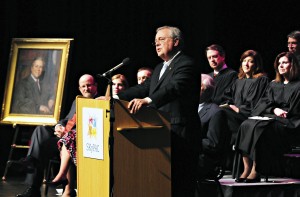
Kentucky Chief Justice John Minton’s tenure as a Warren Circuit Court judge was commemorated Wednesday with the unveiling and dedication of a portrait that will hang in the courtroom where he once presided.

The ceremony took place during the Bowling Green-Warren County Bar Association’s Law Day 2012 program at the Southern Kentucky Performing Arts Center.

Painted by Bowling Green artist Angela Kuprion, Minton’s portrait will hang in Circuit Courtroom A in the Warren County Justice Center alongside those of several other circuit judges who have served over the years in Warren County.

Minton served as a circuit judge from 1992 to 2003 before being named a Kentucky Court of Appeals judge.

In 2006, Minton was appointed by then-Kentucky Gov. Ernie Fletcher to the Kentucky Supreme Court and was sworn in as chief justice in 2008.

During a brief speech accepting his honor, Minton thanked those who enabled him to pursue his dreams and took a moment to specifically recognize community leader Cora Jane Spiller, who Minton said has worked tirelessly in making sure the city’s history is recognized and preserved.

“We would not have this portrait dedication or any portrait dedication in the last decade without Cora Jane,” Minton said.

Minton’s portrait will hang in the courtroom where Warren Circuit Judge John Grise currently serves.

“None of his predecessors I believe have exceeded his abilities and none of his successors I know have come close to approximating them,” Grise said of Minton.

The ceremony Wednesday was the high note of the 55th annual Law Day celebration by the local bar association.

This year’s event took place amid grim budgetary forecasts that have led several states to reduce funding for their judiciary systems.

Last year, 42 states cut funding for their court systems, and Kentucky court employees will be furloughed for three days this year after state lawmakers reduced the budget for its judicial branch. About 3,700 court workers across the state will be affected by the furloughs.

Florence attorney William T. Robinson III, the current president of the American Bar Association, said the American court system plays a crucial role in protecting rights and that it is essential that courts receive adequate funding to carry out their role in government.

“This is something so precious ... and we’re treating it like another line item in the budget,” Robinson said. “This is an issue for all the citizens of this country because it is your freedom that is at stake.”

The Law Day celebration honored a few local attorneys for their work in the community.

Dwight Burton of Bowling Green won the association’s Pro-Bono Publico award, given to the member of the Warren County Lawyer’s Care Program for outstanding commitment to pro-bono work in the community.

Burton has represented several clients in civil cases who could not otherwise afford an attorney. He said that getting justice on behalf of those clients was a “rewarding feeling.”

Rebecca Simpson of Kentucky Legal Aid was honored with the Gwyneth Davis Outstanding Public Service Award for her commitment to causes enhancing justice and civil rights.

Joseph Huddleston, a former Kentucky Court of Appeals judge who died last year, was recognized with the William H. Natcher Award honoring retired or deceased bar members whose life represented serving public interest over personal interest.

Huddleston’s wife, Heidi, accepted the award on his behalf.

Labels: ,

Friday, April 27, 2012

George Zimmerman, KIller Of Trayvon Martin, Made $200,000 In Online donations, Judge Will Be Asked To Increase Bail As His Claim Of Indigency Is UNTRUE. Watch News Video.

Wednesday, December 07, 2011

American Bar Association (ABA) Recommends Kentucky Suspend Death Penalty To Fix Flaws.

Kentucky should suspend death penalty, ABA panel recommends
Written by Andrew Wolfson

An American Bar Assocation panel has recommended that the death penalty be temporarily suspended in Kentucky until it adopts safeguards to prevent the execution of the innocent.

In a 520-page report issued Wednesday, a team of lawyers and retired judges who studied the state’s death penalty laws and procedures for two years found that they do not “sufficiently protect the innocent, convict the guilty and ensure the fair and efficient enforcement of criminal law.”

The report, by a six-member team, found that Kentucky has made “substantial strides” in providing an adequate defense for capital defendants, but that several grave weakness remain. Those include include the failure of police departments to follow nationally recommened eyewitness identification procedures; the failure to retain evidence for subsequent DNA testing; and the absence of a system for ensuring that the state’s 57 commonwealth’s attorneys apply the death penalty in an “even, non-discriminatory manner.”

The report also found that at least 10 of the 78 people sentenced to death in Kentucky since capital punishment was reintroduced in the state in 1976 were represented by defense counsel who were subsequently disbarred, and that 52 of them — or nearly 60 percent — had their sentences reversed on appeal or were granted clemency.

The report recommends more than two dozen reforms and says that halting executions would give all three branches of government the opportunity to address and rectify problems identified in the report.

Terry Sebastian, a spokesman for Gov. Steve Beshear, said the governor’s office would “carefully review” the report but noted that Franklin Circuit Court Judge Phillip Shepherd issued a temporary ban on executions while he decides if the state’s lethal injection protocol is adequate.

Labels: , , ,

Tuesday, November 22, 2011

Mariam Williams: War On Drugs Racist: Mass Incarceration And The Ugly Specter Of A New Jim Crow.

Mariam Williams | War on Drugs racist: Mass incarceration and the ugly specter of a new Jim Crow
Written by Mariam Williams

Last year, I wrote a grant proposal on behalf of three organizations seeking a total of about $300,000 from the Bureau of Justice Assistance to fund a mentoring program for ex-offenders re-entering the community. BJA was one of two offices administering Second Chance Act Grants, funding meant to help nonprofit organizations implement programs that would “improve re-entry planning and implementation,” the purpose of the Second Chance Act of 2007.

After reading Dr. Michelle Alexander’s book, “The New Jim Crow: Mass Incarceration in the Age of Colorblindness,” and hearing her keynote address at the Anne Braden Institute’s memorial lecture last week, I feel like the grant was a sham and a glaring example of the government waste we hear is so prevalent.

I feel this way because, according to Dr. Alexander, the executive, legislative and judicial branches of government have structured our criminal justice system so as to guarantee a vicious cycle of imprisonment and recidivism, especially among the people targeted in the War on Drugs.

The target is poor people of color. To paraphrase Dr. Alexander’s thesis, mass incarceration has relegated millions of black and brown people in America to legalized second-class citizenship, creating a caste system that is the moral equivalent of Jim Crow. Rather than rely on race to strip away civil rights gains, our government and our society in general label people of color “criminals” and continue the practices civil rights legislation was supposed to abolish, including discrimination in employment, education and housing and denial of the rights to vote, to serve on juries and to receive governmental assistance.

Keep these four points from Dr. Alexander’s book in: 1) The U.S. prison population has quintupled since 1970. 2) Mass incarceration is a direct result of the War on Drugs. 3) The War on Drugs has been waged almost exclusively in communities of color, despite research that consistently shows all races use and/or sell illegal drugs at equal rates, except among youth. In that case, black youth are less likely than white youth to use or sell illegal drugs. 4) The role of personal responsibility notwithstanding, mass incarceration is wrong, its seizure of liberties is un-American, and it must end.

Mass incarceration has decimated millions of families and entire communities. While that saddens me, the legislative and judicial role in the imprisonment explosion angers me. Through grant programs and asset allocation legislation, the federal government incentivizes local police departments to continue practices that are 99 percent ineffective at stopping drug possession, sales, use or crime. The U.S. Supreme Court has forced citizens to surrender their 4th Amendment rights and has made it impossible to file a lawsuit against a police department or prosecutor based on racial discrimination. The War on Drugs is well-funded and the U.S. Supreme Court has pre-empted challenges to its enforcement. The system is so thorough it keeps privatized, publicly traded prisons that employ some 700,000 people in business.

And to complicate life forever, or to ensure permanent second-class status, the government often prevents parolees and ex-offenders from obtaining the very stability needed to successfully reintegrate into life on the outside. They do so through legislation that opens all criminals and ex-offenders, no matter the nature of their crime, to employment discrimination and bars them from many professional licenses and from governmental housing, educational funding and even food assistance.

As I read Dr. Alexander’s book, I thought of a number of small ways to combat the War on Drugs and its effects. Get the American Civil Liberties Union into classrooms to teach the youth targeted in the War on Drugs their rights. Build mixed income housing so that a war waged on poor people directly affects people of all incomes, who won’t tolerate invasive tactics in their neighborhoods. Invest in the education, infrastructure and job training needed in poor communities to eliminate the violent crime that the War on Drugs doesn’t.

But I think the most effective way to stop mass incarceration in the near future is to page Dr. Paul and Dr. Paul. That is, cut mass incarceration’s monetary supply and raise awareness about the government’s unchecked power in the War on Drugs.

Kentucky’s own junior U.S. Senator, Dr. Rand Paul, and his father, Dr. Ron Paul, R-Texas, both claim to want a smaller, less intrusive government. (The elder Dr. Paul wants to legalize marijuana, an obvious necessity to ending the War on Drugs.) If that’s true, they have to oppose tax dollars funding a practice that is rendering millions of people unemployable and labeling them useless at a time when America can’t afford to forfeit anyone’s potential.

The people unwilling to consider raising taxes on the “One Percent” to balance the budget should consider not rewarding law enforcement for using expensive and largely ineffective tactics in the War on Drugs. Representatives who fear large government erodes freedom should be appalled at warrantless car sweeps and at mandatory sentencing. And instead of giving away millions of dollars each year to different organizations to do what Congress and the US Supreme Court have made it impossible to do, why not just eliminate the laws that bar ex-offenders from fully participating in the economy?

Given the state of the economy and record-low approval ratings of Congress and the President, declaring the War on Drugs a national economic catastrophe and a failure of big government might be the best approach to ending it.

According to Alexander, however, this is not enough. She asserts that to keep Jim Crow from reincarnating again, we must acknowledge the racial motives behind mass incarceration and have a national conversation about race.

Mass incarceration, she explains, is driven by race, not by crime rates. President Ronald Reagan declared the War on Drugs before crack cocaine appeared in poor communities of color. He made the face of drug use and of crime a black one, and he did it to appeal to poor and working class whites who feared they had lost irrecoverable ground in the years following the Civil Rights Movement. He preferred securing their votes over securing poor communities of color by financing an economic and educational revival in areas that manufacturing had abandoned.

I don’t dispute Alexander’s declaration that talking about race is necessary for preventing another Jim Crow system. As she makes clear in her book, her point has already been proven at least twice. Convict leasing, a form of free labor initiated after the Civil War, replaced slavery. The War on Drugs and the removal of civil rights from ex-offenders has many of the same effects Jim Crow had on “free” blacks from the early 1900s to the signing of the Civil Rights Act. There is no reason to believe that the powerful class won’t again use progress towards racial equality to make poor and working class whites feel slighted and then invent new policies to retract those gains and give the class of whites for whom they possibly have equal disdain a false sense of security.

The question, for me, then becomes: How do you have a conversation with people who aren’t in the room?

You see, there were a number of students who chose not to hear the lecture, and I’m not referring to the thousands of students who attend the school but couldn’t possibly fit in an auditorium that holds 500. The entire student body couldn’t fit in the Yum Center, either. I’m talking about the students who left before the lecture began. When it was clear that about 20 people who wanted to attend would not be able to because there weren’t enough seats, two professors announced that they would still give their students credit for attending the lecture if they left then and gave up their seats for people who wanted to be there. The professors gave their students a choice, and once they knew that in their absence they would still receive their incentive for going, the students chose not to stay and listen to an honest lecture about racialized injustice.

Even in our institutions of higher learning, a place where free thinking is encouraged—and, I must note, a place that gets increasingly inaccessible for poor and working class people every semester—the people we expect to lead us in the future can ignore these stark realities.

Perhaps the solution is to incentivize a national conversation. To engage poor and working class whites who, Alexander notes, have been disenfranchised, and to avoid preaching to the choir, I believe the best chance for this movement is to frame it, initially, as an economic necessity. To compete globally with countries that have billions of people, we must equip as many people as possible in the U.S. for productive citizenship. Is the promise of restoring our world super-power status enough to talk about race in America today? Depending on people to care just because there’s a problem affecting other human beings isn’t enough to end this injustice.

Labels: , , , , , ,

Friday, October 14, 2011

Kentucky Court Of Appeals Reverses Itself, Upholds Klan Verdict. Great!

KY court upholds $1.3 million verdict in Klan case
By BRETT BARROUQUERE

LOUISVILLE, Ky. (AP) -- A $1.3 million civil verdict against a former head of the Imperial Klans of America should stand because the trial court didn't make any significant errors in the case, the Kentucky Court of Appeals ruled Friday, reversing a decision it made nine months ago to throw out the judgment in the case of a Latino teen who was severely beaten in 2006 by two Klan members.

A jury in Brandenburg awarded Jordan Gruver a $2.5 million judgment against one-time grand wizard Ron Edwards, who was responsible for $1.3 million, and Klan member Jarred Hensley. Two other Klan members settled with Gruver out of court and he dropped the Imperial Klans of America as a defendant before trial. Only Edwards appealed the verdict.

Gruver had sued Edwards, with the backing of the Montgomery, Ala.-based Southern Poverty Law Center. The jury ruled in November 2008 that Edwards created an atmosphere of hate and violence within the group before the July 2006 beating at a Meade County fair in which Gruver suffered a broken jaw, permanent damage to his left arm and emotional trauma.

The appeals court in January tossed out the award, finding that Edwards had no duty of "reasonable care" toward Gruver because he had no direct control over the Klansmen who went to the fair.

Judge Glenn E. Acree wrote for the court on Friday that Edwards, in selecting four Klansmen to recruit at the fair, knew about their "violent tendencies" and knew the "proclivities generally" of the type of people attracted to his organization. Because of that, Edwards had a "duty to take reasonable care" when selecting recruiters to prevent "foreseeable acts from occurring."

"Edwards knew better than anyone that his organization was based on hatred of specific groups," Judge Glenn E. Acree wrote for the court. "... If Edwards could not foresee Gruver's assault, it was because he chose not to."

Judge Michael Caperton agreed with part of Acree's opinion, but dissented on the issue of whether Edwards was responsible for the four Klansmen's behavior. Caperton wrote that it is apparent the four men who assaulted Gruver had criminal backgrounds and that Edwards "taught hate of all but the Aryan race."

"Nevertheless, there is no evidence that Edwards told recruiters to assault anyone or that the assault of third persons was condoned by Edwards as an acceptable recruiting method," Caperton wrote.

Richard Cohen, president of the Southern Poverty Law Center, said the ruling should be seen as a warning to the Klan and other groups that leaders can't have others "do their bidding, then claim they aren't responsible for their actions."

"This opinion makes Kentucky a safer place," Cohen said. "This is a message of more than money."

Edwards, 51, is in federal prison in Beckley, W.Va., serving a four-year sentence on gun and drug charges unrelated to Gruver's assault and was unavailable for comment Friday. His attorney, Kyle Burden, has left the Louisville law firm listed in court records. Burden did not immediately return an email seeking comment. Emails sent Friday to an address on the website of the Dawson Springs-based Imperial Klans of America, once considered one of the largest Klan organizations in the country, were returned as undeliverable.

It is unlikely that Edwards has the assets to pay off the judgment, but efforts to collect it will continue, including garnering any wages paid to Edwards and placing liens or seizing any property he owns, Cohen said.

"Our collection efforts don't begin and end in one place," Cohen said.

Labels: , ,

Thursday, October 13, 2011

New Information For Those Of Us Who Practice Bankruptcy Law: Check Out Fee Increases Effective 11/1/11.

A Racial Disparity In Kentucky's Criminal Justice System? Well, You Don't Say!

Too many black children labeled criminals
By Herald-Leader Editorial

Why is a misbehaving black child more likely to look like a criminal to the adults in his life?

This question, raised by statistics from the Administrative Office of the Courts, is one that should demand the attention not just of court officials and lawmakers but also of educators.

It might explain quite a bit.

Black children under the age of 11 are disproportionately the target of criminal complaints and subject to court proceedings in Kentucky.

Unlike 16 other states, Kentucky puts no limit on the age at which a child may be criminally charged. State law also requires schools to report certain incidents, including assault and property damage.

More than 1,000 criminal complaints were filed against children ages 10 and under in 2009 and 2010. A few of the children were as young as 5.

The Herald-Leader's Valarie Honeycutt Spears and Linda J. Johnson analyzed the cases of 748 children under 11 who had complaints filed against them.

They discovered that black children were the subject of 25 percent of the complaints although they make up just 9 percent of the age group.

Half the complaints filed against black children were referred to official court proceedings, while a little more than a quarter, 28 percent, of complaints against white children ended up in the courts.

Also, half the complaints against white children were either dismissed or handled outside the courts compared to a little more than a quarter, 29 percent, of the complaints against black children.

There also seems to be a good bit of variation among counties in how complaints against young children are handled. In Fayette County, a child under 11 is almost never prosecuted.

Rep. Darryl Owens, D-Louisville, is eager to reform a system that relies on the courts to deal with children who are too young to comprehend the proceedings.

He's already getting encouragement from judiciary committee member Rep. Stan Lee, R-Lexington, who says "we've criminalized way too much the misbehaving by children."

Finding more effective ways to deal with children's behavioral issues would be a good use of lawmakers' time.

This is also an issue for educators to examine as they work to close achievement gaps.

In the most recent round of statewide testing, just 50 percent of black students scored proficient or higher in reading and math compared with 72 percent of white students.

The expectations of adults, especially teachers, are powerful forces in the life of a child.

Being labeled a criminal before you even know what it means is a self-fulfilling prophecy that helps no one.

Read more: http://www.kentucky.com/2011/10/12/1917585/too-many-black-children-labeled.html#ixzz1acrWuPqy

Labels: , ,

Tuesday, September 20, 2011

Kentucky Judicial Commission Votes To Remove Harlan County Circuit Judge Russell D. Alred From Office.

Judicial commission votes to remove Harlan circuit judge from office
By Bill Estep

Harlan County's circuit judge violated a long list of ethics rules and should be removed from office, a state disciplinary panel has ruled.

Judge Russell D. Alred is only the fourth judge the Judicial Conduct Commission has ordered removed from office since 1984.

Alred had improper involvement in cases, failed to dispose of cases fairly, used his office to advance personal interests and misrepresented his actions, the commission said in a decision released Monday.

In one of the more high-profile charges, the commission ruled that Alred abused his power by appointing a special grand jury in April 2010 to investigate county Judge-Executive Joe Grieshop, who was being opposed for re-election by Alred's cousin.

Alred wrote the order in a way to discredit Grieshop as the election approached, the commission said.

"The actions of (Alred) show a blatant and persistent failure to uphold the impartiality and integrity of the judiciary," the commission said in its order.

The commission also said some of Alred's positions at a hearing on the charges last month were "at best, disingenuous and, at worst, blatant misrepresentations."

The commission convicted Alred on nine of the 20 ethics charges he faced and voted 6-0 to remove him from office.

Each charge dealt with a number of provisions judges are supposed to follow.

Alred continued his fight against the charges Monday, however, filing an appeal with the Kentucky Supreme Court.

The removal order won't take effect during the appeal.

Alred said that the commission's findings were wrong and that chairman Stephen Wolnitzek was biased against him because Alred had criticized the commission's investigator, a friend of Wolnitzek.

The decision to punish Alred was "cut and dried" before the commission heard testimony last month, Alred said.

Political opponents who covet the circuit judge's job fueled the charges against him and used the commission to further their aim, Alred said.

He said that if the state Supreme Court upholds the order to remove him, he will appeal to federal court.

"I'm going to fight it to the bitter end," Alred said.

Jeff Mando, a Covington attorney who prosecuted the charges against Alred, said he will seek an order suspending Alred during his appeal if Alred will not step aside voluntarily until the Supreme Court rules.

"I think the fair and impartial administration of justice in Harlan County is best served if Judge Alred is not deciding cases while his appeal is pending," Mando said.

Mando said there are concerns about how people would view Alred's rulings during his appeal and about possible retaliation by Alred.

Alred said he would act in a professional manner if he stayed on the bench during the appeal.

Mando said Alred's argument that Wolnitzek pushed through a biased decision against him does a disservice to the panel, which includes several judges.

Alred's claims were a desperate attempt to divert attention from the evidence against him, Mando said.

If the Supreme Court upholds the commission's order stripping Alred of his office, senior judges probably would handle cases in Harlan County until Gov. Steve Beshear appointed a replacement.

The charges against Alred have caused a good deal of tension in Harlan County, where even the judge said politics is sometimes a blood sport.

Two of the charges on which he was convicted involved the special grand jury he appointed last year to investigate Grieshop during the Democratic primary for judge-executive.

Sheriff Marvin Lipfird's office had investigated a claim by a female drug addict that Grieshop was giving her pills in return for sex.

Investigators concluded the woman, who was trying to get a break on drug charges, was not credible.

However, Commonwealth's Attorney Henry Johnson and Alred discussed letting a grand jury hear the case to avoid any perception that local officials declined to pursue charges because of Grieshop's position.

The issue blew up politically after Alred issued a public order — before the election in which his cousin opposed Grieshop — to empanel a special grand jury.

The order spelled out that the panel would investigate alleged drug-dealing from Grieshop's office but not until after the election.

That would have left the issue hanging until after the vote.

Alred could have sealed the order or not specified Grieshop was the subject of the inquiry, the conduct commission said.

Alred also knew there was no evidence for an indictment when he called for the special jury, the commission said.

The commission also noted Alred issued the order the same day he saw a sworn statement Grieshop had given, saying that Alred had asked Grieshop to get back some county land leased to another man because Alred wanted to use it for a drug-testing lab.

Alred said he was not motivated by politics or anger to appoint the panel to investigate Grieshop.

However, the commission said it was clear the statement angered Alred.

Johnson presented the matter before the election to a regular grand jury, which cleared Grieshop.

Other charges on which the commission convicted Alred were:

■ He pushed for the county fiscal court to build a water park with $500,000 donated by two doctors convicted in a drug case.

Judges are not supposed to lobby such government bodies that way.

The commission also said Alred filed a court order that misrepresented the facts surrounding an earlier order giving him control of the money.

■ He barred a woman charged with fraud from substitute teaching at an elementary school that Alred's children attended.

Alred took that action without holding a hearing, and there was no basis for the order, the commission said.

■ He urged police to investigate allegations about illegal gambling machines at local businesses, then presided over the case of a man who was charged as a result.

Alred should not have handled the case because his impartiality could reasonably be questioned, the commission said.

■ He filed a complaint against Kentucky Utilities over electricity charges, then asked an attorney for KU for a $12,500 donation for playground equipment at James A. Cawood Elementary School, which Alred's children attended.

The company made the donation before Alred dismissed his complaint.

Alred also raised money from other sources for the playground.

Alred's actions violated fund-raising rules that apply to judges and constituted an improper use of his office, the commission said.

■ He barred a public defender from his court without giving her a chance for hearing.

Alred said that the woman had missed court appearances and that he wanted to make sure defendants were properly represented.

The commission, however, said there was no legal basis for his order.

Read more: http://www.kentucky.com/2011/09/19/1888613/judicial-commission-votes-to-remove.html#ixzz1YSCInaMy

Labels: ,