Google
 
Web Osi Speaks!

Monday, December 16, 2013

Lexington Herald Leader Editorial: "Eastern Kentucky can't SOAR While Public Corruption Thrives"! .... But Public Corruption Is A Part Of The Culture!!

Eastern Kentucky can't soar while public corruption thrives

At the risk of dampening SOAR's good vibe, we must point out a major obstacle to economic development in Eastern Kentucky that got little to no mention at last week's summit: corruption.

According to the United Nations, "corruption deepens poverty, debases human rights, degrades the environment and derails development (including private sector development) by creating disincentives for investment."

The U.N. observed International Anti-Corruption Day Dec. 9, while in Pikeville 1,700 people rallied under the Shaping Our Appalachian Region banner.

Meanwhile, U.S. prosecutors were unveiling the latest in a long string of criminal charges against Eastern Kentucky officials. Morgan County Judge-Executive Tim Conley pleaded not guilty to federal charges that he exchanged government contracts for kickbacks.

Regardless of how the latest prosecution ends, corruption is not a mountain stereotype or a comic form of local color. It's real, and it impedes investment.

The Herald-Leader's Bill Estep recently cited data from the U.S. Department of Justice showing that from 2002 through 2011, there were 237 public-corruption convictions in the Eastern District of Kentucky compared to 65 in the state's Western District.

Public corruption has abetted a drug abuse epidemic and denied youngsters a decent education. A Manchester pastor told Estep that honest people in Clay County saw no reason to vote until the feds broke up a vote-buying ring.

Ask yourself: What business or bright young person would stake their fortunes or futures on such a place?

Eastern Kentucky is full of honest people. The region is no more bound to be corrupt than it's bound to be poor or dependent on a single extractive industry.

Still, poverty can't be overcome without tackling corruption.

But how? The legislature should require local governments to beef up the ethics codes they were first required to enact in 1996, create some real penalties for violations and make ethics training mandatory for local officials.

Obviously, federal prosecutors and courts and Kentucky's attorney general must be vigilant.

But ethics in government — and business, for that matter — is more than just not doing wrong things.

Ethical government puts the greater good first, makes decisions in an open, accountable way, and invites everyone, including those on the margins, to the table.

Transformations that occur from within are always more successful than those imposed from without. Voters in Eastern Kentucky have the power to make change, provided they're given real choices. Those who care about the region must get busy making sure voters have real choices and honest candidates.

Healthy politics won't divide a community into feuding factions that also stifle development.

Both community and trust are critical to the spread of entrepreneurship, according to a study published this month in the American Sociological Review and summarized by Richard Florida in The Atlantic: "Entrepreneurship of all sorts — from the creative cutting edge, high-tech enterprises to building a small business — is in fact a social process, depending upon teams of people working together and broad social networks. And community itself, the place where entrepreneurial activity happens, is a crucial part of the mix."

A lot of SOAR speakers came close to gigging the elephant in the room. Instead of looking to pave a road where there are 35 votes, Senate President Robert Stivers said, the mind-set should become looking for ways to create 35 jobs.

U.S. Rep. Hal Rogers said that SOAR's real reward might not be the pot of gold at the end of the rainbow but the rainbow itself. That certainly would be true if a new culture of honest, accountable government spreads across the mountains.

Read more here: http://www.kentucky.com/2013/12/15/2989539/eastern-kentucky-cant-soar-while.html#storylink=cpy

Labels: , , ,

Monday, November 25, 2013

One Man Crying In The Wilderness In A Banana Republic!

Fighter of Corruption in Nigeria Considers Next Steps

Afolabi Sotunde for The New York Times
Nuhu Ribadu, Nigeria’s anticorruption commissioner, on Friday. 


James Ibori, the governor of an oil-rich state in southern Nigeria, was so desperate to escape prosecution on corruption charges that he tried to pay off the civil servant, Nuhu Ribadu, Nigeria’s anticorruption commissioner. Mr. Ribadu accepted the money, but it was all a ruse.
A bespectacled former police officer with the no-nonsense style of a G-man, Mr. Ribadu did not keep the money, a remarkable act in a nation where corruption is endemic. Instead he deposited it in a government bank vault, evidence of Mr. Ibori’s many misdeeds, and in 2007 Mr. Ibori was arrested. Ultimately the charges did not stick — the governor was acquitted by a Nigerian court. He was eventually convicted of money laundering and conspiracy to defraud in Britain, where he had stashed a hefty chunk of the hundreds of millions of dollars of oil money he was believed to have embezzled.
The outcome of the case is in many ways an emblem of Mr. Ribadu’s career as a corruption fighter in Nigeria, a country Colin L. Powell once called a nation of “marvelous scammers”: a string of partial victories against a seemingly unbeatable foe.
These days Mr. Ribadu sits at home in a government-issue villa in this prefab 1980s-era capital, ruminating on his next move.
At 53, he has been celebrated inside Nigeria and beyond for his five-year tenure as chief of the anticorruption unit, beginning in 2003.
In that time he built the unit, called the Economic and Financial Crimes Commission, into Nigeria’s largest anticorruption agency, with over 1,200 employees in six offices across Nigeria. He successfully prosecuted in 2005 Tafa Balogun, an inspector general of police who had resigned. Mr. Balogun pleaded guilty to failing to declare his assets. Mr. Ribadu arrested Mr. Ibori, the former governor of Delta State, in December 2007. He prosecuted 10 prominent national public figures, including nine governors.
His reputation gained luster only after he was forced from office in 2008 and into exile after what he said were assassination attempts, after he tried to prosecute corrupt politicians. He was appointed a visiting fellow at the Center for Global Development in Washington and was also a senior fellow at St. Anthony’s College, Oxford.
He returned to Nigeria to run for president in 2011, but came nowhere near victory, and since then has struggled to find a place in Nigerian public life. He continues to investigate graft, but with a less prominent platform. His report pointing out large-scale corruption and waste in the country’s oil industry, which was published last year, was ignored by the government that commissioned it.
“One of my very big disappointments,” Mr. Ribadu said intently in an interview here.
Still, he remains a unique figure, prominent in the political opposition and often named as a possible future candidate for office.
“For the generality of the people, he is a dogged anticorruption crusader,” said Femi Falana, a prominent Nigeria human rights lawyer. “For the corrupt elements that constitute the political class, they fear him.”
Since Mr. Ribadu’s abrupt ouster as head of the anticorruption agency, “there is a feeling that the war on corruption is a lost battle,” Mr. Falana said.
THE anticorruption fight appears to be on sabbatical in the garden of Mr. Ribadu’s home here.
“Most people you will have encountered will want to ‘settle’ you,” the soft-spoken Mr. Ribadu said in an interview in the garden, using a Nigerian term for a bribe. “Up to my last day at work, people were trying to bribe me. That is the shocking thing.”
Mr. Ribadu began his career as a street police officer in some of Lagos’s rougher neighborhoods, eventually rising to become the chief prosecutor for the Nigerian police. He speaks with a piercing intensity, sometimes clenching a fist to punctuate a point. He grew up deep in Nigeria’s northern hinterland in the town of Yola. It was a devout Muslim household and a “refuge against pain and injustice” that succored persecuted lepers, he wrote in his autobiography.


His father was a member of Parliament in the days before independence and later a minister in Nigeria’s first government. He did not die wealthy, a fact noted by Mr. Ribadu as proof of his integrity and a sharp contrast to the “obscene value of aggrandizement that has suffocated our national life,” as he put it in his book.

But his reputation is not entirely unblemished. Some critics have accused his office of selectively prosecuting enemies of the man who appointed him, Olusegun Obasanjo, the president at the time. Indeed, before the national elections in 2007, Mr. Ribadu’s office published a list of 135 “corrupt” candidates it said should not be allowed to run for office. None of Mr. Obasanjo’s close allies were on it, noted Human Rights Watch, an advocacy group. Other critics said that the agency used the country’s gruesome prisons to obtain guilty pleas from defendants seeking to avoid long trials and long stays in fetid, overcrowded cells.
Human Rights Watch said in August 2011 that Mr. Ribadu’s “legacy was tarnished” by such evidence.
Detractors also point to his modest tally, when it was all over, as chairman of the corruption commission: only two convictions.
Yet even the critics call these a watershed, demonstrating to Nigerians that the powerful could be brought down merely because they had stolen large sums of money.
It “was a profoundly important moment” when Nigeria’s top police official, Mr. Balogun, was taken to court in handcuffs in 2005 to answer for his $150 million in ill-gotten assets, Human Rights Watch said in a 2011 report that was otherwise critical of Mr. Ribadu’s record.
That feat, and the subsequent conviction of another oil-state governor for stealing $55 million — since pardoned by the current president, Goodluck Jonathan — contributed to Mr. Ribadu’s reputation for incorruptibility.
He remains a rare figure in Nigerian political life: a public man whose reputation for personal probity remains relatively intact. No one has credibly accused him of stealing or taking bribes. Chickens roam his lawn, his six children romp on the grounds and watch cartoons inside, and there is no elaborate security detail guarding him — a sharp contrast to the normal accouterments of Nigerian senior officials.
IT remains to be seen if Mr. Ribadu’s incorruptible image can vault him into politics. After announcing a bid for the presidency to much fanfare last time around, Mr. Ribadu finished a very distant third. The jockeying is now underway in Nigeria for the 2015 presidential election, a high-stakes game on which billions ride in this oil-producing nation, and Mr. Ribadu is not ruling out a new candidacy.
The odds are against him: The governing People’s Democratic Party, or P.D.P., with oceans of cash and a network of influential state governors, is arrayed against Mr. Ribadu, who has not much besides the news media and a handful of good-government boosters on his side.
But Mr. Ribadu is convinced his moment will arrive. Seven governors from the governing party have recently quit to form a splinter group. Mr. Jonathan’s party faces many problems, like an Islamist rebellion in the north and potentially plummeting revenues from oil after the United States, Nigeria’s biggest customer, cut imports from the country in half from 2011 to the first half of 2012.
The defections have noticeably rattled Mr. Jonathan’s government.
“It’s an implosion of the ruling party that has been in charge for 15 years, promoting corruption, selfishness, incompetence,” Mr. Ribadu said, leaning forward in his garden. “It’s gotten to the point where it’s just like a group of gangsters.”

Labels: ,

Wednesday, October 16, 2013

Corrupt Grayson County Sheriff's Detective, Terry Blanton, Sentence To One Year In Prison For Stealing Drugs, Etc., From Evidence Locker. Watch.

Watch below: You can read more here.

Labels: ,

Thursday, August 29, 2013

Nigerian Scammers? Well, Maybe Not!

Friday, August 02, 2013

Since Obusonjo Obasanjo Is A World Renowed Crook Who Pillaged Nigeria, Why Should Anyone Believe His Views On Robert Mugabe's Re-Election In Zimbabwe?!

Zimbabwe poll 'free and peaceful' say Obasanjo and SADC

Olusegun Obasanjo: "I have never seen an election that is perfect"

Zimbabwe - New Era?

Zimbabwe's elections were free and peaceful, the two leading African observer groups have said.
African Union mission head Olusegun Obasanjo dismissed complaints of fraud, while another observer urged all parties to "accept the hard facts".
A local monitoring group said earlier the poll was "seriously compromised".
President Robert Mugabe's party is claiming victory in the election, which has been dismissed by Prime Minister Morgan Tsvangirai as a "huge farce".
Justice Minister Patrick Chinamasa: "We [Zanu-PF] are going to have a landslide victory"
On Wednesday, voters were choosing a president, 210 lawmakers and local councillors. The results must be declared by the Zimbabwe Electoral Commission (Zec) no later than five days after voting day.
No presidential figures have been announced but the first official results from national assembly elections show that Mr Mugabe's Zanu-PF party is taking an early lead. However, the seats announced were mostly in Mr Mugabe's rural strongholds, correspondents say.
Zanu-PF spokesman Rugaro Gumbo predicted that Mr Mugabe, 89, - who is running for a seventh term - would get at least 70% of the vote in the presidential poll.
"We are expecting a landslide victory," he was quoted as saying in Zimbabwe's state-run Herald newspaper.
It is illegal to publish unofficial election results in Zimbabwe. Police have warned they would take action against anyone trying to leak early results.
Zanu-PF and Mr Tsvangirai's Movement for Democratic Change (MDC) have shared an uneasy coalition government since 2009 under a deal brokered to end the deadly violence that erupted after a disputed presidential poll the previous year.

Views from Zimbabwe press

The Herald (state-run) - 'The people have spoken':
Indications are President Mugabe will sweep to power with a colossal margin as his party scores a two-thirds majority in the National Assembly.
The absence of cases of violence has thrown MDC-T [Tsvangirai] and its handlers off kilter which is why they precariously hang onto trying to attack the voters' roll as if it is compiled at Zanu-PF headquarters.
It should be stated from the outset that the Registrar-General of Voters' Office falls under the Ministry of Home Affairs which was overseen by ministers drawn from Zanu-PF and MDC.
The Zimbabwe Electoral Commission is made up of commissioners chosen from lists submitted by the three parties in Government.
It thus comes as a surprise that today; MDC-T denies ownership of the electoral process it has been party to.
Daily News (privately-owned) - 'Please stop vote fraud':

In Hatfield, hundreds of street kids and youths were given voter registration slips and went on to vote and we are told this was prevalent throughout the country.
What will Zec do about this blatant vote theft?
What people now need is change and that is the reason why yesterday [Wednesday] most of them braved the chilly weather and woke up early to join long queues to exercise their fundamental right.
Their desire is to see a better Zimbabwe. People need to separate good from evil, light from darkness, suffering from prosperity and make a demarcation between history and the future.
People went out in large numbers to put an end to Mugabe's 33-year rule that was characterised by suffering.
'Heavy blow'

Speaking in the capital Harare on Friday, Mr Obasanjo, Nigeria's former president, said the elections were fair and free "from the campaigning point of view".
The former Nigerian president admitted that there were "incidents that could have been avoided", but he stressed that the 69 AU observers did not believe those irregularities could change the overall outcome of the poll.
At the same time, the AU mission expressed concern at the high number of voters turned away and those being assisted to vote - usually reserved for the illiterate or the infirm.
In a statement, it also noted that 8.7m ballot papers were printed - 35% more than the number of registered voters.
Shortly afterwards, monitors from the Southern African Development Community (Sadc) - which had 562 observers - described the elections as "free and peaceful" but said it was too early to call them fair.
"In democracy we not only vote, not only campaign, but accept the hard facts, particularly the outcome," said Sadc mission head Bernard Membe, according to the AFP news agency.
Mr Obasanjo's assessment sharply contrasted to that by the Zimbabwe Election Support Network (ZESN) - the largest group of domestic monitors with some 7,000 people on the ground across the country.
It said on Thursday that the elections were "seriously compromised", with as many as a million people being unable to cast their ballots.
The ZESN said potential voters were much more likely to be turned away from polling stations in urban areas, where support for Mr Tsvangirai is strong, than in President Mugabe's rural strongholds.

Zimbabwe election: Key facts

Zimbabweans wait to cast their votes in presidential and parliamentary elections in Harare, Wednesday 31 July 2013
  • About 6.4 million registered voters
  • Vote for president and parliament
  • Zanu-PF's Robert Mugabe and MDC's Morgan Tsvangirai are the main presidential contenders
  • Mr Mugabe, 89, is seeking to extend his 33-year rule
  • Mr Tsvangirai, 61, hopes to become president after two failed attempts
  • The poll ends the fractious coalition between Zanu-PF and MDC, which was brokered by regional mediators after disputed elections in 2008 that were marred by violence
  • First election under new constitution
The group also alleged significant irregularities before the poll. It said that 99.7% of rural voters were registered on the electoral roll in June compared with only 67.9% of urban voters.
But speaking to al-Jazeera, Mr Obasanjo questioned ZESN's conclusions, describing them as "not verifiable".
He said he was satisfied that the apparent anomalies between urban and rural voter registration had been explained by the registrar-general, who had the accurate figures for births and deaths.
Mr Obasanjo also said that Mr Tsvangirai's camp should have addressed concerns about the electoral roll before the vote - not after.
MDC member and Finance Minister Tendai Biti told the BBC that the assistance voting in rural areas was a "euphemism to say you have to vote for Zanu-PF under the guidance and watch of someone else".
"They [Zanu-PF] have stolen the election so much so that they are embarrassed at what they have done," Mr Biti added.
Still, Mr Obasanjo's assessment of the elections is a big boost for President Mugabe and a heavy blow for his opponents, the BBC's Andrew Harding in Johannesburg says.
It is unclear now how Mr Tsvangirai intends to fight on, our correspondent adds.
On Thursday, the prime minister said the elections were "null and void".
"Our conclusion is that this has been a huge farce... It's a sham election that does not reflect the will of the people."
Extra units - some in riot gear - have been deployed in Harare.
Under the electoral law, if no presidential candidate gains 50% of the ballots, a run-off will be held on 11 September.

Labels: , , ,

Wednesday, July 17, 2013

6Th Circuit Court Of Appeals Springs A (Kentucky Circuit Judge Cletus) Maricle, Overturns Verdict In Vote Buying Fraud Case.

Court overturns convictions in vote fraud case

Eight people from southeastern Kentucky were granted new trials Wednesday after a federal appeals court overturned their convictions in what prosecutors described as a massive vote buying scheme that stretched over three elections.
 
The U.S. 6th Circuit Court of Appeals concluded that U.S. District Judge Danny Reeves allowed jurors to hear some evidence that should not have been admitted and erred in his handling of transcripts of secret tape recordings that an informant made during the FBI investigation.


The unanimous ruling means former Clay County Circuit Judge R. Cletus Maricle, former school superintendent Doug Adams and six other defendants will get a second chance to contest the allegations stemming from the 2002, 2004 and 2006 elections.

Writing for the court, Judge Karen Nelson Moore concluded the errors taken alone might not have hurt the defendants' ability to get a fair trial. But, Moore wrote, the cumulative effect of the mistakes tainted the legal proceedings.
"Given that the government was able to paint an unfair picture of the defendants and offer direct prejudicial evidence that should have been excluded, we remand the case for a new trial," Moore wrote.

Along with Maricle and Adams, former county Clerk Freddy Thompson; former Magistrate Stanley Bowling; Charles Wayne Jones, who was the county's Democratic election commissioner; William E. Stivers, an election officer; and Bart and Debra Morris, a couple who owned a garbage business that had contracts with Manchester and Clay County were covered by the decision.

Prosecutors argued that the group conspired to spend hundreds of thousands of dollars to buy votes in one of the nation's poorest counties in 2002, 2004 and 2006. Attorneys for the eight argued that witnesses were unreliable and that Reeves allowed prosecutors to present some evidence that was not proper.

Several other local officials pleaded guilty to vote-buying and corruption charges in related cases.
Reeves handed down lengthy sentences in the case, including 24 years for Maricle, 69, who is being held at a federal prison in Beaumont, Texas, and 20 years for Adams, 61, who is being held at a federal prison in Elkton, Ohio.

The government has 20 days to seek a review of the decision by the entire appeals court.
"We are reviewing the Court's opinion and will carefully consider how best to proceed with this prosecution," Kerry B. Harvey, U.S. attorney for the Eastern District of Kentucky, said in a statement Wednesday afternoon.

Kent Westberry, a Louisville attorney who represented Adams, said it is likely that defense attorneys will seek release for their clients on bond pending a new trial.
"We'll be in front of the judge on that soon enough," Westberry told The Associated Press.
Adams, who served as school superintendent from 1999 through 2007, was considered a political boss in Clay County. Maricle served as a judge from 1991 through 2007 and was also considered a political boss. Both men were portrayed by prosecutors as leaders of the conspiracy.

The court's ruling mainly turned on a prosecution decision to offer several witnesses to testify about a decade-old drug conspiracy. Moore concluded the testimony shouldn't have been allowed because there was no direct link between the drug sales and the vote buying allegations.
"Furthermore, the sheer amount of drug-dealing evidence that was presented is entirely disproportionate to its probative value, tipping the scales toward unfair prejudice," Moore wrote. "In sum, the evidence of widespread drug dealing in Clay County did not serve as a prelude to the present case or help complete the story of the offense."

The government conceded in legal briefs that the testimony shouldn't have been allowed, but argued it wasn't a large enough error to have damaged the proceedings.
Westberry said the team of defense attorneys felt good after oral arguments about winning on that point.
"But, you just don't ever know what they're going to do until you see a written opinion," Westberry said.

The defendants did not win on every point. The appeals panel said Reeves properly ruled that vote-buying was a proper element to use in prosecuting the eight under a racketeering law.
Moore also found that prosecutors had sufficient evidence against Adams to convict him of vote buying. The court rejected arguments from five other defendants, each of whom claimed a lack of evidence in the case. Moore found that the group didn't explain well enough why they though the evidence was insufficient and rejected their claims.

Labels: , , ,

Wednesday, June 05, 2013

I'm Elated To Witness Nigerian President, Goodluck Johnathan, Continue To Grow Balls As He Battles Terrorist Group, Boko Haram.

Nigeria: Jail terms to tackle Islamist militancy

Nigeria has officially banned two militant Islamist groups, warning that anyone who helps them will face a minimum jail sentence of 20 years.
President Goodluck Jonathan declared Boko Haram and Ansaru to be terrorist groups, his office said.
The army has been waging an offensive against the militants in their northern strongholds since a state of emergency was declared last month.
The insurgency has killed about 2,000 people since 2009.
The activities of both Boko Haram and Ansaru would now fall under the Terrorism Prevention Act, Mr Jonathan's office said, in a statement.
It means that "any person who knowingly, in any manner, directly or indirectly", offers support to Boko Haram and Ansaru would be jailed for "not less than 20 years" if convicted, the statement added.

Boko Haram: Timeline of terror

  • 2002: Founded
  • 2009: Hundreds killed when Maiduguri police stations stormed; leader Mohammed Yusuf captured and killed
  • Dec 2010: Bombed Jos, killing 80 people; blamed for New Year's Eve attack on Abuja barracks
  • Jun-Aug 2011: Bomb attacks on Abuja police HQ and UN building
  • Dec 2011: Multiple bomb attacks on Christmas Day kill dozens
  • Jan 2012: Wave of violence across north-east Nigeria
  • April 2012: Deadly Easter church attack in Kaduna; ThisDay newspaper offices bombed
  • February 2013: French family kidnapped in Cameroon
  • May 2013: Heavily armed incursion into Bama town
On Monday, the US said it was offering rewards for information on Islamist militants in West and North Africa.
The highest reward of up to $7m (£4.6m) is for information leading to the location of Boko Haram leader Abubakar Shekau, the state department said.

Boko Haram launched the insurgency in 2009, carrying out a wave of bombings and assassinations in north and central Nigeria.
Ansaru, which is suspected to be an off-shoot of Boko Haram, joined the insurgency in 2012, taking foreigners hostage.
It said it had killed seven European and Middle Eastern nationals abducted in February 2012 in the northern Bauchi state.

Last month, Mr Jonathan declared a state of emergency in Borno, Yobe and Adamawa states, the three main strongholds of the Islamist groups.
It led to the army launching a ground and air assault to flush out the militants.
Rights groups repeatedly accuse government troops of targeting innocent people after falsely accusing them of backing the militants.
The army denies the allegation.

Labels: , , , ,

Tuesday, May 14, 2013

At Long Last, Nigeria President, Goodluck Johnathan, Starts To "Grow Some Balls" Against Nigeria's Al Qaeda, Boko Haram. Good For Him.

Nigerian president declares state of emergency

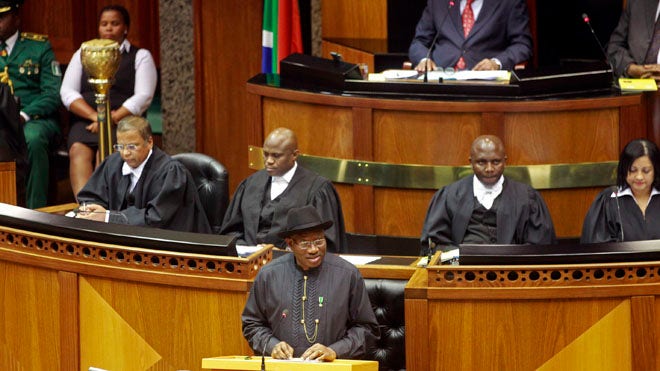
  • May 7, 2013: Nigerian President Goodluck Jonathan, center, makes a speech in the South African Parliament in Cape Town. On May 14, 2013, President Goodluck Jonathan declared a state of emergency in Nigeria. (AP)


Nigeria's president declared a state of emergency Tuesday across the country's troubled northeast, promising to send more troops to fight an increasingly violent Islamic insurgency.
Islamist sect Boko Haram -- whose name means "Western education is sacrilege" in the Hausa language of Nigeria's north -- has intensified its attacks on security forces and government targets in its northeast stronghold this month, prompting President Goodluck Jonathan to declare a state of emergency in certain states.
 
Last week, dozens of Boko Haram fighters in buses and machine gun-mounted trucks laid siege to the town of Bama, in Borno, killing 55, mostly police and other security forces, and freeing more than 100 prison inmates. Days earlier, scores were killed in the fishing village of Baga, also in Borno, on the shores of Lake Chad, when troops from Nigeria, Niger and Chad raided it looking for Islamists. Local residents said soldiers were responsible for many civilian deaths.
 
 President Jonathan, speaking live on state radio and television networks, also warned that any building suspected to house Islamic extremists would be taken over in what he described as the "war" now facing Africa's most populous nation. However, it's unclear what the emergency powers will do to halt the violence, as a similar past effort failed to stop the bloodshed.
"It would appear that there is a systematic effort by insurgents and terrorists to destabilize the Nigerian state and test our collective resolve," Jonathan said.
Jonathan said the order will be in force in Adamawa, Borno and Yobe states. He said the states would receive more troops, though he will not remove state politicians from their posts. Under Nigerian law, the president has the power to remove politicians from their posts and install a caretaker government in emergency circumstances.
 
The president's speech offered a stark vision of the ongoing violence, often downplayed by security forces and government officials for political reasons. Jonathan described the attacks as a "rebellion," at one point describing how fighters had destroyed government buildings and "had taken women and children as hostages."
"Already, some northern parts of Borno state have been taken over by groups whose allegiance are to different flags than Nigeria's," Jonathan said.
The president later added: "These actions amount to a declaration of war and a deliberate attempt to undermine the authority of the Nigerian state and threaten (its) territorial integrity. As a responsible government, we will not tolerate this."
 
This is not the first time Jonathan has implemented emergency measures. In December 2011, Jonathan declared a state of emergency over some limited local government areas in the states, after a church bombing blamed on Boko Haram killed 37 people, but he lifted it in July last year. This new decree, however, is more drastic and covers whole states, likely to cause conflict with powerful governors sitting in those states, as well as the political opposition. On Monday, the Nigeria Governors' Forum, representing the governors of Nigeria's 36 states, issued a statement warning Jonathan against imposing emergency rule in response to the insurgency.
According to an Associated Press count, more than 1,600 people have been killed in attacks by Islamic insurgents since 2010. Recently, Nigeria's military has said Islamic fighters now use anti-aircraft guns mounted on trucks to fight the nation's soldiers, likely outgunning the country's already overstretched security forces.
 
Boko Haram has said it wants its imprisoned members freed and strict Islamic law adopted across the multiethnic nation of more than 160 million people. It has produced several splinter groups, and analysts say its members have contact with two other Al Qaeda-linked groups in Africa.
The Islamic insurgency in Nigeria grew out of a 2009 riot led by Boko Haram members in Maiduguri that ended in a military and police crackdown that killed some 700 people.
The group's leader died in police custody, in an apparent killing. From 2010 on, Islamic extremists have engaged in hit-and-run shootings and suicide bombings. Recently, however, they've begun to use military-grade weapons, some of which they apparently seized from Nigerian military stockpiles.
Nigeria's military and police also have been repeatedly accused by human rights activists and others of torturing and summarily killing suspects, as well as burning down civilian homes and killing civilians in retaliation for militant attacks.
 
The latest incident, in a fishing village in Borno state along the shores of Lake Chad, saw at least 187 people killed and there are allegations that soldiers are responsible. While the military has denied repeatedly that it attacks and kills civilians, the country's armed forces have a history of committing such assaults.
 
Separately on Tuesday, an official in the central Nigerian state of Kaduna said gunmen armed with assault rifles and suspected to be Hausa-Fulani cattle herders killed 11 people in a village there. And in Benue state, a government spokesman said an attack blamed on Hausa-Fulani cattle herders there killed at least 12 people.

Labels: , , ,

Monday, May 13, 2013

The Boko Haram Threat To Nigeria Is Real.

Insight: Nigeria's Islamists staging bolder, deadlier comeback

(Reuters) - After a crackdown pushed them out of Nigeria's northern cities, Islamist militant group Boko Haram have regrouped, rearmed and are staging a bold comeback that has already allowed them to seize control over parts of the northeast.
Using porous borders with Chad, Niger and Cameroon in the desolate scrubland around Lake Chad, they are smuggling bigger weapons, staging cross-border raids, killing and kidnapping in an escalation of violence that could further draw Nigeria's neighbors into its counter-insurgency fight, security officials say.
 

The Islamists now control at least 10 of the 27 local council areas in Borno state, Nigeria's most remote northeastern region on the edge of the Sahara and a relic of one of Africa's oldest medieval Islamic empires, security sources there say.
One says the real figure could be closer to 20, as local councilors fearing assassination have fled, leaving a power vacuum filled by bearded radicals with automatic rifles.
Boko Haram's struggle for an Islamic state has killed thousands since 2009 and is the main threat to Africa's top oil producer, although its fighters have so far not struck anywhere near the southern oil fields.
 

When Borno's governor Kassim Shettima briefed visiting senators and military advisers in a confidential security meeting on May 7, he said something that stunned them: Boko Haram were on the verge of seizing control of his state.
"What the governor said was frightening. He informed us there is a possibility that this state will be taken over by Boko Haram ... that they have the ability to do whatever they wanted here," senator Abdul Ahmed Ningi, a delegate and deputy majority leader for the ruling party, said after the meeting.
"I had thought Boko Haram had been subdued to some extent."
 

MOVEMENT IN FLUX
 

A wave of Islamic fervor took hold of northern Nigeria during an economic crisis in the early 1980s, triggering riots in the north's main city of Kano and later prompting many states to introduce Sharia law from 1999.
 

In 2002, a cleric called Mohammed Yusuf founded a radical Islamist movement in Borno, later nicknamed 'Boko Haram' or 'Western education is sinful' in the northern Hausa language because of its opposition to Western cultural influences.
A military crackdown during an uprising in 2009 led to the deaths of 800 people, including Yusuf, who died in police custody.
 

Far from being silenced, they struck back, first shooting or throwing bombs at police off the back of motorcycles, then graduating to increasingly sophisticated bomb-making technology.
By late last year it seemed the militants had been chased out of city centers and were losing the ability to carry out large-scale attacks, but Boko Haram have repeatedly proved masters of recovering from apparent defeat.
 

A coordinated strike by some 200 Boko Haram fighters on an army barracks, police station and prison in the town of Bama last week that left 55 people dead and freed more than 100 prisoners was the latest evidence that they have recovered their strength.
Initially funded by northern politicians who later distanced themselves from the militants, Boko Haram have forged growing links with Saharan Islamists such as al Qaeda in the Islamic Maghreb, giving them new access to funding and training.
 

LAWLESS LAKE
 

The road from Borno's capital Maiduguri to Lake Chad, where Niger, Chad, Nigeria and Cameroon join, cuts through a semi-desert landscape dotted with lonely trees and thatched straw hamlets.
In one village, a skinny old man herds goats across wind-swept sands while a woman in a purple hijab balances a jug on her head, not far from the ashen remains of a car bomb.
Further along, a man in a turban and flowing robes rides on horseback across an expanse of grayish sand, a flashback to the centuries past when Borno was a prosperous sultanate profiting from trade routes crossing the Sahara to the Mediterranean.
Save the odd military checkpoint, there are few signs of statehood here. Disused schools and council buildings decay in dry heat. A fisheries college that was abandoned last year after an attack killed some staff stands eerily empty.
 

Boko Haram, under the leadership of fiery, gun-toting militant Abubakar Shekau, is thought to be getting closer to achieving its dream of creating some kind of Islamic rule in the lawless areas around Lake Chad, where even the police have fled.
"They are now holding territory," Kole Shettima, chairman of the Centre for Democracy and Development, said. "The next step is to create institutions: justice, social services," as Malian Islamists did before the French forced them out of its cities.
The Bama attack showed their substantial firepower, including machine guns, large numbers of rocket propelled grenades (RPGs) and pick-up trucks mounted with anti-aircraft guns, a sign the weapons flood from the Libyan war that helped rebels seize parts of Mali last year has reached Nigeria, officials say.
"They're getting bolder, better armed, more organized. it's looking bleak," a security official in Maiduguri said.
 

The exact number of Boko Haram fighters is hard to estimate -- and the degree to which Shekau and the four main members of his 'Shura council' -- Habibu Yusuk, Khalis Albarnawai, Momodu Bama and Mohammed Zangina -- have control over them is unclear.
They rarely communicate with the press since their spokesman was killed last year, although Shekau sometimes uploads videos of himself making bellicose statements onto the web.
Security officials believe they have several hundred well armed and trained fighters and possibly thousands of members.
The army spokesman for Borno state, Lieutenant-Colonel Sagir Musa, denied that the group were staging a significant comeback, but he told Reuters they were moving in bigger numbers than before.
 

"KILLERS"
 

A military convoy rumbles into the remote fishing settlement of Baga, on the shores of Lake Chad, scene of fighting last month that killed dozens of people, many of them civilians.
As it weaves past the charred remains of ruined houses, locals shout abuse at soldiers in the Hausa language.
On April 16, Boko Haram militants armed with guns and RPGs killed a soldier on patrol, slicing his head off with an axe.
What happened next is disputed. Brigadier-General Austin Edokpayi, who heads a multinational force comprising 1,200 Nigerians, 700 Chadians and 300 troops from Niger charged with securing this volatile border area, said reinforcements arrived and met fierce resistance from entrenched Boko Haram gunmen.
 

Community leaders say the Boko Haram militants had already fled over the border into Chad by the time the soldiers arrived, who then exacted vengeance on the civilian population, shooting, setting fire to houses and killing 185 people.
Whatever the truth of what happened at Baga, Boko Haram's creeping establishment of a stronghold around Lake Chad is becoming a major headache for Nigeria and its neighbors.
"It has emboldened the terrorists," Edokpayi said, complaining that since most local government officials have fled, the military were effectively on their own. "They are eating deep into the ... sovereignty of the Nigerian state."
At one Baga village meeting in which elders complained of heavy handedness by Nigerian troops, an intelligence official told Reuters around half the attendees were Boko Haram members.
Many are poor, young men with little if any formal education and no job prospects in some of the poorest places on earth.
 

The group's ability to strike fear stems both from its secretiveness -- no one who isn't a member can be sure who is -- and its visibility in places where the state has withered.
"They are there for everybody to see. You can see them sitting in front of their houses, holding their guns," said a man near Baga fish market who gave his name only as Abubakar.
That Boko Haram is also a menace to other countries around the lake was highlighted in February when it kidnapped a French family of seven from a game park in north Cameroon, taking them over the border into Nigeria. They were freed in April.
The cross border threat is likely to prompt more joint operations. The multinational force was originally set up in 1998 to deal with marauding Chadian rebels, but last year was expanded to include anti Boko Haram operations.
 

Yet the insurgents' ability to melt away under military pressure and then come back has convinced many that only some kind of political solution will resolve the conflict.
President Goodluck Jonathan set up a body last month to formulate terms for an amnesty, like the one that helped silence militancy in the oil producing Niger Delta in 2009, but the Islamists showed no interest, with Shekau denouncing it.
 

And few think any peace can hold unless Jonathan's administration can address the underlying causes of insecurity -- the north's extreme poverty and unemployment.
In the meantime, Boko Haram's efforts to revive an Islamist theocracy in northeast Nigeria will cause more bloodshed yet.

Labels: , ,

Friday, May 03, 2013

In Nigeria, A Lot Of Criminals Who Need To Be Shot Are Instead Celebrated. What A Banana Republic!


Terror and Amnesty in Nigeria


In Lagos, Nigeria, where I live, people have been posing a counterfactual: How would Americans react if the Unites States pardoned the terrorists behind 9/11 or the Boston Marathon bombing? The Nigerian government has announced that it is preparing to offer amnesty to an unknown number of militants associated with the Boko Haram Islamist group, an entity responsible for the deaths of more than two thousand Nigerians in recent years. President Goodluck Jonathan has set up a committee that includes scholars, lawyers, and political and military leaders to examine what an amnesty process would look like.
 
Yet last week, in a massacre that was as much the fault of the heavy-handed military as Boko Haram, over two hundred people in the town Baga, on the shores of Lake Chad, in northern Nigeria, were killed in a battle between the two sides—and hundreds of houses were destroyed.
“There is no way this violence can end and we achieve peace if the government has maintained a double standard of voicing out support for dialogue and at the other time sabotaging it,” Shehu Sani, a human-rights lawyer with the Civil Rights Congress of Nigeria, said recently in a statement. Sani was named to the committee, but rejected the idea of participating.

Civil and religious leaders in the predominately Muslim north of Nigeria have long advocated for amnesty for Boko Haram—and the government has long rejected their plea. Just last month, President Jonathan dismissed granting amnesty to Boko Haram, calling the move impossible because the group’s members were essentially faceless, “operating under a veil.” That hasn’t changed. It’s not evident why Jonathan has changed his mind, but those who live in central and northern Nigeria and who have borne the brunt of Boko Haram’s attacks—including people named to the amnesty committee—wonder if this last-ditch effort will be enough. (Boko Haram itself voiced opposition to the idea of a negotiated amnesty.)

Boko Haram claims to be working for a purer, Islam-driven society, a contrast to the corrupt patronage of the federal and state governments. It has recruited college graduates and political thugs—young men used by politicians to do their dirty work and set off violence after lost elections. They have robbed banks and bombed police stations with homemade I.E.D.s, acquiring guns and cash as they have bounced from the sponsorship of one northern politician to another, politicians who often end up denouncing the group after its members turn on them.
When, in 2009, Abubakar Shekau, Boko Haram’s leader, was captured and later killed in police custody, the group began its war on civilians. Pastors, Christians, openly critical imams, and Muslims—none have been immune. And all the while, the identities of the group’s members and followers (except for their spokespersons and leaders) have stayed concealed. Some may have scared their neighbors into silence while others live essentially off the grid, Bawa Abdullahi Wise, a security analyst who studies Boko Haram, told me. “Their mission has been to create chaos and make people feel that the country is ungovernable since they already mistrust their leaders. They want to force leaders to step down or concede to demands to change direction of leadership.” Amnesty, it appears, would only be a Band-Aid.

Last month, the group released a French family of seven that it was holding in what appeared to be a desert-like patch of the north, after it had demanded prisoners in exchange. The hostages were taken, said the group, in retaliation for Nigeria’s leading role in a military intervention targeting Islamists in northern Mali. The Nigerian government did not release any prisoners, though the Cameroonian government may have done so (and paid, with France, a ransom). But, strangely, a Boko Haram “factional leader” has claimed to reporters that he ordered the family freed as a good-faith gesture in the interest of the amnesty process.

Sani, the human-rights lawyer, has been petitioning the International Criminal Court to investigate alleged atrocities committed by youth leaders, politicians, and retired Army personnel in the lushly green and mountainous region of central Nigeria called Plateau State, the site of havoc between Muslims and Christians after every election in the past decade. In Plateau, Muslim-Christian tensions have been exacerbated by the presence of Boko Haram, which has bombed a number of churches and markets, and driven the two communities, which previously mixed freely, further apart.
“This crisis has been lingering for so many years now, and the government has not produced any fruitful solutions to address it. I do not think the government is serious about investigating the violence,” Sani told me.

Central and northern Nigeria exemplify what happens when a country abandons certain regions so completely, failing to provide adequate education, social services, development, employment, and transparent political culture: extreme results rise up. In Plateau, I have spent time with a Christian who makes and sells guns, a reflective twenty-two-year old man with melancholic eyes who once thought he would go to college and start his own business, until his hometown became an undeclared war zone.

A 2009 amnesty program for militants in Nigeria’s oil-drenched Niger Delta mostly succeeded in quelling conflict there. Militants were pleased with the monetary settlement that aimed to make up for the immense oil profits the region has never seen, despite the pollution that energy companies are dumping in the area. Coming full circle, those same Niger Delta militants released a statement in April saying that, beginning in the end of May, they will attack mosques, Muslim institutions, and imams that they deem hostile, supposedly in order to “save Christianity in Nigeria from annihilation.” Who will save Nigeria from itself?

Alexis Okeowo is a journalist based in Lagos; she received support for the reporting in this post from the International Reporting Project Fellowship in Global Religion Reporting.
Above: President Goodluck Jonathan, center right, standing next to Borno State Governor Kashim Shettima, center left, in March. Photograph by Wole Emmanuel/AFP/Getty.

Labels: , , ,

Tuesday, April 02, 2013

Nigerian President, Goodluck Jonathan, Serves As Country's "Morgue Attendant"!

Nigerian president is 'squeezing the life out of our country'

Goodluck Jonathan is more interested in retaining power and accumulating wealth than truly tackling terror and corruption
Goodluck Jonathan
Nigerian president Goodluck Jonathan.

There is a joke about a morgue attendant who was so used to
 seeing dead bodies that one day, when a supposedly dead
body started twitching, his response was, "this is the morgue,
not the emergency room". He promptly smothered the
twitching body until it was well and truly dead. "That's more
like it",he said, as he sat down to guard the cabinet
full of dead bodies and to wait for new arrivals.

In many ways, the way Goodluck Jonathan has handled
the affairs of Nigeria since becoming president can be
likened to that of the morgue attendant. And worse still,
Nigeria under his administrationhas grown to become
a vast, sprawling mortuary where deaths and dead
bodies do not seem to matter at all. In the aftermath
of Jonathan's visit to Maiduguri, the trouble northern
city under attack by Boko Haram,in security operatives
reportedly dumped about 70 bodies at the morgue,
up from the daily average of 10 or 20.

Like the morgue attendant in the story, when about two
years ago, the Borno state Elders Forum met the
president and asked him to order the withdrawal
of troops from Maiduguri to enable them take a different
approach against the jihadist group, Jonathan flatly refused.
In the two years since, how many more lives have been
needlessly lost in the fighting? His attitude seems to be,
"I'd rather preside over dead bodies than save lives".

Accepted, Jonathan took over a country that was severely
distressed. But what is the job of the president?
For someone who has spent the last 14 years in power
at the state and federal levels, the excuse that he is still
studying the situation is one of the lamest apologies in
political history. Either deliberately or inadvertently,
like the morgue attendant, Jonathan's actions and inactions
all seem geared towards killing Nigeria off once and for all.

Why was it that when he was eventually shamed into visiting
northern Borno and Yobe states by opposition governors,
his response to calls for an amnesty for Boko Haram was,
"We can't grant amnesty to ghosts". Within a week of
his mindless retort, another 25 Nigerians had been blown
to smithereens in Kano. Since he can't grant amnesty to
ghosts, perhaps, he can grant amnesty to dead bodies?

Incidentally, more and more Nigerians are beginning
to suspect that the deteriorating security situation may
be more than the handiwork of Boko Haram. More than ever,
there are growing fears that some, if not many of the attacks
attributed to Boko Haram may be the work of other "ghosts"
beyond the militants,whose ultimate objective may be to divide
Nigerians further along ethnic and religious lines for political
advantage. The very nature and timing of some of the attacks
on churches and some ethnic groups lend credence to that
supposition.

Is this the same Jonathan who told us on his inauguration
that, "Today, our unity is firm, and our purpose is strong,
our determination unshakable. Together, we will unite
our nation and improve the living standards of all our peoples
whether in the north or in the south; in the east or in the west.
Our decade of development has begun. The march is on. The
day of transformation begins today. We will not allow anyone
 exploit differences in creed or tongue, to set us one against
another?"

Perhaps, Nigerians should not be surprised at what Jonathan
has become. From the supposedly timid state governor and
vice president, we now have one of the most calculating and
thick-skinned leaders, totally deaf to criticism. The only
thing on his mind seems to be to retain power beyond
2015 while allegedly helping friends and cronies accumulate
wealth. After all, when he was asked about politicians
declaring their assets in public, he said: "The issue of public
asset declaration is a matter of personal principle. That is
 the way I see it, and I don't give a damn about it, even
if you criticise me from heaven."

Which is why the condemnations of the pardon he granted
to Diepreye Alamiesegha, a former state governor who stole
millions of dollars and jumped bail in the UK after disguising
 himself in as a woman, are likely to fall on deaf ears. It is why,
even with a daily income of $224 million, Nigerians are among
the poorest people on earth. It's why we have 68 million people
unemployed; why Nigeria is the most corrupt nation in the world
and why studies show that a child would be off being born
in Somalia, Mali, Chad, South Sudan and other war-ravaged
countries than in Nigeria.

Jonathan's well-paid and ill-mannered army of internet and media
warriors may sing his praises to high heavens and work hard to
distort any discourse about the woeful failures of their paymaster,
but they cannot hide the fact that, under Jonathan, Nigeria has
become a vast mortuary where death and tragedy are routine.

And like the morgue attendant, the president seems intent on
smothering all remaining signs of life.

Labels: , ,

Wednesday, July 25, 2012

FOX NEWS HEADLINE: DRUG MONEY FUNDS VOTER FRAUD IN EASTERN KENTUCKY, WELL, I'M SHOCKED! NOT!! WINK!!! WATCH VIDEO.

Wednesday, November 23, 2011

Nigerian President Goodluck Jonathan Fires Anti Corruption Chief Farida Waziri. Who Wants To Bet That The Firing Is For Her Corruption? Anyone?

Nigeria president fires anti-corruption czar
By JON GAMBRELL

LAGOS, Nigeria — Nigeria's president unexpectedly fired the head of the lead anti-corruption agency Wednesday, removing an official accused of being controlled by the political elite in this graft-prone nation.

A statement from President Goodluck Jonathan's office only said Farida Waziri was "effectively relieved" of her duties as chairwoman of the Economic and Financial Crimes Commission, which once garnered international praise for its pursuit of corrupt politicians.

However, the statement gave no reason for her firing. Presidential spokesman Reuben Abati did not respond to repeated requests for comment Wednesday and Waziri couldn't be reached.

Waziri leaves an agency and a cause she herself appeared to grow weary of in recent weeks.

"The best any law enforcement agency can do is properly investigate cases and file charges," she said in a speech Tuesday. "The frustrations faced by law enforcement agencies within the tedious common law process ... must be voided."

Waziri still had at least another year in her tenure before Jonathan's sudden decision, agency spokesman Femi Babafemi said. Babafemi confirmed that Waziri had been fired, but said he didn't know the president's reasons for pushing Waziri out.

The anti-graft agency came into existence only a few years after Nigeria became a democracy in 1999. Its first chief, Nuhu Ribadu, claimed at one point that Africa's most populous nation likely lost more than $380 billion to graft between 1960 and 1999.

That post-independence period saw a string of military dictatorships and failed civilian governments. About $8 billion a year has been stolen in the time since, according to analysts.

Such thefts remain easy as government budgeting at every level remains opaque, and the nation pulls in billions of dollars from its joint ventures with foreign oil firms in its crude-rich southern delta.

The looting may be rising as crude oil prices have spiked in recent years, sending more unaccounted-for cash into one of the top suppliers to the U.S.

The nation's political class reigned with impunity until the agency's creation. Under Ribadu, who later became a failed presidential opposition candidate, the agency arrested powerful state governors and earned media praise.

However, the agency under Ribadu trampled on suspects' rights while avoiding targeting the allies of then-President Olusegun Obasanjo, Human Rights Watch said in a report released in August.

The rights group also said despite its headlines, the commission has only garnered four convictions against Nigeria's political elite since its creation in 2003, with those found guilty facing little or no prison time.

The administration of late President Umaru Yar'Adua forced Ribadu from the agency in 2008. Waziri, who took over the commission, has been criticized by U.S. diplomats in leaked diplomatic cables for being unprepared and for apparently being controlled by politicians.

Others have leveled corruption allegations against her and operatives of the commission, though none has been proven.

The commission under Waziri has charged several prominent bankers over the fraud that caused the near-collapse of the country's banks in 2009. It also recently arrested and charged former House Speaker Dimeji Bankole over corruption allegations - the first major strike against the nation's political elite in many months.

Still, prosecutions by the agency have not risen since 2007, according to a recent Human Rights Watch report. The rights group said the commission's funding tripled during that period.

The president appointed agency deputy Ibrahim Lamurde as the commission's acting chairman, Babafemi said. Lamurde served as a trusted official under Ribadu, but later was sidelined following his departure.

The return of Lamurde could signal a more robust and aggressive pursuit of corruption in Nigeria, though it remains unclear whether he'll remain as the commission's top official.

Read more: http://www.kentucky.com/2011/11/23/1970375/nigeria-president-fires-anti-corruption.html#ixzz1eYAqr2t7

Labels:

Sunday, November 06, 2011

Did You Miss CBS' "60 Minutes" Again? At Least Watch Jack Abramoff's Washington, D. C.'s "Culture Of Corruption". Yes, There's A Reason I Call It CONgress! Watch Video.

Thursday, October 13, 2011

Lexington Herald Leader Correctly Recognizes The Face Of "Blatant Cause Of Unethical Conduct", And You Are Looking At Keith Hall's Mug Shot!

Blatant cause of unethical conduct

Kentucky State Representative Keith Hall (D), House District 93, Pike County. LRC Photo

The slimy case of Rep. Keith Hall's ethics violation is a case study on the gaps in Kentucky's ethics laws.

The short story is that in 2005 Hall voted to appropriate money that ultimately was paid to one of the companies he owns. Hall's company earned $171,000 on the job.

Tuesday, the Legislative Ethics Commission reprimanded Hall for violating the legislative ethics code. Under an agreed order, Hall denied guilt and agreed to pay the maximum penalty, $2,000. Hall's attorney delivered a check on the spot.

The fine represents 1.16 percent of the contract. That's a cost of doing business — not a disincentive.

That's it.

At a minimum, House leadership should react to the Commission's finding by getting Hall out of the business of influencing how public money is spent, which he does from his seat on the House Appropriations Committee.

However, there's nothing that requires the House to discipline a wayward member and House Speaker Greg Stumbo, D-Prestonsburg, didn't seem to be in any hurry to take action against his fellow Democrat from the mountains. Stumbo said he'd wait to see the commission's report first.

Hall's self-dealing only came to light because State Auditor Crit Luallen referred it to the commission after an audit of Mountain Water District, a public water and sewer utility in Pike County.

Hall's B.M.M. Inc did electrical work for the district. Although the $171,000 in work far exceeds the $20,000 limit for a no-bid contract, the work was split up into a series of invoices of $20,000 or less,

Things get a little murky after that because the water district and the superintendent who oversaw the work refused to speak with Luallen's auditors.

Also, Utility Management Group, the private company that the Water District had paid more than $36 million in fees over five years to operate the system refused to provide state auditors with financial data.

The Water Board hired UMG without any public discussion of the proposed contract or its terms.

Attorney General Jack Conway ruled in September that UMG is covered under Kentucky open-records laws because it receives more than 25 percent of its income from public sources. UMG said it plans to appeal that ruling.

What can be salvaged from this tale?

First, the legislative ethics commission should press for stronger remedies and adopt a more aggressive stance on ferreting out conflicts of interest. It shouldn't have taken five years and another agency to uncover Hall's self-dealing.

Second, the House must take Hall's offense seriously and at a minimum remove him from the Appropriations Committee. Responding to his actions (his son also worked for UMG) with only a wink and a nod undermines the little faith the public has left in the legislative process.

Third, in the next session the General Assembly should pass legislation recommended by Conway and others to ensure private contractors conducting public work open the relevant portions of their books.

More and more government functions have been outsourced to private companies as a way to save money. We'll never know if we're getting our money's worth unless the books are opened for public inspection.

Read more: http://www.kentucky.com/2011/10/13/1918933/blatant-cause-of-unethical-conduct.html#ixzz1ag4V8k6q

Labels: , ,

Wednesday, October 12, 2011

More On The BANANA Republic Of Nigeria.

Nigeria: Insecurity - What Hope for the Common Man?

The security situation in the country has degenerated to the extent that public functions are now held in secluded places amidst tight security. ROSE ADAH reports that governments seeming inability to handle the situation may have left ordinary Nigerians to their fate.

In a twinkle of an eye, Nigeria has become a violence filled state with crises prevalent in many parts of the country. A country that has been known for peace, unity and love has become troubled, divided and insecure.

Security of lives and property which ought to be one of the responsibilities of the government does not seem to be the case anymore, as people no longer sleep with two eyes closed or move about freely without looking back for fear of been attacked by armed robbers, kidnappers or terrorist groups.

Every individual has become so security conscious that security gadgets are seen in homes that can afford it, banks, corporate organisations and embassies.

Churches are not left out too, as worshippers are thoroughly screened before they are allowed entrance into worship centres in some parts of the country, while some churches have banned the use of big handbags by women in their churches.

Security has been beefed up in every part of the country and people no longer go in and out of places freely, as everybody has become a suspect.

The security of the life and property of citizens lies with the government, as enshrined in Section 14(2c) of the constitution of the Federal Republic of Nigeria, which states that "The security and welfare of the people shall be a Primary purpose of the government."

For the first time since Nigeria got her independence in 1960, independence anniversary celebration was held within the secure walls of the Aso Rock Presidential Villa, and not the public square where such events are held.

The decision of the government to mark the anniversary with low key celebrationat the Villa, was perceived by many to be an act of fear on the part of the government, as there were bomb threats by the Movement for the Emancipation of Niger Delta, ahead of 51st Independence Day celebration.

In a statement circulated via the internet, the spokesperson of MEND had said "October 1, 2011, the Movement for the Emancipation of the Niger Delta intends to place bombs within and in the vicinity of the proposed 2011 independence anniversary celebrations. After 51 years of independence, Nigerians still have nothing to celebrate. The general public is strongly advised to consider this as a 1st and final warning, no additional warnings will be issued subsequent to deployment or detonation of these devices, which will be novel in nature."

The government was later to clear the air on this, as the information minister, Labaran Maku, said attributing the decision of the government to fear was unfounded, as the decision was intended to save cost from the elaborate celebration, and added that the decision was in good faith and in the best interest of the country.

But the question on the minds of many Nigerians is how a small fraction of the population of the country can subject a large majority of the populace and the government to so much trauma and fear, with no drastic step from the government to put an end to the situation.

Despite efforts by individuals and the government to beef up security, armed robbery has been on a steady rise, kidnappers are still at their game just as the Islamic sect, Boko Haram, appears to be more resolute in its determination to bomb the country at the slightest provocation.

Recently in Zamfara State, when people were supposed to be celebrating the country's independence, armed bandits killed 19 persons, including a man, his wife, son and brother, in a single operation.

On October 2, 2011, a day after the robbery incident in Zamfara, kidnappers abducted the father of Akwa Ibom State Governor, Godswill Akpabio's security aide from a church in the state. According to media reports, the abductors seemed not to be in a hurry as they took their time to carry out the operation, while the women in the church kept screaming for help.

On the same day in Nnewi, Anambra State, suspected kidnappers abducted the father of a member of the House of Representatives in his house, while he was preparing for church service.

The National Youth Service Corps (NYSC) recently cancelled its passing-out parade for the Batch C corps members, citing insecurity.

The Nigeria Law School, Bwari, Abuja, on October 5, 2011, also shifted its call to bar ceremony from the school premises, to the International Conference Centre, Abuja, as part of security measures to forestall any eventuality.

The event was held amidst tight security, and only guests with invitation cards to the ceremony were allowed entrance into the venue.

A legal practitioner at the venue, Mr. Benson Agada, lamented the security situation in the country. He said, "The security situation in the country has become so bad that the venue of this ceremony had to be moved from the Law School to this place. The director-general of the Nigerian Law School, Tahir Mamman was trying to explain that the change in the venue is due to the ongoing road construction but I think we all know why the venue was changed because the road to the school is not affected by the construction.

"Could it be that the government is not capable of tackling this menace? The government needs to have a headlong confrontation with these militants, Jonathan has to fight them because, they had threatened earlier that they will make his government ungovernable if he becomes president, and that is exactly what they are doing."

A group of women, seating outside the gate were seen scampering and when confronted, one of them, who spoke on anonymity said, "A lady who was sitting with us told me she wanted to get some snacks and that I should watch over her handbag. When she was gone, I had no option than alert the others to flee since we didn't know what was contained in that bag. You know one has to be security conscious with all these happenings here and there, you can't trust anyone. That is why the security here is so tight that we can't even go in to celebrate with our loved ones."

With all the measures the government says it has put in place to fight this menace, one cannot but wonder why violence still persists and why the Boko Haram sect appears to be such a hard nut to crack.

This may justify the suspicions by the government and some security agencies that there could be an infiltration of the Boko Haram sect in the security agencies in the country. Otherwise, how else can one explain the sect's success at launching attacks on their targets, especially in Borno State, despite the presence of the Joint Task Force in the state.

A source in one of the security agencies, who craved anonymity, told LEADERSHIP that "We are suspecting infiltration of security agencies by Boko Haram members. They seem to have more intelligence information on our security agencies than we had thought; and the manner in which they beat security agencies to attack, point to some moles within the security network. Some security operatives have not risen above ethnic and religious persuasions. We think such operatives might be leaking information. If there are no moles, why will a security chief release a Boko Haram leader in detention? This infiltration is being addressed. I won't say more than this."

But the leader of the Shiites Islamic sect, Mallam Ibraheem el-Zakzaky, has accused some politicians and officials within the country's security agencies of being the brain behind the security situation in the country.

Recently, a self-acclaimed co-founder of Boko Haram, Mallam Aliyu Tishau, who was in detention was released and the only explanation given was that he was released to a sister security agency; but the Army and the SSS denied that Tishau was released to them, only to agree after a meeting that Tishau was released based on a court order. But why the confusion, what do Nigerians believe?

While the blame game continues between the security agencies, Nigerians are yearning for the Nigeria where security and value for life was the order.

Labels: ,

Former Governors Of Nigerian States Flee The Banana Republic's Capital Of Abuja, Amid Arrests For THIEVERY. POX On ALL Their Houses!

Go here and select your reading displeasure.

Labels: ,

Thursday, July 14, 2011

Nigerian President, Goodluck Jonathan, Doubles Pay Of Youth Services Workers. While We Applaud Move, We STILL Insist That Youth Service Corps Be Disbanded, Or Service Be SOLELY On Voluntary Basis.

Yes, we do.

FYI: Pay went from a lower than slavery monthly wage of nine thousand eight hundred Naira, to almost slavery wage of nineteen thousand seven hundred Naira.

Labels: ,

Monday, June 06, 2011

More News From Banana Republic Of Nigeria, As Outgoing House Speaker Is Arrested On Corruption Charges.

Lawmaker arrested on corruption charge
By BASHIR ADIGUN

ABUJA, Nigeria — Nigeria's anti-corruption agency arrested one of the West African nation's top politicians Sunday night on suspicion of defrauding the oil-rich country, an official said.

Officers arrested outgoing House of Representatives speaker Dimeji Bankole at his home in Nigeria's capital of Abuja after the lawmaker resisted arrest for more than four hours, said Femi Babafemi, a spokesman for the Economic and Financial Crimes Commission.

Babafemi gave no additional details about the allegations facing Bankole, other than to say that he would be held "in custody to enable him to have sufficient time to answer questions on the numerous fraud allegations against him." The lawmaker apparently refused several requests by officials to be interviewed.

"An intelligence report … showed that the former speaker was planning to leave Abuja for Lagos on Sunday evening and thereafter flee the country through an illegal route," a statement from Babafemi read.

It was not immediately clear if Bankole had a lawyer. His spokesman, Idowu Bakare, previously issued a statement saying Bankole "never benefited" from his position, including taking a more than $66 million loan from United Bank for Africa PLC for his office. That was on top of his annual salary and money already budgeted for his office, which runs into the millions of dollars.

Positions in Nigeria's National Assembly are highly lucrative, where even low-ranking members get more than $1 million in salaries and benefits, plus the ability to direct a swollen budget in a nation where billions in oil revenues routinely go missing.

Bankole conceded defeat to an opposition party candidate in Nigeria's April elections, one of a number of prominent politicians who lost their seats in the country's National Assembly.

Many pointed to Bankole's defeat as a sign that Nigeria's elections, typically marred by fraud and thuggery, had improved over the nation's 12 years as a democracy. However, ballot-box stuffing and violence dominated later polls, with more than 800 people dying in religious rioting after the presidential election.

Nigeria, one of the top crude oil suppliers to the U.S., has a long history of corruption, with one officials once estimating the country has lost more than $380 billion to graft since gaining its independence from Britain in 1960. Corruption trickles down from corrupt politicians in Abuja to the lowest police officer shaking down bribes from motorists at one of the country's many traffic checkpoint.

Bankole's detention is the highest profile case in many months for the Economic and Financial Crimes Commission, founded by former President Olusegun Obasanjo in 2003. While critics say Obasanjo used the agency to go after his opponents, officers did make major arrests under then-chief Nuhu Ribadu.

After late President Umaru Yar'Adua's administration forced Ribadu out of office in 2008, the agency largely fell quiet. A U.S. diplomatic cable released by the anti-secrecy website WikiLeaks shows diplomats have questioned new leader Farida Waziri's preparedness and willingness to take on the country's powerful political elite. Waziri has been slow to prosecute many of the high-ranking politicians once under heavy scrutiny — even after Yar'Adua's May 2010 death.

Labels: ,

Thursday, June 02, 2011

Nigerian Police Break Up Human Trafficking Ring In Which Babies Where Sold For Adoptions And Rituals. HORRIBLE!


Nigeria police break suspected baby-trafficking ring
By Anamesere Igboeroteonwu

(Reuters) - Police in Nigeria have arrested a doctor and 32 pregnant teenage girls who authorities believe belonged to a human-trafficking ring in which babies were sold for adoption or for rituals.

Hyacinth Orikara, a doctor at the Heda clinic in Aba in the southeastern state of Abia, was arrested along with the girls during a raid last weekend which followed a tip-off that infants were being "farmed" and sold, police said on Thursday.

"He was arrested along with 32 pregnant teenage girls found in his clinic," Abia police spokesman Geoffery Ogbonna said.

Orikara told police the clinic was an adoption agency meant to help teenagers with unwanted pregnancies and that the babies were usually handed over to the social welfare office. But police said he could not mention any specific office.

The girls, aged between 15 and 17, told police they were offered between 25,000 and 30,000 naira ($160-190) for their babies, depending on the sex. Some said they were directed to the clinic by friends who had been there before.

Police said the 33 suspects would either be charged on Friday or handed over to the National Agency for the Prohibition of Trafficking in Persons (NAPTIP) for further investigations.

Officials say infants are sometimes sold for as much as 340,000 naira to people desperate for babies. Many in Africa's most populous country see childlessness as a curse.

Authorities also suspect some people buy babies to use their body parts in rituals by witch doctors who they believe can make them instant millionaires. Others have been trafficked to Europe -- especially the United Kingdom -- where they are used in welfare fraud schemes, rights groups say.

Despite being the world's eighth-biggest crude oil exporter, most people in Nigeria live on less than $2 a day. Apart from illegal adoption agencies, Nigeria also faces the problem of domestic and international trafficking in women and children.

The police in 2008 broke a major baby trafficking ring and arrested a doctor who was believed to have been buying infants from pregnant girls and selling them at a profit for more than two decades.

Labels: , , ,