Google
 
Web Osi Speaks!

Monday, December 16, 2013

Lexington Herald Leader Editorial: "Eastern Kentucky can't SOAR While Public Corruption Thrives"! .... But Public Corruption Is A Part Of The Culture!!

Eastern Kentucky can't soar while public corruption thrives

At the risk of dampening SOAR's good vibe, we must point out a major obstacle to economic development in Eastern Kentucky that got little to no mention at last week's summit: corruption.

According to the United Nations, "corruption deepens poverty, debases human rights, degrades the environment and derails development (including private sector development) by creating disincentives for investment."

The U.N. observed International Anti-Corruption Day Dec. 9, while in Pikeville 1,700 people rallied under the Shaping Our Appalachian Region banner.

Meanwhile, U.S. prosecutors were unveiling the latest in a long string of criminal charges against Eastern Kentucky officials. Morgan County Judge-Executive Tim Conley pleaded not guilty to federal charges that he exchanged government contracts for kickbacks.

Regardless of how the latest prosecution ends, corruption is not a mountain stereotype or a comic form of local color. It's real, and it impedes investment.

The Herald-Leader's Bill Estep recently cited data from the U.S. Department of Justice showing that from 2002 through 2011, there were 237 public-corruption convictions in the Eastern District of Kentucky compared to 65 in the state's Western District.

Public corruption has abetted a drug abuse epidemic and denied youngsters a decent education. A Manchester pastor told Estep that honest people in Clay County saw no reason to vote until the feds broke up a vote-buying ring.

Ask yourself: What business or bright young person would stake their fortunes or futures on such a place?

Eastern Kentucky is full of honest people. The region is no more bound to be corrupt than it's bound to be poor or dependent on a single extractive industry.

Still, poverty can't be overcome without tackling corruption.

But how? The legislature should require local governments to beef up the ethics codes they were first required to enact in 1996, create some real penalties for violations and make ethics training mandatory for local officials.

Obviously, federal prosecutors and courts and Kentucky's attorney general must be vigilant.

But ethics in government — and business, for that matter — is more than just not doing wrong things.

Ethical government puts the greater good first, makes decisions in an open, accountable way, and invites everyone, including those on the margins, to the table.

Transformations that occur from within are always more successful than those imposed from without. Voters in Eastern Kentucky have the power to make change, provided they're given real choices. Those who care about the region must get busy making sure voters have real choices and honest candidates.

Healthy politics won't divide a community into feuding factions that also stifle development.

Both community and trust are critical to the spread of entrepreneurship, according to a study published this month in the American Sociological Review and summarized by Richard Florida in The Atlantic: "Entrepreneurship of all sorts — from the creative cutting edge, high-tech enterprises to building a small business — is in fact a social process, depending upon teams of people working together and broad social networks. And community itself, the place where entrepreneurial activity happens, is a crucial part of the mix."

A lot of SOAR speakers came close to gigging the elephant in the room. Instead of looking to pave a road where there are 35 votes, Senate President Robert Stivers said, the mind-set should become looking for ways to create 35 jobs.

U.S. Rep. Hal Rogers said that SOAR's real reward might not be the pot of gold at the end of the rainbow but the rainbow itself. That certainly would be true if a new culture of honest, accountable government spreads across the mountains.

Read more here: http://www.kentucky.com/2013/12/15/2989539/eastern-kentucky-cant-soar-while.html#storylink=cpy

Labels: , , ,

Monday, September 02, 2013

Child Brides Disgrace!

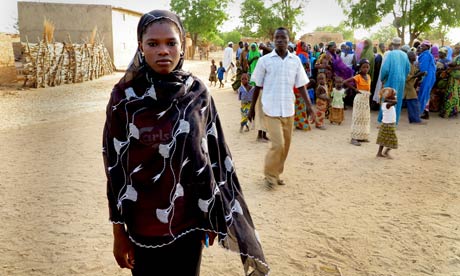
Nigeria's child brides: 'I thought being in labour would never end'

Though child marriage is prohibited under Nigerian law,
a toxic blend of routine and religion continues to ruin
young lives
MDG : Child bride in Nigeria : Zainab Oussman  refused, and stayed in schoo
Nigerian child bride activist Zainab Oussman, 16,
in Kwassaw village. At 14, she refused to marry,
instead staying in school.

Ibrahim Kanuma winces as he recalls the moment
a 63-year-old man asked him for his teenage
daughter's hand in marriage. The proposal was not
unusual in north-western Nigeria's remote, dust-blown
state of Zamfara, but he considered the suitor too old
for his only daughter, Zainab, 13.
"Even if he had been aged up to 50 – OK. But that old,
he'll soon die and leave her lonely," says the civil
servant in his peeling office in Gusau, the state
capital. To protect his school-aged child from the
crushing stigma of widowhood, Kanuma instead
gave his blessing to a union with a "reasonably aged"
 colleague – in his 40s – even though such a betrothal
is illegal.

For Kanuma and many others in northern Nigeria,
the recent outcry over child marriage is puzzling.
Zainab's marriage is prohibited under Nigeria's
Child Rights Act, which bans marriage or betrothal
before the age of 18. But federal laws compete with
age-old customs, as well as a decade of state-level
sharia law in Muslim states.
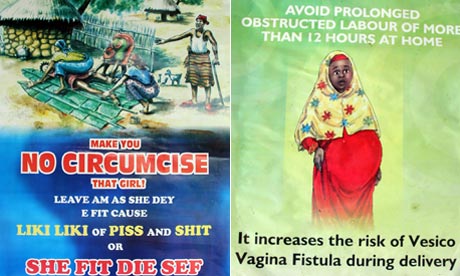
MDG : Posters about sexual health for women in Nigeria : VVF and FGM  
Warning posters about female circumcision and 
fistulas. 

"I wouldn't force my daughter to marry somebody she
doesn't like, but as soon as a girl is of age
[starts menstruating], she should be married,"
Kanuma says.

Four of the 10 countries with the highest rates of child
marriage are in west Africa's Sahel and Sahara belt. In
the years when rains or crops fail, so-called "drought brides"
– who bring in a dowry while being one fewer mouth to feed
– push numbers up dramatically.

But the practice came under scrutiny in July, when
legislators tried to scrap a constitutional clause that states
citizenship can be renounced by anyone over 18 or a married
woman, apparently implying womencan be married under 18.
The obscure ruling will have little direct impact on the one
in four rural northern Nigerian girls married off before they
turn 15, but it reveals
prevailing attitudes in a nation with acute gender disparity.


A successful vote was later derailed by senator Ahmed Yerima,
who in 2010 married a 13-year-old from Egypt. A former
Zamfara governor who
introduced a rigidly enforced version of sharia law in the north
in 2000, Yerima argued that a married girl was considered an
adult under certain interpretations of Islamic law. That prompted
outrage. "Does it then follow that the married girl who is
below 18, at election time, would be permitted to vote?" says
Maryam Uwais, a lawyer and child rights advocate in the
northern capital of Kano.

Other grassroot Muslim activists, however, fear the oxygen
of negative publicity trailing the high-profile Yerima, coming
most vocally from non-Muslims, could trigger a backlash among
conservative, rural Muslims. This would threaten painstaking
progress towards modernisation over the past decade.

In the week headlines erupted over Yerima, Aisha, nine, was
quietly rushed through the corridors of Zamfara's Faridat Yakubu
general hospital. Its cheerful cornflower blue walls belie stories of
the hidden horrors of early marriage. Aisha does not have the
words for what happened to her on her wedding night. Her husband,
she says, did something "painful from behind".

Nearby, Halima was on her third visit in three years. "I like it here.
It is the only time I ever see a television," she says. Just shy of 13,
the newlywed came under pressure to demonstrate her fertility.
"I thought [being in labour] would never end," she adds softly.

In the tradition of the rural Hausa people of the north, women are
expected to give birth at home. Crying out while in labour is seen as
a sign of weakness. But after three days close to death in her village,
Halima begged to be taken to a hospital. By the time her relatives
had scraped together enough to ferry her to the state capital, it was
too late.

The baby had died.

The prolonged labour left Halima with a fistula, which causes
uncontrolled urination or defecation. "Fistulas can happen to anyone,
but are most common among young women whose pelvises aren't at
full capacity to accommodate the passage of a child," says Dr Mutia,
one of two practising fistula surgeons in Zamfara.

Despite the obvious link, he is reluctant to blame child marriage for
Nigeria having the highest global rate of fistula. "The problem is not
early marriage. It is giving birth at home," he says.

Small victories

There have been small victories in reversing the ripple effects of
early and forced marriage, defined as forms of modern-day slavery
by the International Labour Organisation.

Fifteen years ago, Zamfara's statistics director, Lubabatu Ammani,
carried out a census to record the number of girls attending
secondary school in the state. The results were shocking: fewer than
4,000 girls were enrolled out of a population of 3.2 million.

"It was a combination of dropouts, early marriage and religious
misinterpretations," explained Ammani, who proposed creating a
female education board to help remedy the problem. "We asked all
the local emirs and found the main problem was that parents didn't
want girls who had hit puberty to be in co-ed schools."

Female enrolment in Zamfara is at its highest since independence
five decades ago, with 22,000 secondary school students. On most
days, Ammani visits wavering parents to encourage them to keep
their daughters in school.
Ammani welcomes the reawakened debate on child marriage but
warns of its limits: "The fact is, a lot of people [here], when they
hear the campaigning is by people from a different tradition or
religion, they won't agree with it."

Others are more blunt. Haliru Andi, who served as Yerima's top
aide while he led the call for sharia, bristles at the idea of interference
with his faith. "How I even use the toilet, how I share my time with my
family – everything is contained in my religion," he says in his
Persian-carpeted living room. "How, then, can I take instructions from
anybody who does not have a deep understanding of Islam?"

Cultural norms further muddy the issue. Posters outside Mutia's office
exhort against another disturbing practice related to child marriage.
In one,a woman is being forcibly restrained on a woven palm-frond mat.
An assistant grabs her legs; another sits on her chest, and yet another
reaches between her legs with a razor blade.

The scene shows a common recourse when a child bride refuses to sleep
with her husband, prompting her parents or in-laws to drag her to the  
wanzan, or traditional barber. "This traditional barber, he doesn't
understand anatomy. He thinks there's something obstructing the girl
down there, and that's whyshe fears her husband. So anything he sees,
he will just use his knife to cut it,"
Mutia explains. "They think they are helping."
None of the northern-based grassroots Muslim activists the Guardian
interviewedwanted to go on the record about child marriage – reflecting,
says one activist, the difficulties women face "going against the grain".

The storm of Twitter and online commentary has translated into a
handful of protests in the more liberal south, which is predominantly
Christian but also home to millions of Muslims.
In the tiny village of Rigasa, flanked by baobab trees and fields of millet,
Nafisa, 14, draws letters in the powdered maize she grinds every morning
for herself and her in-laws. A-B-C-D, she writes. It is all she remembers.
"My husband gets angry any time I asked him if I can take up my schooling
again, so I stopped asking. But my heart is in school," she says.

Labels: , , ,

Friday, August 02, 2013

Since Obusonjo Obasanjo Is A World Renowed Crook Who Pillaged Nigeria, Why Should Anyone Believe His Views On Robert Mugabe's Re-Election In Zimbabwe?!

Zimbabwe poll 'free and peaceful' say Obasanjo and SADC

Olusegun Obasanjo: "I have never seen an election that is perfect"

Zimbabwe - New Era?

Zimbabwe's elections were free and peaceful, the two leading African observer groups have said.
African Union mission head Olusegun Obasanjo dismissed complaints of fraud, while another observer urged all parties to "accept the hard facts".
A local monitoring group said earlier the poll was "seriously compromised".
President Robert Mugabe's party is claiming victory in the election, which has been dismissed by Prime Minister Morgan Tsvangirai as a "huge farce".
Justice Minister Patrick Chinamasa: "We [Zanu-PF] are going to have a landslide victory"
On Wednesday, voters were choosing a president, 210 lawmakers and local councillors. The results must be declared by the Zimbabwe Electoral Commission (Zec) no later than five days after voting day.
No presidential figures have been announced but the first official results from national assembly elections show that Mr Mugabe's Zanu-PF party is taking an early lead. However, the seats announced were mostly in Mr Mugabe's rural strongholds, correspondents say.
Zanu-PF spokesman Rugaro Gumbo predicted that Mr Mugabe, 89, - who is running for a seventh term - would get at least 70% of the vote in the presidential poll.
"We are expecting a landslide victory," he was quoted as saying in Zimbabwe's state-run Herald newspaper.
It is illegal to publish unofficial election results in Zimbabwe. Police have warned they would take action against anyone trying to leak early results.
Zanu-PF and Mr Tsvangirai's Movement for Democratic Change (MDC) have shared an uneasy coalition government since 2009 under a deal brokered to end the deadly violence that erupted after a disputed presidential poll the previous year.

Views from Zimbabwe press

The Herald (state-run) - 'The people have spoken':
Indications are President Mugabe will sweep to power with a colossal margin as his party scores a two-thirds majority in the National Assembly.
The absence of cases of violence has thrown MDC-T [Tsvangirai] and its handlers off kilter which is why they precariously hang onto trying to attack the voters' roll as if it is compiled at Zanu-PF headquarters.
It should be stated from the outset that the Registrar-General of Voters' Office falls under the Ministry of Home Affairs which was overseen by ministers drawn from Zanu-PF and MDC.
The Zimbabwe Electoral Commission is made up of commissioners chosen from lists submitted by the three parties in Government.
It thus comes as a surprise that today; MDC-T denies ownership of the electoral process it has been party to.
Daily News (privately-owned) - 'Please stop vote fraud':

In Hatfield, hundreds of street kids and youths were given voter registration slips and went on to vote and we are told this was prevalent throughout the country.
What will Zec do about this blatant vote theft?
What people now need is change and that is the reason why yesterday [Wednesday] most of them braved the chilly weather and woke up early to join long queues to exercise their fundamental right.
Their desire is to see a better Zimbabwe. People need to separate good from evil, light from darkness, suffering from prosperity and make a demarcation between history and the future.
People went out in large numbers to put an end to Mugabe's 33-year rule that was characterised by suffering.
'Heavy blow'

Speaking in the capital Harare on Friday, Mr Obasanjo, Nigeria's former president, said the elections were fair and free "from the campaigning point of view".
The former Nigerian president admitted that there were "incidents that could have been avoided", but he stressed that the 69 AU observers did not believe those irregularities could change the overall outcome of the poll.
At the same time, the AU mission expressed concern at the high number of voters turned away and those being assisted to vote - usually reserved for the illiterate or the infirm.
In a statement, it also noted that 8.7m ballot papers were printed - 35% more than the number of registered voters.
Shortly afterwards, monitors from the Southern African Development Community (Sadc) - which had 562 observers - described the elections as "free and peaceful" but said it was too early to call them fair.
"In democracy we not only vote, not only campaign, but accept the hard facts, particularly the outcome," said Sadc mission head Bernard Membe, according to the AFP news agency.
Mr Obasanjo's assessment sharply contrasted to that by the Zimbabwe Election Support Network (ZESN) - the largest group of domestic monitors with some 7,000 people on the ground across the country.
It said on Thursday that the elections were "seriously compromised", with as many as a million people being unable to cast their ballots.
The ZESN said potential voters were much more likely to be turned away from polling stations in urban areas, where support for Mr Tsvangirai is strong, than in President Mugabe's rural strongholds.

Zimbabwe election: Key facts

Zimbabweans wait to cast their votes in presidential and parliamentary elections in Harare, Wednesday 31 July 2013
  • About 6.4 million registered voters
  • Vote for president and parliament
  • Zanu-PF's Robert Mugabe and MDC's Morgan Tsvangirai are the main presidential contenders
  • Mr Mugabe, 89, is seeking to extend his 33-year rule
  • Mr Tsvangirai, 61, hopes to become president after two failed attempts
  • The poll ends the fractious coalition between Zanu-PF and MDC, which was brokered by regional mediators after disputed elections in 2008 that were marred by violence
  • First election under new constitution
The group also alleged significant irregularities before the poll. It said that 99.7% of rural voters were registered on the electoral roll in June compared with only 67.9% of urban voters.
But speaking to al-Jazeera, Mr Obasanjo questioned ZESN's conclusions, describing them as "not verifiable".
He said he was satisfied that the apparent anomalies between urban and rural voter registration had been explained by the registrar-general, who had the accurate figures for births and deaths.
Mr Obasanjo also said that Mr Tsvangirai's camp should have addressed concerns about the electoral roll before the vote - not after.
MDC member and Finance Minister Tendai Biti told the BBC that the assistance voting in rural areas was a "euphemism to say you have to vote for Zanu-PF under the guidance and watch of someone else".
"They [Zanu-PF] have stolen the election so much so that they are embarrassed at what they have done," Mr Biti added.
Still, Mr Obasanjo's assessment of the elections is a big boost for President Mugabe and a heavy blow for his opponents, the BBC's Andrew Harding in Johannesburg says.
It is unclear now how Mr Tsvangirai intends to fight on, our correspondent adds.
On Thursday, the prime minister said the elections were "null and void".
"Our conclusion is that this has been a huge farce... It's a sham election that does not reflect the will of the people."
Extra units - some in riot gear - have been deployed in Harare.
Under the electoral law, if no presidential candidate gains 50% of the ballots, a run-off will be held on 11 September.

Labels: , , ,

Wednesday, June 05, 2013

I'm Elated To Witness Nigerian President, Goodluck Johnathan, Continue To Grow Balls As He Battles Terrorist Group, Boko Haram.

Nigeria: Jail terms to tackle Islamist militancy

Nigeria has officially banned two militant Islamist groups, warning that anyone who helps them will face a minimum jail sentence of 20 years.
President Goodluck Jonathan declared Boko Haram and Ansaru to be terrorist groups, his office said.
The army has been waging an offensive against the militants in their northern strongholds since a state of emergency was declared last month.
The insurgency has killed about 2,000 people since 2009.
The activities of both Boko Haram and Ansaru would now fall under the Terrorism Prevention Act, Mr Jonathan's office said, in a statement.
It means that "any person who knowingly, in any manner, directly or indirectly", offers support to Boko Haram and Ansaru would be jailed for "not less than 20 years" if convicted, the statement added.

Boko Haram: Timeline of terror

  • 2002: Founded
  • 2009: Hundreds killed when Maiduguri police stations stormed; leader Mohammed Yusuf captured and killed
  • Dec 2010: Bombed Jos, killing 80 people; blamed for New Year's Eve attack on Abuja barracks
  • Jun-Aug 2011: Bomb attacks on Abuja police HQ and UN building
  • Dec 2011: Multiple bomb attacks on Christmas Day kill dozens
  • Jan 2012: Wave of violence across north-east Nigeria
  • April 2012: Deadly Easter church attack in Kaduna; ThisDay newspaper offices bombed
  • February 2013: French family kidnapped in Cameroon
  • May 2013: Heavily armed incursion into Bama town
On Monday, the US said it was offering rewards for information on Islamist militants in West and North Africa.
The highest reward of up to $7m (£4.6m) is for information leading to the location of Boko Haram leader Abubakar Shekau, the state department said.

Boko Haram launched the insurgency in 2009, carrying out a wave of bombings and assassinations in north and central Nigeria.
Ansaru, which is suspected to be an off-shoot of Boko Haram, joined the insurgency in 2012, taking foreigners hostage.
It said it had killed seven European and Middle Eastern nationals abducted in February 2012 in the northern Bauchi state.

Last month, Mr Jonathan declared a state of emergency in Borno, Yobe and Adamawa states, the three main strongholds of the Islamist groups.
It led to the army launching a ground and air assault to flush out the militants.
Rights groups repeatedly accuse government troops of targeting innocent people after falsely accusing them of backing the militants.
The army denies the allegation.

Labels: , , , ,

Tuesday, May 14, 2013

At Long Last, Nigeria President, Goodluck Johnathan, Starts To "Grow Some Balls" Against Nigeria's Al Qaeda, Boko Haram. Good For Him.

Nigerian president declares state of emergency

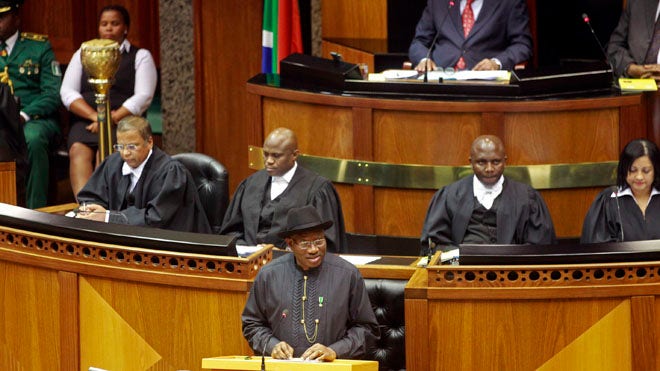
  • May 7, 2013: Nigerian President Goodluck Jonathan, center, makes a speech in the South African Parliament in Cape Town. On May 14, 2013, President Goodluck Jonathan declared a state of emergency in Nigeria. (AP)


Nigeria's president declared a state of emergency Tuesday across the country's troubled northeast, promising to send more troops to fight an increasingly violent Islamic insurgency.
Islamist sect Boko Haram -- whose name means "Western education is sacrilege" in the Hausa language of Nigeria's north -- has intensified its attacks on security forces and government targets in its northeast stronghold this month, prompting President Goodluck Jonathan to declare a state of emergency in certain states.
 
Last week, dozens of Boko Haram fighters in buses and machine gun-mounted trucks laid siege to the town of Bama, in Borno, killing 55, mostly police and other security forces, and freeing more than 100 prison inmates. Days earlier, scores were killed in the fishing village of Baga, also in Borno, on the shores of Lake Chad, when troops from Nigeria, Niger and Chad raided it looking for Islamists. Local residents said soldiers were responsible for many civilian deaths.
 
 President Jonathan, speaking live on state radio and television networks, also warned that any building suspected to house Islamic extremists would be taken over in what he described as the "war" now facing Africa's most populous nation. However, it's unclear what the emergency powers will do to halt the violence, as a similar past effort failed to stop the bloodshed.
"It would appear that there is a systematic effort by insurgents and terrorists to destabilize the Nigerian state and test our collective resolve," Jonathan said.
Jonathan said the order will be in force in Adamawa, Borno and Yobe states. He said the states would receive more troops, though he will not remove state politicians from their posts. Under Nigerian law, the president has the power to remove politicians from their posts and install a caretaker government in emergency circumstances.
 
The president's speech offered a stark vision of the ongoing violence, often downplayed by security forces and government officials for political reasons. Jonathan described the attacks as a "rebellion," at one point describing how fighters had destroyed government buildings and "had taken women and children as hostages."
"Already, some northern parts of Borno state have been taken over by groups whose allegiance are to different flags than Nigeria's," Jonathan said.
The president later added: "These actions amount to a declaration of war and a deliberate attempt to undermine the authority of the Nigerian state and threaten (its) territorial integrity. As a responsible government, we will not tolerate this."
 
This is not the first time Jonathan has implemented emergency measures. In December 2011, Jonathan declared a state of emergency over some limited local government areas in the states, after a church bombing blamed on Boko Haram killed 37 people, but he lifted it in July last year. This new decree, however, is more drastic and covers whole states, likely to cause conflict with powerful governors sitting in those states, as well as the political opposition. On Monday, the Nigeria Governors' Forum, representing the governors of Nigeria's 36 states, issued a statement warning Jonathan against imposing emergency rule in response to the insurgency.
According to an Associated Press count, more than 1,600 people have been killed in attacks by Islamic insurgents since 2010. Recently, Nigeria's military has said Islamic fighters now use anti-aircraft guns mounted on trucks to fight the nation's soldiers, likely outgunning the country's already overstretched security forces.
 
Boko Haram has said it wants its imprisoned members freed and strict Islamic law adopted across the multiethnic nation of more than 160 million people. It has produced several splinter groups, and analysts say its members have contact with two other Al Qaeda-linked groups in Africa.
The Islamic insurgency in Nigeria grew out of a 2009 riot led by Boko Haram members in Maiduguri that ended in a military and police crackdown that killed some 700 people.
The group's leader died in police custody, in an apparent killing. From 2010 on, Islamic extremists have engaged in hit-and-run shootings and suicide bombings. Recently, however, they've begun to use military-grade weapons, some of which they apparently seized from Nigerian military stockpiles.
Nigeria's military and police also have been repeatedly accused by human rights activists and others of torturing and summarily killing suspects, as well as burning down civilian homes and killing civilians in retaliation for militant attacks.
 
The latest incident, in a fishing village in Borno state along the shores of Lake Chad, saw at least 187 people killed and there are allegations that soldiers are responsible. While the military has denied repeatedly that it attacks and kills civilians, the country's armed forces have a history of committing such assaults.
 
Separately on Tuesday, an official in the central Nigerian state of Kaduna said gunmen armed with assault rifles and suspected to be Hausa-Fulani cattle herders killed 11 people in a village there. And in Benue state, a government spokesman said an attack blamed on Hausa-Fulani cattle herders there killed at least 12 people.

Labels: , , ,

Friday, May 03, 2013

In Nigeria, A Lot Of Criminals Who Need To Be Shot Are Instead Celebrated. What A Banana Republic!


Terror and Amnesty in Nigeria


In Lagos, Nigeria, where I live, people have been posing a counterfactual: How would Americans react if the Unites States pardoned the terrorists behind 9/11 or the Boston Marathon bombing? The Nigerian government has announced that it is preparing to offer amnesty to an unknown number of militants associated with the Boko Haram Islamist group, an entity responsible for the deaths of more than two thousand Nigerians in recent years. President Goodluck Jonathan has set up a committee that includes scholars, lawyers, and political and military leaders to examine what an amnesty process would look like.
 
Yet last week, in a massacre that was as much the fault of the heavy-handed military as Boko Haram, over two hundred people in the town Baga, on the shores of Lake Chad, in northern Nigeria, were killed in a battle between the two sides—and hundreds of houses were destroyed.
“There is no way this violence can end and we achieve peace if the government has maintained a double standard of voicing out support for dialogue and at the other time sabotaging it,” Shehu Sani, a human-rights lawyer with the Civil Rights Congress of Nigeria, said recently in a statement. Sani was named to the committee, but rejected the idea of participating.

Civil and religious leaders in the predominately Muslim north of Nigeria have long advocated for amnesty for Boko Haram—and the government has long rejected their plea. Just last month, President Jonathan dismissed granting amnesty to Boko Haram, calling the move impossible because the group’s members were essentially faceless, “operating under a veil.” That hasn’t changed. It’s not evident why Jonathan has changed his mind, but those who live in central and northern Nigeria and who have borne the brunt of Boko Haram’s attacks—including people named to the amnesty committee—wonder if this last-ditch effort will be enough. (Boko Haram itself voiced opposition to the idea of a negotiated amnesty.)

Boko Haram claims to be working for a purer, Islam-driven society, a contrast to the corrupt patronage of the federal and state governments. It has recruited college graduates and political thugs—young men used by politicians to do their dirty work and set off violence after lost elections. They have robbed banks and bombed police stations with homemade I.E.D.s, acquiring guns and cash as they have bounced from the sponsorship of one northern politician to another, politicians who often end up denouncing the group after its members turn on them.
When, in 2009, Abubakar Shekau, Boko Haram’s leader, was captured and later killed in police custody, the group began its war on civilians. Pastors, Christians, openly critical imams, and Muslims—none have been immune. And all the while, the identities of the group’s members and followers (except for their spokespersons and leaders) have stayed concealed. Some may have scared their neighbors into silence while others live essentially off the grid, Bawa Abdullahi Wise, a security analyst who studies Boko Haram, told me. “Their mission has been to create chaos and make people feel that the country is ungovernable since they already mistrust their leaders. They want to force leaders to step down or concede to demands to change direction of leadership.” Amnesty, it appears, would only be a Band-Aid.

Last month, the group released a French family of seven that it was holding in what appeared to be a desert-like patch of the north, after it had demanded prisoners in exchange. The hostages were taken, said the group, in retaliation for Nigeria’s leading role in a military intervention targeting Islamists in northern Mali. The Nigerian government did not release any prisoners, though the Cameroonian government may have done so (and paid, with France, a ransom). But, strangely, a Boko Haram “factional leader” has claimed to reporters that he ordered the family freed as a good-faith gesture in the interest of the amnesty process.

Sani, the human-rights lawyer, has been petitioning the International Criminal Court to investigate alleged atrocities committed by youth leaders, politicians, and retired Army personnel in the lushly green and mountainous region of central Nigeria called Plateau State, the site of havoc between Muslims and Christians after every election in the past decade. In Plateau, Muslim-Christian tensions have been exacerbated by the presence of Boko Haram, which has bombed a number of churches and markets, and driven the two communities, which previously mixed freely, further apart.
“This crisis has been lingering for so many years now, and the government has not produced any fruitful solutions to address it. I do not think the government is serious about investigating the violence,” Sani told me.

Central and northern Nigeria exemplify what happens when a country abandons certain regions so completely, failing to provide adequate education, social services, development, employment, and transparent political culture: extreme results rise up. In Plateau, I have spent time with a Christian who makes and sells guns, a reflective twenty-two-year old man with melancholic eyes who once thought he would go to college and start his own business, until his hometown became an undeclared war zone.

A 2009 amnesty program for militants in Nigeria’s oil-drenched Niger Delta mostly succeeded in quelling conflict there. Militants were pleased with the monetary settlement that aimed to make up for the immense oil profits the region has never seen, despite the pollution that energy companies are dumping in the area. Coming full circle, those same Niger Delta militants released a statement in April saying that, beginning in the end of May, they will attack mosques, Muslim institutions, and imams that they deem hostile, supposedly in order to “save Christianity in Nigeria from annihilation.” Who will save Nigeria from itself?

Alexis Okeowo is a journalist based in Lagos; she received support for the reporting in this post from the International Reporting Project Fellowship in Global Religion Reporting.
Above: President Goodluck Jonathan, center right, standing next to Borno State Governor Kashim Shettima, center left, in March. Photograph by Wole Emmanuel/AFP/Getty.

Labels: , , ,

Monday, May 02, 2011

A Letter For The Self Induced IGNORAMUSES (Is There Such A Word?) -- Read: "Birthers" -- In Our Midst.

President's citizenship

I am glad the President finally showed his birth certificate. Although this should put an end to the “birther” movement, I am sure there will still be zealots that say he modified it in Photoshop.

I never doubted the President's origin of birth. However, this should have never been an issue in the first place. According to Title 8, Section 1401 of the U.S. Code, there are 10 definitions of what is a “natural born citizen.” While one is being born on the soil of the United States, there are several other ways to be considered a natural born citizen. Number 7 states: “A person born outside the geographical limits of the United States and its outlying possessions of parents one of whom is an alien, and the other a citizen of the United States who, prior to the birth of such person, was physically present in the United States or its outlying possessions for a period or periods totaling not less than five years, at least two of which were after attaining the age of 14 years.”

This means even if he had been born in Kenya, he would have still been considered a natural born citizen because his mother was born in Kansas and did live at least five years in the U.S. and two years after attaining the age of 14. No one has disputed her citizenship status and thus no matter what country her son was born in, he is still a natural born citizen.

While the ignorance of the American people when it comes to civics has been well-documented, what I want to know is why did not one media outlet spend five minutes looking up this definition in the first place? His citizenship status was never in doubt; neither is the ignorance of many Americans.

Labels: , ,

Sunday, December 05, 2010

Pam Platt Reveals Kentucky's "Whirlwind Of [ABJECT] IGNORANCE". IT Is A MUST Read.


(Y'all don't forget, the Scopes trial, depicted above, took place, across our border, in Tennessee!)

Pam Platt | A whirlwind of ignorance
Creationism park a step backward

Several years ago, on my first trip to Mammoth Cave, my fellow tourists noticed a sign on the side of the two-lane road leading to the national park. The reaction of one of them was so severe I thought I was going to have to stop and do CPR. As he clapped his hands over his mouth and flopped around in his seat, I swung the car back around to get a better look at what did this to him.

There it was:

Golgotha Fun Park.

As I recall, it was a simple sign, perhaps even hand-painted. Since we were there, we got out to take a look around and to let my friend get some air. Crickets. Golgotha looked closed for business.

No, my friend did not find anything funny about crucifixion. But he did find the idea of a putt-putt “fun park” borrowing the name of the place of Jesus' horrendous suffering and death one of the oddest things he'd seen in a lifetime dedicated to noticing the world's oddities — heck, he'd even been to Roswell — but this literally took his breath away. (I found an online review of the park, as it was in flush times www.roadsideamerica.com/story/3342.)

Having seen what was left of Golgotha and having read about its glory days, I guess I shouldn't have been surprised at the news last week that Kentucky could be the home of a real E-ticket creationism theme park, this big-budget one built around Noah, the ark and the great flood. And why not? The almost-new Creation Museum in Northern Kentucky has been a huge hit, outperforming visitor projections, never mind how much of its information flies in the face of established science and the history of the world. (Which is changing as we speak. See NASA's breaking news from last Thursday — in which the agency announced the discovery of a microbe which “changes the fundamental knowledge about what comprises all known life on Earth,” and added potential for discoveries of extraterrestrial life. Wonder how creation museums and parks and the fundamentalists who support them will deal with that?)

With Golgotha in the rearview, the Bluegrass State would seem to be fertile ground for this grander proposal. Indeed, the perfect storm of election-year pandering, hinky political wind shears and a jittery economy seems to have snatched the cloak of dignity from our governor, who banged the drum, shouted to the heavens and rolled out the welcome wagon, all spangled with tax incentives, for the project and its investors — which is pretty much the biggest problem I have with this particular project.

This is America, which means people can believe whatever they want to believe. If they want to believe that Adam rode Western on a brontosaurus and Eve rode side-saddle on a stegosaurus (hey, those pesky plates), despite the eons that science tells us separate the 'saurs from the human folk, and spend good money on going to a place that peddles this fairy tale, that's their business. Don't go if you don't like.

But using taxpayer money to support a park that might also support these same themes, well, that's a whole other story and one that surely will be taken up with lawyers representing different points of view. I say let the investors homosapien up with their own cash if that's what they're selling.

But I also have a bigger problem with what this project represents, and that problem goes beyond Kentucky and the inevitable jokes that are being made about us because of this proposed park.

As I said earlier, this is America, which is becoming fertile ground, too. When people talk about American exceptionalism, I'm sure they don't mean this:

Did you know that only 39 percent of Americans believe in the theory of evolution? That 36 percent have no opinion either way? That 25 percent don't believe in it? That 40 percent of people who go to church every week don't believe in evolution? That people with more education are more likely to believe in Darwin's theory, and those with high school educations or less are more likely to have no opinion or don't believe in it? (Gallup)

Did you know that the U.S. ranked 18th of 36 nations whose high school students graduate on time? South Korea is No. 1 with 93 percent; the U.S. is in the middle of the studied pack with 75 percent. (Source: Organization for Economic Cooperation and Development)

Did you know that, according to 2007 figures, with the half a trillion dollars spent thus far on the Iraq war, the U.S. could have provided 21.5 million full four-year scholarships to public universities, 7.6 million new public school teachers and 58.7 million chances for children to attend Head-Start? (education-portal.com)

Did you know that the American Library Association and other groups are seeing a rise in complaints about and challenges to literature used in advanced, honors or college-level courses, and that they have noticed an increase in organized, rather than solo, efforts, and that these challenges occur across the U.S.? (USA Today)

Did you know that a book that says the Grand Canyon was formed by Noah's flood and is only a few thousand years old is still on sale at Grand Canyon National Park, despite geological consensus that the canyon contains rock formations that are 2 billion years old and despite concerns raised by park staff, members of the public, scientists and geologists that the book defies the mission of the National Park Service to present accurate and scholarly information based on science? Did you know that the sale of the book at the park has been under review by the U.S. Department of Interior for the past six years? (Public Employees for Environmental Responsibility)

Did you know that a conservative majority of members of the Texas State Board of Education changed or amended school social studies textbooks in hundreds of ways, including: to question the American separation of church and state and whether the founders were committed to a secular society, to remove Thomas Jefferson as an influential political philosopher (he came up with “separation of church and state”) for St. Thomas Aquinas and John Calvin, to study the “unintended consequences” of Affirmative Action and Title IX, to replace “capitalism” with “free-enterprise system” and to describe the U.S. government as a “constitutional republic” rather than “democratic”? Did you know these changes could spread far beyond Texas, because of the number of school textbooks published in that state? (The Associated Press; The New York Times; PBS)

So let us not consider Kentucky, and its real and perceived backwardness, apart and separate from our 49 fellow states and from the whole of the country. Yes, the proposed creationism park reinforces unfortunate stereotypes about Kentucky and Kentuckians, some of them true, but the points I assembled about the United States ought to be provoking a lot of questions about who Americans are and where, exactly, we're heading.

All of which produced the occasion to re-watch the DVD I own of a movie classic, “Inherit the Wind,” which basically tells the story of the trial of John Scopes, a public high school teacher who was accused of violating a Tennessee state law that forbade the teaching of evolution. The trial took place in 1925, the movie was released in 1960, and it — like its subject matter — stands the test of time as an elegant and eloquent examination of the friction between closed and open minds. It also brings great humanity to the subject, which would be welcome in today's conversation about all manner of topics. (It contains the loveliest expression I've encountered of how “God” and “evolution” or “science” do not have to be oxymoronic entities: “Man wasn't just planted here like a geranium. Life came from a long miracle … it didn't just take seven days.”)

My take-away point of this movie — and all the points I assembled in pursuit of the bigger problem I have with what the creationism park represents — comes in several lines of dialogue spoken by Spencer Tracy in the Clarence Darrow role:

“Can't you understand? If you take a law like evolution and you make it a crime to teach it in the public schools, tomorrow you can make it a crime to teach it in the private schools? And tomorrow you may make it a crime to read about it. And soon you may ban books and newspapers. And then you may turn Catholic against Protestant, and Protestant against Protestant, and try to foist your own religion upon the mind of man. If you can do one, you can do the other. Because fanaticism and ignorance is forever busy, and needs feeding. And soon, your Honor, with banners flying and with drums beating we'll be marching backward, BACKWARD, through the glorious ages of that Sixteenth Century when bigots burned the man who dared bring enlightenment and intelligence to the human mind.”

That backward march may not be the outcome we expect from underfunding education, disregarding science, shaping textbooks to reflect specific political philosophy or providing tax incentives to creationism theme parks. But we must at least consider the results we live with now.

I may be getting my gusts confused, but I believe we're sowing the wind and we will reap the whirlwind, if we aren't already.

Pam Platt is an editorial writer and columnist for the Courier-Journal. Her column appears in the Sunday Forum. Call her at (502) 582-4578

Labels:

Monday, October 25, 2010

Leonard Pitts: "The Public Face Of Ignorance", Christine O'Donnell.

The public face of ignorance
By Leonard Pitts

“Congress shall make no law respecting an establishment of religion, or prohibiting the free exercise thereof …”

U.S. Constitution

First Amendment

That's for Christine O'Donnell.

“Where in the Constitution is separation of church and state?” she asked last week, drawing gasps and astonished laughter from an audience of law school students.

Chris Coons, her Democratic opponent for a Delaware Senate seat, replied that in asking the question, O'Donnell shows “fundamental misunderstanding of what our Constitution is. … The First Amendment establishes the separation …”

O'Donnell wasn't buying it. “The First Amendment does? … So you're telling me that the separation of church and state, the phrase ‘separation of church and state,' is found in the First Amendment?”

It was a bizarre exchange that permits but two conclusions. One, O'Donnell is frighteningly ignorant, particularly for a woman who claims constitutional expertise and aspires to the Senate. Or, two, assuming you buy her after-the-fact explanation (she was merely observing that the phrase “separation of church and state” is not in the First Amendment), she is terribly disingenuous.

After all, the framers' intention to isolate church from state and vice versa is evident in the amendment's wording and is a matter of long-settled law, besides. The phrase “freedom of expression” doesn't appear in the First Amendment, either. Would O'Donnell question that right, too?

Maybe I shouldn't ask.

While one is appalled by O'Donnell's ignorance and/or disingenuousness, one is not surprised. The capacity to be surprised by her died long ago, victim of revelations that she once “dabbled” in witchcraft. And was the subject of an IRS lien. And said people with AIDS brought the disease upon themselves. And was sued for nonpayment by her college and mortgage company. And was cited eight times by the Federal Elections Commission. And thinks scientists have created mice with human brains.

That this woman is a major party candidate for national office, that she is among the brightest stars of a constellation of like-minded cranks — some of them already in office — tells you all you need to know about this moment in our political life. Welcome to the United States of Amnesia.

Somehow we have forgotten the lesson we spent most of the last decade learning at ruinous cost, that faith-based governance, foreign policy by gut instinct, choosing leaders on the basis of which one we'd most like to watch television with, simply does not work.

Some say this is a conservative revolution, but this is no conservatism Ronald Reagan or Barry Goldwater would have recognized. At least their ideology adhered to an interior logic. This ideology adheres to a perverse “illogic” that posits that the less you know, the more authentic you are. So what triumphs here is not conservatism but rather, mediocrity. The Know Nothings and Flat Earthers are ascendant.

But intellect matters. Knowledge is good. And what's it tell you that that point even needs to be made?

In a recent debate, O'Donnell was asked to name a modern Supreme Court decision to which she objects. “Oh, gosh,” she said. “Give me a specific one, I'm sorry. … Right off the top of my head, I know that there are a lot, but I'll put it up on my Web site, I promise you.”

Some of us are reminded how candidate George W. Bush kept calling Greeks “Grecians.” Some of us remember how the electorate shrugged off that evidence of looming gaps in his basic knowledge because he had a folksy way and twinkling eyes. Some of us remember how that came out.

Others apparently don't. Others are ready to travel that road again. It brings to mind an old saying: we get the leaders we deserve.

You and I better hope that's not true.

Leonard Pitts is a columnist for the Miami Herald. His e-mail address is lpitts@miamiherald.com.

Labels:

Friday, January 01, 2010

Starting The New York With PATHETIC And GREEDY Preachers, Who Will Say ANYTHING To Justify Themselves. Jesus WARNED Us Of FALSE PROPHETS, Didn't He?


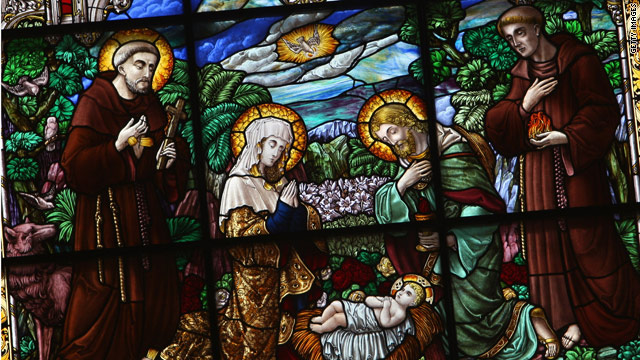
- Each Christmas, Christians tell stories about the poor baby Jesus born in a lowly manger because there was no room in the inn.

But the Rev. C. Thomas Anderson, senior pastor of the Living Word Bible Church in Mesa, Arizona, preaches a version of the Christmas story that says baby Jesus wasn't so poor after all.

Anderson says Jesus couldn't have been poor because he received lucrative gifts -- gold, frankincense and myrrh -- at birth. Jesus had to be wealthy because the Roman soldiers who crucified him gambled for his expensive undergarments. Even Jesus' parents, Mary and Joseph, lived and traveled in style, he says.

"Mary and Joseph took a Cadillac to get to Bethlehem because the finest transportation of their day was a donkey," says Anderson. "Poor people ate their donkey. Only the wealthy used it as transportation."

Many Christians see Jesus as the poor, itinerant preacher who had "no place to lay his head." But as Christians gather around the globe this year to celebrate the birth of Jesus, another group of Christians are insisting that Jesus' beginnings weren't so humble.

They say that Jesus was never poor -- and neither should his followers be. Their claim is embedded in the doctrine known as the prosperity gospel, which holds that God rewards the faithful with financial prosperity and spiritual gifts.

A clash of gospels?

The prosperity gospel has attracted plenty of critics. But popular televangelists such as the late Oral Roberts, Kenneth Hagin and, today, Creflo Dollar have built megachurches and a global audience by equating piety with prosperity.

The prosperity gospel, however, clashes with the traditional depictions of Jesus as poor. That's because the traditional image of Jesus as destitute is wrong, says the Rev. Tom Brown, senior pastor of the Word of Life Church in El Paso, Texas.
"I believe he was the richest man on the face of the earth because he had God as his source."
--Rev. Tom Brown, pastor of Word of Life Church, El Paso, Texas

The proof, he says, is scattered throughout the New Testament. One example: The 12th chapter of the Gospel of John says that Jesus had a treasurer, or a "keeper of the money bag."

"The last time I checked, poor people don't have treasurers to take care their money," says Brown, author of "Devil, Demons and Spiritual Warfare."

A debate over the economic status of Jesus may seem nonsensical to some. Does it really matter whether Jesus was rich or poor?

It matters to people like Luke Timothy Johnson, a prominent New Testament scholar and author. He says that a rich Jesus is a distortion of history and a threat to one of Christianity's core teachings: God's identification with the poor.

"If Jesus reveals God, there is something powerful about God appearing and working among the poor," says Johnson, a New Testament professor at Emory University's Candler School of Theology in Atlanta, Georgia.

"Jesus' lifestyle is not of one in a gated community or a corporate office," says Johnson, a former Benedictine monk. "You don't have to go through a security gate to get to Jesus. People touch him. He reached out and touched children. His accessibility is one of the most powerful messages of Christianity. In Jesus, God is with us, and the majority of us are poor."

'The poor won't follow the poor'

Some prosperity preachers extract a different message from the same biblical texts. Brown, the El Paso minister, says he doesn't say that Jesus was rich because he wants to give people an excuse to live self-indulgent lives. He wants people to understand that Jesus used his material and spiritual riches to help people -- and so should they.

Brown says Jesus' own words prove that he wasn't poor.

"Jesus said you will always have the poor, but you will not always have me," Brown says. "Jesus did not affirm himself as being part of the poor class...

"I believe he was the richest man on the face of the earth because he had God as his source," Brown says.

Jesus' wealth is evident even in the Gospel accounts of his execution, some pastors say.

The New Testament reports that Roman soldiers gambled for Jesus' clothing while he hung on the cross. They wouldn't gamble for Jesus' clothing unless it was expensive, Anderson says.

"I don't know anybody -- even Pamela Anderson -- that would have people gambling for his underwear," Anderson says. "That was some fine stuff he wore."

Anderson says Jesus never would have had disciples or a large following if he was poor. He would not have been able to command their respect.

"The poor will follow the rich, the rich will follow the rich, but the rich will never follow the poor," Anderson says.

Twisting scripture for personal gain?

Johnson, the Emory University New Testament professor, calls Anderson's argument "completely illogical."
The only way you can make Jesus into a rich man is by advocating torturous interpretations and by being wholly naive historically.
--Bruce W. Longenecker

"So Martin Luther King must have been a millionaire," he says. "Crowds followed Siddhartha Buddha and he was poor. And mobs followed Mahatma Gandhi, and Gandhi wore a diaper, for God's sake."

The argument that Jesus was wealthy because the soldiers gambled for his clothes at his crucifixion doesn't makes historical sense, either, says Johnson, author of "Among the Gentiles: Greco-Roman Religion and Christianity."

"Crucifixion was the sort of execution carried out for slaves and for rebels," Johnson says. "It wasn't an execution for wealthy people."

A Baylor University religion professor who specializes in the study of the poor in the Greco-Roman world also says there is "no way" that Jesus could be considered wealthy.

Bruce W. Longenecker says life in Jesus' world was brutal. About 90 percent of people lived in poverty. A famine or a bad crop could ruin a family. There was no middle class.

"In the ancient world, you were relatively poor or filthy rich, there's very little in-between," says Longenecker, author of "Engaging Economics: New Testament Scenarios and Early Christian Reception."

The New Testament is full of parables where Jesus actually condemns the rich and praises the poor, Longenecker says. In the sixth chapter of the Gospel of Luke, Jesus actually curses the rich, he says.

"The only way you can make Jesus into a rich man is by advocating torturous interpretations and by being wholly naive historically," Longenecker says.

Anderson, the Arizona pastor, doesn't buy that argument. He says the church has actually been damaged by teaching that Jesus was poor. God wants his followers to be rich, not for selfish gain, but to help others in need and spread the gospel.

When he first preached that Jesus wasn't poor to his church, Anderson says he "ruffled some feathers."

Now, he says, his church has 9,000 members and a global ministry.

"That's so pathetic, to say that Jesus was struggling alone in the dust and dirt," Anderson says. "That just makes no sense whatsoever. He was constantly in a state of wealth."

Editor's note: H/T: CNN

Labels: , , , ,

Sunday, May 11, 2008

Now Do You STILL Wonder Why The World Ignores Appalachia?