Google
 
Web Osi Speaks!

Thursday, May 08, 2014

Who Is Boko Haram's Leader? Watch Video.

Tuesday, January 14, 2014

The Rights Of The People In A Banana Republic, Like #Nigeria!

the one thing that distinguishes a banana republic, like #nigeria, from any other, is the right of the people to bear arms.

people in a banana republic have no such universal god given rights, as their government denies it to them, lest the people overthrow them!!

Labels: ,

Monday, January 13, 2014

U. S. Issues Travel Warning To Banana Republic Of #Nigeria! Ignore It At Your Peril!!

US: Nigerian Islamic Uprising Could Spread

An alarming U.S. travel advisory warns Nigeria's Islamic uprising could expand out of the north and counsels against travel to 16 of the West African nation's 36 states, saying Americans have suffered violent crimes from kidnappings and rape to home invasions.

The advisory says nine foreign nationals including Americans died last year in kidnappings in southwest Nigeria, three of them killed by their captors during military-led rescue raids.

The advisory posted at the U.S. State Department website and dated Jan. 8 tells citizens to expect little help from law enforcers known for harassing and shaking down foreigners and Nigerians at checkpoints.

It says U.S. missionaries in northern Nigeria have received "night letters" — covertly distributed specific written threats to their safety.

Pointing to possible targets of extremists, it says U.S. citizens should be particularly vigilant around government security facilities; churches, mosques, and other places of worship; locations where large crowds gather such as hotels, clubs, beer parlors, restaurants, markets and shopping malls; and all other areas frequented by expatriates and foreign travelers.

Thousands of people have been killed in a 4-year-old uprising by the Boko Haram terrorist network based in northeast Nigeria, many more Muslims than Christians, which continues despite an 8-month-long state of emergency that deployed thousands of troops to three states covering one-sixth of the country.

"Late 2013 saw an increase in Boko Haram attacks and clashes with Nigerian government security forces in northern Nigeria," the travel advisory says. "Boko Haram is known to descend on whole towns, robbing banks and businesses, attacking police and military installations, and setting fire to private homes."

It warns "U.S. citizens should be aware that extremists could expand their operations beyond northern Nigeria to other areas of the country." Boko Haram already operates in neighboring Chad, from which it kidnapped a French priest who was released earlier this month, and militants from Chad, Niger and Cameroon have been reported fighting alongside Boko Haram in Nigeria, raising fears the rebellion could also spread beyond Nigeria's borders.

The United States advises against all but essential travel to all 13 northern and central-northern Nigerian states as well as central Plateau state, for years the site of deadly ethnic-religious clashes, and the oil-rich southwestern states of Delta and Bayelsa, on the Gulf of Guinea where piracy is on the rise and militancy by activists demanding a bigger share of oil riches from a government embroiled in numerous corruption scandals.

Kidnappings of foreigners and attacks against Nigerian police forces in the Niger Delta region and in Lagos State, home to the commercial capital Lagos city, continue to be a danger, it says. "Criminals or militants have abducted foreign nationals, including U.S. citizens, from offshore and land-based oil facilities, residential compounds, and public roadways."

It adds that international companies and local authorities assert that the number of kidnapping incidents throughout Nigeria is underreported.

And home invasions "remain a serious threat," with armed robbers getting into even heavily guarded compounds.

"Violent crimes occur throughout the country," the advisory says. "U.S. citizen visitors and residents have experienced armed muggings, assaults, burglaries, armed robberies, carjackings, rapes, kidnappings, and extortion."

For more, go to: http://travel.state.gov/content/passports/english/alertswarnings.html

Labels: ,

Monday, December 23, 2013

In Banana Republic Of Nigeria, Everything Invites Fraud, Including The Churches!

In Nigeria, Miracles Compete With Modern Medicine
End-of-life care is a tough sell, one doctor says, “because everybody wants a cure.”

An assistant pastor at Celestial Church of Christ leads the congregation in a bout of "deliverance"—prayer against spiritual attacks. (Rowan Moore Gerety)
IBADAN, Nigeria — Marcus Chukwu was having a hard time coming to terms with the idea that he should refrain from evangelizing to a patient on his deathbed. “Religion is always effective, when the patient gets to the end of the road,” said Chukwu, who works as a nurse at an Anglican hospital in the southwestern Nigerian city of Ibadan. “When you are seeking medical help, and you know there is nothing left to do, then the next step is God; even a Muslim, in that situation, 70 percent of them will go to church.”

Chukwu and a handful of colleagues were gathered around a horseshoe of folding tables at the Center for Palliative Care in Ibadan, a cream-colored stucco bungalow that houses Nigeria’s oldest hospice program, established in 2007. The occasion was a three-day “Training for Carers”, which for the first time included a session on the role of spirituality and religion in end-of-life care. As an oversized fan hummed in one corner, Chukwu and other caregivers working for local religious organizations went over the basics and boundaries of palliative care.

Life-threatening illness can bring anyone face to face with the supernatural. In Nigeria, though, the supernatural peers out from posters and billboards everywhere. It invites you to attend “Miracle Arenas” and “Anointing Revivals,” and reminds you in block letters on hospital walls, “We care, God cures.” Nigeria is roughly 50 percent Christian, and an increasing number of the faithful are “Renewalists,” a subset of Protestant Christianity including Pentecostal and so-called Charismatic churches, whose adherents believe in God’s ongoing intervention in daily life. This is thought to occur through the physical presence of the Holy Spirit, which possesses believers and wards off illness and all manner of misfortune.

In Nigeria, the supernatural peers out from posters and billboards everywhere.
For these reasons, Nigerians, who attend church at rates that are among the highest in the world, often echo the words of their pastors when faced with a terminal diagnosis. “It's not my portion, in Jesus’s name,” they declare. To say anything else would be to cast doubt on God’s power. That makes delivering end-of-life care difficult—particularly in a region, sub-Saharan Africa, where faith-based organizations administer 40 percent of hospitals and clinics.

The growth of Renewalist Christianity in Nigeria mirrors a trend throughout sub-Saharan Africa, and indeed much of the world. Renewalists represented just 6 percent of global Christendom in 1970; today, they account for one in four Christians worldwide, or more than 500 million people. In Nigeria, that increase has been spurred along by religious services that attract more people than the Super Bowl and showcase the power of miracles. While I was in Lagos, evangelists stood at busy intersections in neon-green vests advertising the “Only God can do this” crusade, to be held by the Lord’s Chosen Church the following week. The church’s general overseer billed the two-day gathering as a place where “problems that have defied solution will … receive solution.”

The challenge for Nigerian doctors providing palliative care, then, is to make the case for treatment that is explicitly not about solutions, or at least not about the sort of solutions you encounter at a Christian crusade. O.A. Soyannwo, an anesthesiologist who founded the Center for Palliative Care, says it’s difficult to persuade patients that some diseases can only be managed. “Everything about palliative care is new, because everybody wants a cure,” she notes.

If the country’s radio and television programming is any indication, Nigeria is a place where miracles happen every minute: HIV, tuberculosis, diabetes, and cancer melt away at church services every Sunday and at all-night prayer vigils on Fridays.

Across town from Soyannwo’s clinic, I visited the Apete branch of the Celestial Church of Christ, one of several popular churches where believers walk barefoot and wear white robes from head to toe. Pastor Emmanuel Adewale, known to his followers as Daddy, showed me a medical clinic his congregation had recently built in the church compound, where members are screened for diabetes and high blood pressure. He proceeded to tell me, however, that many medical problems are caused by “spiritual attacks” and therefore cannot be cured until they’re resolved spiritually. Accordingly, Daddy encourages members of his congregation to pray and ask for deliverance before seeking conventional medical treatment.

To demonstrate how commonplace miracles had become, he asked an aide to bring him artifacts from a kind of museum of miracles past. Exhibit A was a plastic water bottle filled with rusty nails, which he emptied onto a clean white sheet of paper on his desk. A nine-year-old boy, he explained, had vomited them up without explanation during a revival a few months earlier. At the service that same day—between choral singing backed by synth-keyboards and African drums, and fire-and-brimstone preaching by Daddy—a woman in her forties gave raucous testimony over a fuzzy PA system. Terrible stomach pains had plagued her for years before subsiding once and for all at a revival led by Daddy the year before; she blamed the problem on the Devil.


Pastor Emmanuel Adewale sifts through a pile of nails he says a nine-year-old follower vomited during a revival. (Rowan Moore Gerety)
“There needs to be a re-orientation,” Soyannwo says, starting with the causes of illness. “If people believe a disease is caused by witchcraft, then they believe there’s nothing an orthodox hospital can do.”

Rather than contend with broken machines, brusque treatment at the hands of overburdened doctors, and lab tests they can’t afford, patients often seek cures at churches and alternative providers instead. Nigeria’s health system is vastly underfunded and ill-equipped to respond to the needs of a burgeoning population of 168 million (doctors in the country’s public hospitals were on strike for most of October over unpaid salaries stretching back several months). Fees for service in public hospitals, introduced in the 1980s, have risen steadily over the last 25 years, making treatment for chronic illnesses like diabetes and sickle cell anemia unaffordable for most Nigerians. It’s hard not to see the rising popularity of Christianity-as-medicine as an externality brought on by the failures of the health system.

“If people believe a disease is caused by witchcraft, then they believe there’s nothing a hospital can do.”
“There’s inadequate provision of public services in Nigeria almost across the board, so people fill in through private services,” says Peter Lewis, a political scientist who chairs the African Studies Program at Johns Hopkins University. “If they have money, they go to private [medical] clinics. If they don’t have money, they go to traditional healers, churches, and elsewhere.”

According to Soyannwo, patients who do seek help at hospitals like UCH Ibadan commonly delay treatment for financial reasons while they try to gather the money for surgery or costly medication from friends and family. This delay can necessitate palliative care down the line rather than other forms of treatment—as illnesses like cancer worsen over time. Ultimately, Soyannwo says, “If you can’t get what the hospital has to offer, the patient is the loser, in terms of pain and suffering.”

Until recently, Nigerian hospitals also didn’t have a lot to offer patients battling late-stage cancer and other terminal illnesses. Access to morphine, which is widely used to manage chronic pain in the industrialized world, was restricted by treaties designed to control drug trafficking. It was only last year that the government began importing the drug in significant quantities—55 pounds in 2012, or enough for about 4,000 patients receiving palliative care. That’s a small fraction of what would be needed to provide pain relief to the 181,000 Nigerians who die with pain from cancer and HIV each year.

And only a handful of African countries offer formal medical training in palliative care; the nurse leading the training in Ibadan got her degree in Uganda. But as training expands alongside access to painkillers, Soyannwo says the widespread adoption of palliative care depends on both caregivers and patients accepting that some illnesses simply can’t be cured. “People talk about denial, but it’s not really denial,” she says. “It’s just a different conception of illness.”


O.A. Soyannwo, an anesthesiologist and one of Nigeria’s leading advocates for palliative care, talks with a group of nurses during training at the Center for Palliative Care, in Ibadan. (Rowan Moore Gerety)
Obafemi Jegede, who lectures on African religion at the University of Ibadan, scoffed when I brought up the idea of incurable illness. “Incurability is your concept; it doesn’t exist in the African medical paradigm,” he said. Then again, it isn’t a concept that comes easily to Americans either. In the U.S., a 2012 survey of palliative care and hospice doctors found that more than half have had colleagues or patients’ relatives accuse them of practicing euthanasia or murder. The difference is that American resistance to palliative care usually comes in the form of demanding more medical interventions in the form of respirators and feeding tubes; in Nigeria, patients are more likely to seek life-extending treatment at church.

Mercy Awogboro, a health liaison for the Christ Apostolic Church who participated in Training for Carers alongside Chukwu, told me her congregation practices what the pastor calls “total healing,” where any ailment can be cured using a combination of anointed water, fasting, and prayer. When Awogboro herself falls ill, she says she appeals to God to learn whether she should speak with her pastor or with her doctor, then acts accordingly.

Others are more resolute. At the time of the training, Awogboro said, there was a woman in her congregation who’d just been healed of chronic kidney disease after fasting for 21 days, and steering clear of medical care of any kind. When I asked Awogboro about the woman’s choice to forgo medication, she said, simply, “that is her own faith.”

Tolu Ogunlesi, a Nigerian journalist who has written extensively on religion, says “Christianity has done a good job selling itself as a pipeline of solutions: you’ll never hear of the 999 people who went to church and never got a baby, but you’ll always hear of the one woman who went and got a set of twins.”

Since these victories are usually framed in terms of an individual’s faith, the failure to achieve a miracle—whether it’s childbirth or a permanent cure to an illness physicians have declared incurable—sometimes leads to shame and low self-esteem. Soyannwo says a large number of her patients request in-home care, and ask visiting nurses to arrive out of uniform, to avoid being judged either for having a chronic illness or seeking scientific treatment.

As Soyannwo sees it, advocates for palliative care in countries like Nigeria have to strike a delicate balance between preserving the hope miracles can offer, and preventing that hope from driving patients away from the hospital.

“There’s no point in criticizing churches,” she stressed when we met in October. “There’s good work they’re doing, in terms of social and psychological support.... I’m a believer myself.” If patients do benefit from a miracle, she added, it’s for the best. “But if they take medication and eventually they die, they’ll still go to God, so nothing is lost.”

Labels:

Wednesday, November 13, 2013

It Is Way Past Time!

US Names 2 Nigerian-Based Groups Terrorist Organizations

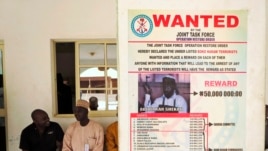
FILE - A poster announcing a reward for the capture of Boko Haram leader Abubakar Shekau is seen on a wall in Baga village on the outskirts of Maiduguri in the north-eastern Nigerian state of Borno.FILE - A poster announcing a reward for the capture of Boko Haram leader Abubakar Shekau is seen on a wall in Baga village on the outskirts of Maiduguri in the north-eastern Nigerian state of Borno.


Labels: , ,

Monday, September 02, 2013

Child Brides Disgrace!

Nigeria's child brides: 'I thought being in labour would never end'

Though child marriage is prohibited under Nigerian law,
a toxic blend of routine and religion continues to ruin
young lives
MDG : Child bride in Nigeria : Zainab Oussman  refused, and stayed in schoo
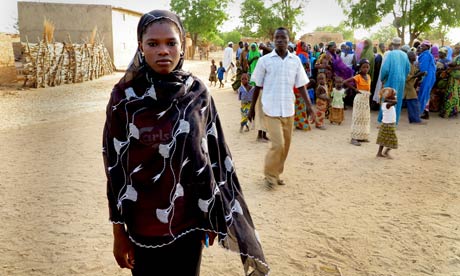
Nigerian child bride activist Zainab Oussman, 16,
in Kwassaw village. At 14, she refused to marry,
instead staying in school.

Ibrahim Kanuma winces as he recalls the moment
a 63-year-old man asked him for his teenage
daughter's hand in marriage. The proposal was not
unusual in north-western Nigeria's remote, dust-blown
state of Zamfara, but he considered the suitor too old
for his only daughter, Zainab, 13.
"Even if he had been aged up to 50 – OK. But that old,
he'll soon die and leave her lonely," says the civil
servant in his peeling office in Gusau, the state
capital. To protect his school-aged child from the
crushing stigma of widowhood, Kanuma instead
gave his blessing to a union with a "reasonably aged"
 colleague – in his 40s – even though such a betrothal
is illegal.

For Kanuma and many others in northern Nigeria,
the recent outcry over child marriage is puzzling.
Zainab's marriage is prohibited under Nigeria's
Child Rights Act, which bans marriage or betrothal
before the age of 18. But federal laws compete with
age-old customs, as well as a decade of state-level
sharia law in Muslim states.
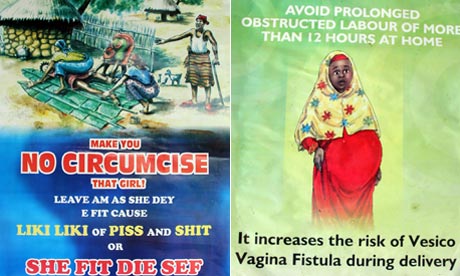
MDG : Posters about sexual health for women in Nigeria : VVF and FGM  
Warning posters about female circumcision and 
fistulas. 

"I wouldn't force my daughter to marry somebody she
doesn't like, but as soon as a girl is of age
[starts menstruating], she should be married,"
Kanuma says.

Four of the 10 countries with the highest rates of child
marriage are in west Africa's Sahel and Sahara belt. In
the years when rains or crops fail, so-called "drought brides"
– who bring in a dowry while being one fewer mouth to feed
– push numbers up dramatically.

But the practice came under scrutiny in July, when
legislators tried to scrap a constitutional clause that states
citizenship can be renounced by anyone over 18 or a married
woman, apparently implying womencan be married under 18.
The obscure ruling will have little direct impact on the one
in four rural northern Nigerian girls married off before they
turn 15, but it reveals
prevailing attitudes in a nation with acute gender disparity.


A successful vote was later derailed by senator Ahmed Yerima,
who in 2010 married a 13-year-old from Egypt. A former
Zamfara governor who
introduced a rigidly enforced version of sharia law in the north
in 2000, Yerima argued that a married girl was considered an
adult under certain interpretations of Islamic law. That prompted
outrage. "Does it then follow that the married girl who is
below 18, at election time, would be permitted to vote?" says
Maryam Uwais, a lawyer and child rights advocate in the
northern capital of Kano.

Other grassroot Muslim activists, however, fear the oxygen
of negative publicity trailing the high-profile Yerima, coming
most vocally from non-Muslims, could trigger a backlash among
conservative, rural Muslims. This would threaten painstaking
progress towards modernisation over the past decade.

In the week headlines erupted over Yerima, Aisha, nine, was
quietly rushed through the corridors of Zamfara's Faridat Yakubu
general hospital. Its cheerful cornflower blue walls belie stories of
the hidden horrors of early marriage. Aisha does not have the
words for what happened to her on her wedding night. Her husband,
she says, did something "painful from behind".

Nearby, Halima was on her third visit in three years. "I like it here.
It is the only time I ever see a television," she says. Just shy of 13,
the newlywed came under pressure to demonstrate her fertility.
"I thought [being in labour] would never end," she adds softly.

In the tradition of the rural Hausa people of the north, women are
expected to give birth at home. Crying out while in labour is seen as
a sign of weakness. But after three days close to death in her village,
Halima begged to be taken to a hospital. By the time her relatives
had scraped together enough to ferry her to the state capital, it was
too late.

The baby had died.

The prolonged labour left Halima with a fistula, which causes
uncontrolled urination or defecation. "Fistulas can happen to anyone,
but are most common among young women whose pelvises aren't at
full capacity to accommodate the passage of a child," says Dr Mutia,
one of two practising fistula surgeons in Zamfara.

Despite the obvious link, he is reluctant to blame child marriage for
Nigeria having the highest global rate of fistula. "The problem is not
early marriage. It is giving birth at home," he says.

Small victories

There have been small victories in reversing the ripple effects of
early and forced marriage, defined as forms of modern-day slavery
by the International Labour Organisation.

Fifteen years ago, Zamfara's statistics director, Lubabatu Ammani,
carried out a census to record the number of girls attending
secondary school in the state. The results were shocking: fewer than
4,000 girls were enrolled out of a population of 3.2 million.

"It was a combination of dropouts, early marriage and religious
misinterpretations," explained Ammani, who proposed creating a
female education board to help remedy the problem. "We asked all
the local emirs and found the main problem was that parents didn't
want girls who had hit puberty to be in co-ed schools."

Female enrolment in Zamfara is at its highest since independence
five decades ago, with 22,000 secondary school students. On most
days, Ammani visits wavering parents to encourage them to keep
their daughters in school.
Ammani welcomes the reawakened debate on child marriage but
warns of its limits: "The fact is, a lot of people [here], when they
hear the campaigning is by people from a different tradition or
religion, they won't agree with it."

Others are more blunt. Haliru Andi, who served as Yerima's top
aide while he led the call for sharia, bristles at the idea of interference
with his faith. "How I even use the toilet, how I share my time with my
family – everything is contained in my religion," he says in his
Persian-carpeted living room. "How, then, can I take instructions from
anybody who does not have a deep understanding of Islam?"

Cultural norms further muddy the issue. Posters outside Mutia's office
exhort against another disturbing practice related to child marriage.
In one,a woman is being forcibly restrained on a woven palm-frond mat.
An assistant grabs her legs; another sits on her chest, and yet another
reaches between her legs with a razor blade.

The scene shows a common recourse when a child bride refuses to sleep
with her husband, prompting her parents or in-laws to drag her to the  
wanzan, or traditional barber. "This traditional barber, he doesn't
understand anatomy. He thinks there's something obstructing the girl
down there, and that's whyshe fears her husband. So anything he sees,
he will just use his knife to cut it,"
Mutia explains. "They think they are helping."
None of the northern-based grassroots Muslim activists the Guardian
interviewedwanted to go on the record about child marriage – reflecting,
says one activist, the difficulties women face "going against the grain".

The storm of Twitter and online commentary has translated into a
handful of protests in the more liberal south, which is predominantly
Christian but also home to millions of Muslims.
In the tiny village of Rigasa, flanked by baobab trees and fields of millet,
Nafisa, 14, draws letters in the powdered maize she grinds every morning
for herself and her in-laws. A-B-C-D, she writes. It is all she remembers.
"My husband gets angry any time I asked him if I can take up my schooling
again, so I stopped asking. But my heart is in school," she says.

Labels: , , ,

Thursday, August 29, 2013

Nigerian Scammers? Well, Maybe Not!

Friday, August 02, 2013

Since Obusonjo Obasanjo Is A World Renowed Crook Who Pillaged Nigeria, Why Should Anyone Believe His Views On Robert Mugabe's Re-Election In Zimbabwe?!

Zimbabwe poll 'free and peaceful' say Obasanjo and SADC

Olusegun Obasanjo: "I have never seen an election that is perfect"

Zimbabwe - New Era?

Zimbabwe's elections were free and peaceful, the two leading African observer groups have said.
African Union mission head Olusegun Obasanjo dismissed complaints of fraud, while another observer urged all parties to "accept the hard facts".
A local monitoring group said earlier the poll was "seriously compromised".
President Robert Mugabe's party is claiming victory in the election, which has been dismissed by Prime Minister Morgan Tsvangirai as a "huge farce".
Justice Minister Patrick Chinamasa: "We [Zanu-PF] are going to have a landslide victory"
On Wednesday, voters were choosing a president, 210 lawmakers and local councillors. The results must be declared by the Zimbabwe Electoral Commission (Zec) no later than five days after voting day.
No presidential figures have been announced but the first official results from national assembly elections show that Mr Mugabe's Zanu-PF party is taking an early lead. However, the seats announced were mostly in Mr Mugabe's rural strongholds, correspondents say.
Zanu-PF spokesman Rugaro Gumbo predicted that Mr Mugabe, 89, - who is running for a seventh term - would get at least 70% of the vote in the presidential poll.
"We are expecting a landslide victory," he was quoted as saying in Zimbabwe's state-run Herald newspaper.
It is illegal to publish unofficial election results in Zimbabwe. Police have warned they would take action against anyone trying to leak early results.
Zanu-PF and Mr Tsvangirai's Movement for Democratic Change (MDC) have shared an uneasy coalition government since 2009 under a deal brokered to end the deadly violence that erupted after a disputed presidential poll the previous year.

Views from Zimbabwe press

The Herald (state-run) - 'The people have spoken':
Indications are President Mugabe will sweep to power with a colossal margin as his party scores a two-thirds majority in the National Assembly.
The absence of cases of violence has thrown MDC-T [Tsvangirai] and its handlers off kilter which is why they precariously hang onto trying to attack the voters' roll as if it is compiled at Zanu-PF headquarters.
It should be stated from the outset that the Registrar-General of Voters' Office falls under the Ministry of Home Affairs which was overseen by ministers drawn from Zanu-PF and MDC.
The Zimbabwe Electoral Commission is made up of commissioners chosen from lists submitted by the three parties in Government.
It thus comes as a surprise that today; MDC-T denies ownership of the electoral process it has been party to.
Daily News (privately-owned) - 'Please stop vote fraud':

In Hatfield, hundreds of street kids and youths were given voter registration slips and went on to vote and we are told this was prevalent throughout the country.
What will Zec do about this blatant vote theft?
What people now need is change and that is the reason why yesterday [Wednesday] most of them braved the chilly weather and woke up early to join long queues to exercise their fundamental right.
Their desire is to see a better Zimbabwe. People need to separate good from evil, light from darkness, suffering from prosperity and make a demarcation between history and the future.
People went out in large numbers to put an end to Mugabe's 33-year rule that was characterised by suffering.
'Heavy blow'

Speaking in the capital Harare on Friday, Mr Obasanjo, Nigeria's former president, said the elections were fair and free "from the campaigning point of view".
The former Nigerian president admitted that there were "incidents that could have been avoided", but he stressed that the 69 AU observers did not believe those irregularities could change the overall outcome of the poll.
At the same time, the AU mission expressed concern at the high number of voters turned away and those being assisted to vote - usually reserved for the illiterate or the infirm.
In a statement, it also noted that 8.7m ballot papers were printed - 35% more than the number of registered voters.
Shortly afterwards, monitors from the Southern African Development Community (Sadc) - which had 562 observers - described the elections as "free and peaceful" but said it was too early to call them fair.
"In democracy we not only vote, not only campaign, but accept the hard facts, particularly the outcome," said Sadc mission head Bernard Membe, according to the AFP news agency.
Mr Obasanjo's assessment sharply contrasted to that by the Zimbabwe Election Support Network (ZESN) - the largest group of domestic monitors with some 7,000 people on the ground across the country.
It said on Thursday that the elections were "seriously compromised", with as many as a million people being unable to cast their ballots.
The ZESN said potential voters were much more likely to be turned away from polling stations in urban areas, where support for Mr Tsvangirai is strong, than in President Mugabe's rural strongholds.

Zimbabwe election: Key facts

Zimbabweans wait to cast their votes in presidential and parliamentary elections in Harare, Wednesday 31 July 2013
  • About 6.4 million registered voters
  • Vote for president and parliament
  • Zanu-PF's Robert Mugabe and MDC's Morgan Tsvangirai are the main presidential contenders
  • Mr Mugabe, 89, is seeking to extend his 33-year rule
  • Mr Tsvangirai, 61, hopes to become president after two failed attempts
  • The poll ends the fractious coalition between Zanu-PF and MDC, which was brokered by regional mediators after disputed elections in 2008 that were marred by violence
  • First election under new constitution
The group also alleged significant irregularities before the poll. It said that 99.7% of rural voters were registered on the electoral roll in June compared with only 67.9% of urban voters.
But speaking to al-Jazeera, Mr Obasanjo questioned ZESN's conclusions, describing them as "not verifiable".
He said he was satisfied that the apparent anomalies between urban and rural voter registration had been explained by the registrar-general, who had the accurate figures for births and deaths.
Mr Obasanjo also said that Mr Tsvangirai's camp should have addressed concerns about the electoral roll before the vote - not after.
MDC member and Finance Minister Tendai Biti told the BBC that the assistance voting in rural areas was a "euphemism to say you have to vote for Zanu-PF under the guidance and watch of someone else".
"They [Zanu-PF] have stolen the election so much so that they are embarrassed at what they have done," Mr Biti added.
Still, Mr Obasanjo's assessment of the elections is a big boost for President Mugabe and a heavy blow for his opponents, the BBC's Andrew Harding in Johannesburg says.
It is unclear now how Mr Tsvangirai intends to fight on, our correspondent adds.
On Thursday, the prime minister said the elections were "null and void".
"Our conclusion is that this has been a huge farce... It's a sham election that does not reflect the will of the people."
Extra units - some in riot gear - have been deployed in Harare.
Under the electoral law, if no presidential candidate gains 50% of the ballots, a run-off will be held on 11 September.

Labels: , , ,

Wednesday, July 24, 2013

Meeting Fire With Fire: Vigilantes Target Boko Haram In Nigeria.

Nigeria's vigilantes take on Boko Haram

Nigeria under attack

Vigilante groups have formed in the northern Nigerian city of Maiduguri to fight the militant Islamist group Boko Haram, a move welcomed by the military as it battles to quell the insurgency, as the BBC's Will Ross reports.
Military checkpoints have been a common sight in the northern Nigerian city of Maiduguri - the birthplace of the militant Islamist group Boko Haram - for several years.

But these days the people asking the questions at the ubiquitous roadblocks are often not in uniform.

They are civilians who are adding their muscle to the fight against Boko Haram, which is waging a military campaign to create an Islamic state across Nigeria.
More than 2,000 people have been killed since it launched an insurgency in 2009.
"When the situation became too bad to endure, we decided to find the Boko Haram members ourselves," said Mohammed, who was stopping and searching cars at one of the checkpoints.
Map locator
"Whenever we see them we arrest them and hand them over to the army. Some of us know these people," he said, adding that he and his colleagues are not paid for the work.

The vigilantes started appearing on the streets in early June, after a state of emergency was declared in May and thousands of extra troops sent to the area to wipe out the militants.
The civilian-run checkpoints have since spread across almost every district of the mainly Muslim town. They are mostly manned by teenage boys and young men in their twenties but there are also some women searching female passengers.

Mohammed said that when they detain a suspected militant, "we bring the holy Koran and then ask him to swear on it. If he's lying we are sure he will die".
'Idiotic thieves' The vigilantes all carry crude weapons; sticks, machetes, knives and metal pipes.

Considering the

"It is thanks to the protection of God - God is our guide whenever you do something with good intention you will definitely succeed," said Mohammed, who normally works as a lorry driver.
"If we are allowed to operate without any interference, definitely we will bring an end to this problem," he said.

His colleague Salisu, normally a bricklayer, said that the vigilantes, and not Boko Haram, are carrying out the work of Allah.
"It is a mission for the sake of Allah.
"If we refuse to expose these irresponsible archaic hypocritical idiotic thieves, then we will face the wrath of the Koran."

The Nigerian military Joint Task Force (JTF) has welcomed the presence of the vigilantes on the streets of Maiduguri.
"These gestures are commendable as it underscores the desired positive civil-military collaboration necessary for the success of the ongoing internal security operation," said Brig-Gen Chris Olukolade just after civilians had started appearing at the roadblocks.

It is not clear if the vigilantes, also known as the civilian JTF, will later be armed with guns by the government.
Many of the soldiers deployed in northern Nigeria are from other parts of the country and do not know the Kanuri language, the most common used in Maiduguri.
'Guns in coffins' "Without knowing the environment and the people, building confidence and establishing a presence is very difficult," said Kole Shettima, chairman of the Centre of Democracy and Development in Abuja.

Boko Haram at a glance

Boko Haram leader Abubakar Shekau
  • Founded in 2002
  • Official Arabic name, Jama'atu Ahlis Sunna Lidda'awati wal-Jihad, means "People Committed to the Propagation of the Prophet's Teachings and Jihad"
  • Initially focused on opposing Western education
  • Nicknamed Boko Haram, a phrase in the local Hausa language meaning, "Western education is forbidden"
  • Launches military operations in 2009 to create an Islamic state across Nigeria
  • Founding leader Mohammed Yusuf killed in same year in police custody
  • Succeeded by Abubakar Shekau, who is said to be well-versed in theology
  • Suspected to have split into rival factions in 2012
"The vigilantes know the local population and can help fish out the insurgents."
"But increased conflict between the vigilantes and Boko Haram is possible and this would further militarise the society and make it extremely difficult to see and end to the violence," he said.
"A new group of young people who may get armed could then try to get what they can out of the situation. They may themselves become a danger and mete out their own form of justice."
There are already some reports from Maiduguri of vigilantes killing people, rather than handing suspects over to the army.

In order to sidestep the tighter security presence in Maiduguri, the Islamist militants have diversified their tactics.
Earlier this month several suspected Boko Haram members disguised themselves as women.
They hid their faces behind veils and their guns beneath full-length robes.
Local reports from Maiduguri said their mission was thwarted and soldiers shot several of them dead.
In June eyewitnesses said Islamist insurgents shot dead 13 people in an apparent reprisal attack on members of a vigilante group.
They had sneaked their weapons into the area by pretending to be on their way to a burial, hiding their weapons in the coffin.

The recent attacks on schools have also proved how vulnerable the local population is. Over the past month 48 students and seven teachers have been killed in four attacks in northern Nigeria.
In a video on the internet, Boko Haram leader Abubakar Shekau said his group supported the recent attacks on schools, although he denied being behind the attack on Mamudo in Yobe State where at least 29 students were killed.

There are dangers associated with relying on vigilante groups to offer security for the population.
But as Islamist militants seem determined to attack softer targets, the vigilantes could play a vital role in trying to thwart attacks and save lives, some analysts say.

Labels: ,

Wednesday, June 05, 2013

I'm Elated To Witness Nigerian President, Goodluck Johnathan, Continue To Grow Balls As He Battles Terrorist Group, Boko Haram.

Nigeria: Jail terms to tackle Islamist militancy

Nigeria has officially banned two militant Islamist groups, warning that anyone who helps them will face a minimum jail sentence of 20 years.
President Goodluck Jonathan declared Boko Haram and Ansaru to be terrorist groups, his office said.
The army has been waging an offensive against the militants in their northern strongholds since a state of emergency was declared last month.
The insurgency has killed about 2,000 people since 2009.
The activities of both Boko Haram and Ansaru would now fall under the Terrorism Prevention Act, Mr Jonathan's office said, in a statement.
It means that "any person who knowingly, in any manner, directly or indirectly", offers support to Boko Haram and Ansaru would be jailed for "not less than 20 years" if convicted, the statement added.

Boko Haram: Timeline of terror

  • 2002: Founded
  • 2009: Hundreds killed when Maiduguri police stations stormed; leader Mohammed Yusuf captured and killed
  • Dec 2010: Bombed Jos, killing 80 people; blamed for New Year's Eve attack on Abuja barracks
  • Jun-Aug 2011: Bomb attacks on Abuja police HQ and UN building
  • Dec 2011: Multiple bomb attacks on Christmas Day kill dozens
  • Jan 2012: Wave of violence across north-east Nigeria
  • April 2012: Deadly Easter church attack in Kaduna; ThisDay newspaper offices bombed
  • February 2013: French family kidnapped in Cameroon
  • May 2013: Heavily armed incursion into Bama town
On Monday, the US said it was offering rewards for information on Islamist militants in West and North Africa.
The highest reward of up to $7m (£4.6m) is for information leading to the location of Boko Haram leader Abubakar Shekau, the state department said.

Boko Haram launched the insurgency in 2009, carrying out a wave of bombings and assassinations in north and central Nigeria.
Ansaru, which is suspected to be an off-shoot of Boko Haram, joined the insurgency in 2012, taking foreigners hostage.
It said it had killed seven European and Middle Eastern nationals abducted in February 2012 in the northern Bauchi state.

Last month, Mr Jonathan declared a state of emergency in Borno, Yobe and Adamawa states, the three main strongholds of the Islamist groups.
It led to the army launching a ground and air assault to flush out the militants.
Rights groups repeatedly accuse government troops of targeting innocent people after falsely accusing them of backing the militants.
The army denies the allegation.

Labels: , , , ,

Tuesday, May 14, 2013

At Long Last, Nigeria President, Goodluck Johnathan, Starts To "Grow Some Balls" Against Nigeria's Al Qaeda, Boko Haram. Good For Him.

Nigerian president declares state of emergency

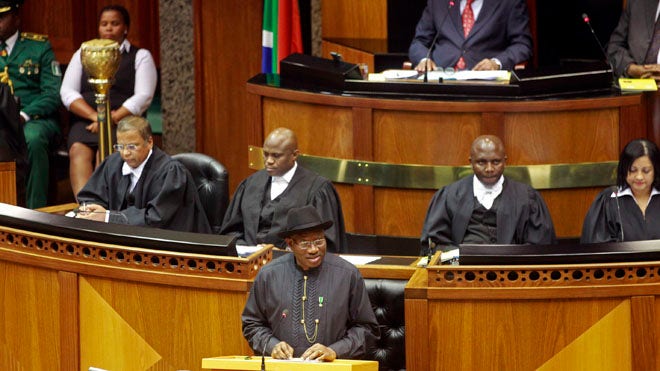
  • May 7, 2013: Nigerian President Goodluck Jonathan, center, makes a speech in the South African Parliament in Cape Town. On May 14, 2013, President Goodluck Jonathan declared a state of emergency in Nigeria. (AP)


Nigeria's president declared a state of emergency Tuesday across the country's troubled northeast, promising to send more troops to fight an increasingly violent Islamic insurgency.
Islamist sect Boko Haram -- whose name means "Western education is sacrilege" in the Hausa language of Nigeria's north -- has intensified its attacks on security forces and government targets in its northeast stronghold this month, prompting President Goodluck Jonathan to declare a state of emergency in certain states.
 
Last week, dozens of Boko Haram fighters in buses and machine gun-mounted trucks laid siege to the town of Bama, in Borno, killing 55, mostly police and other security forces, and freeing more than 100 prison inmates. Days earlier, scores were killed in the fishing village of Baga, also in Borno, on the shores of Lake Chad, when troops from Nigeria, Niger and Chad raided it looking for Islamists. Local residents said soldiers were responsible for many civilian deaths.
 
 President Jonathan, speaking live on state radio and television networks, also warned that any building suspected to house Islamic extremists would be taken over in what he described as the "war" now facing Africa's most populous nation. However, it's unclear what the emergency powers will do to halt the violence, as a similar past effort failed to stop the bloodshed.
"It would appear that there is a systematic effort by insurgents and terrorists to destabilize the Nigerian state and test our collective resolve," Jonathan said.
Jonathan said the order will be in force in Adamawa, Borno and Yobe states. He said the states would receive more troops, though he will not remove state politicians from their posts. Under Nigerian law, the president has the power to remove politicians from their posts and install a caretaker government in emergency circumstances.
 
The president's speech offered a stark vision of the ongoing violence, often downplayed by security forces and government officials for political reasons. Jonathan described the attacks as a "rebellion," at one point describing how fighters had destroyed government buildings and "had taken women and children as hostages."
"Already, some northern parts of Borno state have been taken over by groups whose allegiance are to different flags than Nigeria's," Jonathan said.
The president later added: "These actions amount to a declaration of war and a deliberate attempt to undermine the authority of the Nigerian state and threaten (its) territorial integrity. As a responsible government, we will not tolerate this."
 
This is not the first time Jonathan has implemented emergency measures. In December 2011, Jonathan declared a state of emergency over some limited local government areas in the states, after a church bombing blamed on Boko Haram killed 37 people, but he lifted it in July last year. This new decree, however, is more drastic and covers whole states, likely to cause conflict with powerful governors sitting in those states, as well as the political opposition. On Monday, the Nigeria Governors' Forum, representing the governors of Nigeria's 36 states, issued a statement warning Jonathan against imposing emergency rule in response to the insurgency.
According to an Associated Press count, more than 1,600 people have been killed in attacks by Islamic insurgents since 2010. Recently, Nigeria's military has said Islamic fighters now use anti-aircraft guns mounted on trucks to fight the nation's soldiers, likely outgunning the country's already overstretched security forces.
 
Boko Haram has said it wants its imprisoned members freed and strict Islamic law adopted across the multiethnic nation of more than 160 million people. It has produced several splinter groups, and analysts say its members have contact with two other Al Qaeda-linked groups in Africa.
The Islamic insurgency in Nigeria grew out of a 2009 riot led by Boko Haram members in Maiduguri that ended in a military and police crackdown that killed some 700 people.
The group's leader died in police custody, in an apparent killing. From 2010 on, Islamic extremists have engaged in hit-and-run shootings and suicide bombings. Recently, however, they've begun to use military-grade weapons, some of which they apparently seized from Nigerian military stockpiles.
Nigeria's military and police also have been repeatedly accused by human rights activists and others of torturing and summarily killing suspects, as well as burning down civilian homes and killing civilians in retaliation for militant attacks.
 
The latest incident, in a fishing village in Borno state along the shores of Lake Chad, saw at least 187 people killed and there are allegations that soldiers are responsible. While the military has denied repeatedly that it attacks and kills civilians, the country's armed forces have a history of committing such assaults.
 
Separately on Tuesday, an official in the central Nigerian state of Kaduna said gunmen armed with assault rifles and suspected to be Hausa-Fulani cattle herders killed 11 people in a village there. And in Benue state, a government spokesman said an attack blamed on Hausa-Fulani cattle herders there killed at least 12 people.

Labels: , , ,

Monday, May 13, 2013

The Boko Haram Threat To Nigeria Is Real.

Insight: Nigeria's Islamists staging bolder, deadlier comeback

(Reuters) - After a crackdown pushed them out of Nigeria's northern cities, Islamist militant group Boko Haram have regrouped, rearmed and are staging a bold comeback that has already allowed them to seize control over parts of the northeast.
Using porous borders with Chad, Niger and Cameroon in the desolate scrubland around Lake Chad, they are smuggling bigger weapons, staging cross-border raids, killing and kidnapping in an escalation of violence that could further draw Nigeria's neighbors into its counter-insurgency fight, security officials say.
 

The Islamists now control at least 10 of the 27 local council areas in Borno state, Nigeria's most remote northeastern region on the edge of the Sahara and a relic of one of Africa's oldest medieval Islamic empires, security sources there say.
One says the real figure could be closer to 20, as local councilors fearing assassination have fled, leaving a power vacuum filled by bearded radicals with automatic rifles.
Boko Haram's struggle for an Islamic state has killed thousands since 2009 and is the main threat to Africa's top oil producer, although its fighters have so far not struck anywhere near the southern oil fields.
 

When Borno's governor Kassim Shettima briefed visiting senators and military advisers in a confidential security meeting on May 7, he said something that stunned them: Boko Haram were on the verge of seizing control of his state.
"What the governor said was frightening. He informed us there is a possibility that this state will be taken over by Boko Haram ... that they have the ability to do whatever they wanted here," senator Abdul Ahmed Ningi, a delegate and deputy majority leader for the ruling party, said after the meeting.
"I had thought Boko Haram had been subdued to some extent."
 

MOVEMENT IN FLUX
 

A wave of Islamic fervor took hold of northern Nigeria during an economic crisis in the early 1980s, triggering riots in the north's main city of Kano and later prompting many states to introduce Sharia law from 1999.
 

In 2002, a cleric called Mohammed Yusuf founded a radical Islamist movement in Borno, later nicknamed 'Boko Haram' or 'Western education is sinful' in the northern Hausa language because of its opposition to Western cultural influences.
A military crackdown during an uprising in 2009 led to the deaths of 800 people, including Yusuf, who died in police custody.
 

Far from being silenced, they struck back, first shooting or throwing bombs at police off the back of motorcycles, then graduating to increasingly sophisticated bomb-making technology.
By late last year it seemed the militants had been chased out of city centers and were losing the ability to carry out large-scale attacks, but Boko Haram have repeatedly proved masters of recovering from apparent defeat.
 

A coordinated strike by some 200 Boko Haram fighters on an army barracks, police station and prison in the town of Bama last week that left 55 people dead and freed more than 100 prisoners was the latest evidence that they have recovered their strength.
Initially funded by northern politicians who later distanced themselves from the militants, Boko Haram have forged growing links with Saharan Islamists such as al Qaeda in the Islamic Maghreb, giving them new access to funding and training.
 

LAWLESS LAKE
 

The road from Borno's capital Maiduguri to Lake Chad, where Niger, Chad, Nigeria and Cameroon join, cuts through a semi-desert landscape dotted with lonely trees and thatched straw hamlets.
In one village, a skinny old man herds goats across wind-swept sands while a woman in a purple hijab balances a jug on her head, not far from the ashen remains of a car bomb.
Further along, a man in a turban and flowing robes rides on horseback across an expanse of grayish sand, a flashback to the centuries past when Borno was a prosperous sultanate profiting from trade routes crossing the Sahara to the Mediterranean.
Save the odd military checkpoint, there are few signs of statehood here. Disused schools and council buildings decay in dry heat. A fisheries college that was abandoned last year after an attack killed some staff stands eerily empty.
 

Boko Haram, under the leadership of fiery, gun-toting militant Abubakar Shekau, is thought to be getting closer to achieving its dream of creating some kind of Islamic rule in the lawless areas around Lake Chad, where even the police have fled.
"They are now holding territory," Kole Shettima, chairman of the Centre for Democracy and Development, said. "The next step is to create institutions: justice, social services," as Malian Islamists did before the French forced them out of its cities.
The Bama attack showed their substantial firepower, including machine guns, large numbers of rocket propelled grenades (RPGs) and pick-up trucks mounted with anti-aircraft guns, a sign the weapons flood from the Libyan war that helped rebels seize parts of Mali last year has reached Nigeria, officials say.
"They're getting bolder, better armed, more organized. it's looking bleak," a security official in Maiduguri said.
 

The exact number of Boko Haram fighters is hard to estimate -- and the degree to which Shekau and the four main members of his 'Shura council' -- Habibu Yusuk, Khalis Albarnawai, Momodu Bama and Mohammed Zangina -- have control over them is unclear.
They rarely communicate with the press since their spokesman was killed last year, although Shekau sometimes uploads videos of himself making bellicose statements onto the web.
Security officials believe they have several hundred well armed and trained fighters and possibly thousands of members.
The army spokesman for Borno state, Lieutenant-Colonel Sagir Musa, denied that the group were staging a significant comeback, but he told Reuters they were moving in bigger numbers than before.
 

"KILLERS"
 

A military convoy rumbles into the remote fishing settlement of Baga, on the shores of Lake Chad, scene of fighting last month that killed dozens of people, many of them civilians.
As it weaves past the charred remains of ruined houses, locals shout abuse at soldiers in the Hausa language.
On April 16, Boko Haram militants armed with guns and RPGs killed a soldier on patrol, slicing his head off with an axe.
What happened next is disputed. Brigadier-General Austin Edokpayi, who heads a multinational force comprising 1,200 Nigerians, 700 Chadians and 300 troops from Niger charged with securing this volatile border area, said reinforcements arrived and met fierce resistance from entrenched Boko Haram gunmen.
 

Community leaders say the Boko Haram militants had already fled over the border into Chad by the time the soldiers arrived, who then exacted vengeance on the civilian population, shooting, setting fire to houses and killing 185 people.
Whatever the truth of what happened at Baga, Boko Haram's creeping establishment of a stronghold around Lake Chad is becoming a major headache for Nigeria and its neighbors.
"It has emboldened the terrorists," Edokpayi said, complaining that since most local government officials have fled, the military were effectively on their own. "They are eating deep into the ... sovereignty of the Nigerian state."
At one Baga village meeting in which elders complained of heavy handedness by Nigerian troops, an intelligence official told Reuters around half the attendees were Boko Haram members.
Many are poor, young men with little if any formal education and no job prospects in some of the poorest places on earth.
 

The group's ability to strike fear stems both from its secretiveness -- no one who isn't a member can be sure who is -- and its visibility in places where the state has withered.
"They are there for everybody to see. You can see them sitting in front of their houses, holding their guns," said a man near Baga fish market who gave his name only as Abubakar.
That Boko Haram is also a menace to other countries around the lake was highlighted in February when it kidnapped a French family of seven from a game park in north Cameroon, taking them over the border into Nigeria. They were freed in April.
The cross border threat is likely to prompt more joint operations. The multinational force was originally set up in 1998 to deal with marauding Chadian rebels, but last year was expanded to include anti Boko Haram operations.
 

Yet the insurgents' ability to melt away under military pressure and then come back has convinced many that only some kind of political solution will resolve the conflict.
President Goodluck Jonathan set up a body last month to formulate terms for an amnesty, like the one that helped silence militancy in the oil producing Niger Delta in 2009, but the Islamists showed no interest, with Shekau denouncing it.
 

And few think any peace can hold unless Jonathan's administration can address the underlying causes of insecurity -- the north's extreme poverty and unemployment.
In the meantime, Boko Haram's efforts to revive an Islamist theocracy in northeast Nigeria will cause more bloodshed yet.

Labels: , ,

Radical Fanatical Muslims In Nigeria Kill At Will, And Government (?For Lack Of A Better Word To Describe What Passes As A Government) Appears Impotent.

Extremism in Nigeria: Africa's great unreported bloodletting

The sophisticated weaponry flooding into the country has enabled Boko Haram to step up the ferocity of its attacks

At first, the Islamic extremists in Nigeria's dusty north-east rode on the backs of motorcycles, firing on government officials and other perceived enemies with worn Kalashnikovs hidden beneath their flowing robes. Now, they come prepared for war.

When Islamic fighters drove into a town in north-eastern Nigeria last week, they used anti-aircraft guns, mounted on the backs of trucks, to destroy nearly every landmark of the nation's federal government. Fighters also rode in on at least one bus, the military said, while in other assaults insurgents have fired rocket-propelled grenades.

The militarisation of Islamic radicals in the north comes after witnesses saw Nigerian fighters mingle with the extremists who took over northern Mali in the weeks following a coup there. It also comes after fighters seized massive deposits of Nigerian military equipment and have gained access to arms smuggled out of the lawlessness of Libya.

Those new arms, and the willingness of extremists to use them, highlight the increasing instability in Nigeria's north and the ever-growing dangers facing the nation's weak central government. With dozens dead in other incidents in the past few days, the violence in this country is mounting, but has yet to make headlines in the West. This is, in ways that Mali – with the intervention of French troops – was not, Africa's great silent bloodletting.
"Each year, they grow in prominence and sophistication," said David Zounmenou, an analyst at the Institute for Security Studies in Pretoria, South Africa. "That's what's making the fighting that much more difficult for the Nigerian security forces."

The sophistication of the fighters, who are most likely from the extremist network Boko Haram, could be seen in their assault on Bama, a town some 40 miles south-east of Maiduguri, the capital of Borno state. The military said some 200 fighters in buses and pickup trucks laid siege to the town. In their arsenal were truck-mounted anti-aircraft guns, weapons seen during the civil war in Libya and the recent fighting in northern Mali.
That attack in Bama killed at least 42 people, as well as 13 others that authorities described as Boko Haram fighters. The insurgents' heavy weapons helped them overrun the barracks of the Nigerian army's 202nd Battalion, as well as a police station, a police barracks, a magistrate's court, local government offices and a federal prison. The extremist fighters freed 105 prisoners during their assault, a Nigerian military spokesman, Lt-Col Sagir Musa, said.

The use of such weapons marks a transformation of Nigeria's Islamist insurgency, which grew out of a riot in 2009 led by Boko Haram members in Maiduguri. That ended in a military and police crackdown that killed 700 people. The group's leader died in police custody in an apparent execution-style murder, fuelling dissent that broke into the open in 2010 with the targeted killings of government officials, security agents and religious leaders who spoke out against Boko Haram.
Since then, Islamists have engaged in hit-and-run shootings and suicide bombings, attacks that have killed at least 1,618 people, according to an Associated Press count. That number doesn't include the killing in April this year of at least 187 people in the fishing village of Baga during fighting between extremists and security forces, as witnesses and human rights activists said Nigeria's military killed civilians and burned thousands of homes and businesses.

Casualties are expected to rise as the extremists now have access to sophisticated weaponry. While in the past decade Nigeria's military has fought against heavily armed militants and criminal gangs operating in the creeks of its oil-rich southern delta, analysts and security officials say those groups never had access to anti-aircraft weapons. Nor did those groups launch attacks on military barracks, or level towns.

Where the weaponry has come from also remains unclear. A propaganda video released in March by Boko Haram, featuring its leader, Abubakar Shekau, showed fighters gathered around weapons they said they had stolen from an attack on an army barracks. Those weapons included what appeared to be heavy machine guns, rocket-propelled grenades and possibly anti-aircraft weapons, as well as ammunition and brand-new bulletproof vests.

Another source of tactics and weapons may come from northern Mali, where Nigerian extremists had joined the fighting.
"Boko Haram will also likely recruit militants who fought and obtained new skills from warfare in Mali," wrote the analyst Jacob Zenn in a recent publication by the Combating Terrorism Center at the US Army's West Point. "The Boko Haram attack on an army barracks in Monguno... in which the militants mounted weapons on four-wheel drive vehicles, and the discovery of improvised fighting vehicles in a raid on a Boko Haram hideout in Maiduguri... suggest that Boko Haram has already learned new methods of fighting from the Islamist militants in Mali."

Abubakar Shekau is a shadowy figure, now seen mainly in propaganda footage released by the group. Part theorist and part hoodlum, the former theology student is known to be taciturn, but other details remain murky. Even his age – said sometimes to be 34, on other occasions to be nearer 43 – is a matter of conjecture. And even his very existence has been disputed, as Nigerian authorities believed that he had been killed in 2009, only for him to re-emerge in Boko Haram videos.

Meanwhile, arms are likely to continue to come out of Libya from heavily armed militias there, Mr Zounmenou said. He explained that arms can be transported quickly through the Sahara and into West Africa's Sahel to Nigeria, a major shipment stop for illegal weapons.
While Nigeria's President Goodluck Jonathan has spoken before about the need to control arms shipments throughout West Africa, the trade continues largely unhindered. And as more of those weapons end up in the hands of Islamists in Nigeria's north, more violence can be expected.
"They are now really going to war," Mr Zounmenou said. It is not surprising that on Thursday, the Nigerian President abandoned a much-heralded diplomatic visit to southern Africa to return home to speak to security services about the increased body counts from violence across his nation.

Labels:

Thursday, April 04, 2013

Maybe, God Is Allowing The Devil To Have A Foothold In Nigeria Because That's What Nigerians Allow! Watch Video.

Labels:

Tuesday, April 02, 2013

Nigerian President, Goodluck Jonathan, Serves As Country's "Morgue Attendant"!

Nigerian president is 'squeezing the life out of our country'

Goodluck Jonathan is more interested in retaining power and accumulating wealth than truly tackling terror and corruption
Goodluck Jonathan
Nigerian president Goodluck Jonathan.

There is a joke about a morgue attendant who was so used to
 seeing dead bodies that one day, when a supposedly dead
body started twitching, his response was, "this is the morgue,
not the emergency room". He promptly smothered the
twitching body until it was well and truly dead. "That's more
like it",he said, as he sat down to guard the cabinet
full of dead bodies and to wait for new arrivals.

In many ways, the way Goodluck Jonathan has handled
the affairs of Nigeria since becoming president can be
likened to that of the morgue attendant. And worse still,
Nigeria under his administrationhas grown to become
a vast, sprawling mortuary where deaths and dead
bodies do not seem to matter at all. In the aftermath
of Jonathan's visit to Maiduguri, the trouble northern
city under attack by Boko Haram,in security operatives
reportedly dumped about 70 bodies at the morgue,
up from the daily average of 10 or 20.

Like the morgue attendant in the story, when about two
years ago, the Borno state Elders Forum met the
president and asked him to order the withdrawal
of troops from Maiduguri to enable them take a different
approach against the jihadist group, Jonathan flatly refused.
In the two years since, how many more lives have been
needlessly lost in the fighting? His attitude seems to be,
"I'd rather preside over dead bodies than save lives".

Accepted, Jonathan took over a country that was severely
distressed. But what is the job of the president?
For someone who has spent the last 14 years in power
at the state and federal levels, the excuse that he is still
studying the situation is one of the lamest apologies in
political history. Either deliberately or inadvertently,
like the morgue attendant, Jonathan's actions and inactions
all seem geared towards killing Nigeria off once and for all.

Why was it that when he was eventually shamed into visiting
northern Borno and Yobe states by opposition governors,
his response to calls for an amnesty for Boko Haram was,
"We can't grant amnesty to ghosts". Within a week of
his mindless retort, another 25 Nigerians had been blown
to smithereens in Kano. Since he can't grant amnesty to
ghosts, perhaps, he can grant amnesty to dead bodies?

Incidentally, more and more Nigerians are beginning
to suspect that the deteriorating security situation may
be more than the handiwork of Boko Haram. More than ever,
there are growing fears that some, if not many of the attacks
attributed to Boko Haram may be the work of other "ghosts"
beyond the militants,whose ultimate objective may be to divide
Nigerians further along ethnic and religious lines for political
advantage. The very nature and timing of some of the attacks
on churches and some ethnic groups lend credence to that
supposition.

Is this the same Jonathan who told us on his inauguration
that, "Today, our unity is firm, and our purpose is strong,
our determination unshakable. Together, we will unite
our nation and improve the living standards of all our peoples
whether in the north or in the south; in the east or in the west.
Our decade of development has begun. The march is on. The
day of transformation begins today. We will not allow anyone
 exploit differences in creed or tongue, to set us one against
another?"

Perhaps, Nigerians should not be surprised at what Jonathan
has become. From the supposedly timid state governor and
vice president, we now have one of the most calculating and
thick-skinned leaders, totally deaf to criticism. The only
thing on his mind seems to be to retain power beyond
2015 while allegedly helping friends and cronies accumulate
wealth. After all, when he was asked about politicians
declaring their assets in public, he said: "The issue of public
asset declaration is a matter of personal principle. That is
 the way I see it, and I don't give a damn about it, even
if you criticise me from heaven."

Which is why the condemnations of the pardon he granted
to Diepreye Alamiesegha, a former state governor who stole
millions of dollars and jumped bail in the UK after disguising
 himself in as a woman, are likely to fall on deaf ears. It is why,
even with a daily income of $224 million, Nigerians are among
the poorest people on earth. It's why we have 68 million people
unemployed; why Nigeria is the most corrupt nation in the world
and why studies show that a child would be off being born
in Somalia, Mali, Chad, South Sudan and other war-ravaged
countries than in Nigeria.

Jonathan's well-paid and ill-mannered army of internet and media
warriors may sing his praises to high heavens and work hard to
distort any discourse about the woeful failures of their paymaster,
but they cannot hide the fact that, under Jonathan, Nigeria has
become a vast mortuary where death and tragedy are routine.

And like the morgue attendant, the president seems intent on
smothering all remaining signs of life.

Labels: , ,

Wednesday, October 12, 2011

More On The BANANA Republic Of Nigeria.

Nigeria: Insecurity - What Hope for the Common Man?

The security situation in the country has degenerated to the extent that public functions are now held in secluded places amidst tight security. ROSE ADAH reports that governments seeming inability to handle the situation may have left ordinary Nigerians to their fate.

In a twinkle of an eye, Nigeria has become a violence filled state with crises prevalent in many parts of the country. A country that has been known for peace, unity and love has become troubled, divided and insecure.

Security of lives and property which ought to be one of the responsibilities of the government does not seem to be the case anymore, as people no longer sleep with two eyes closed or move about freely without looking back for fear of been attacked by armed robbers, kidnappers or terrorist groups.

Every individual has become so security conscious that security gadgets are seen in homes that can afford it, banks, corporate organisations and embassies.

Churches are not left out too, as worshippers are thoroughly screened before they are allowed entrance into worship centres in some parts of the country, while some churches have banned the use of big handbags by women in their churches.

Security has been beefed up in every part of the country and people no longer go in and out of places freely, as everybody has become a suspect.

The security of the life and property of citizens lies with the government, as enshrined in Section 14(2c) of the constitution of the Federal Republic of Nigeria, which states that "The security and welfare of the people shall be a Primary purpose of the government."

For the first time since Nigeria got her independence in 1960, independence anniversary celebration was held within the secure walls of the Aso Rock Presidential Villa, and not the public square where such events are held.

The decision of the government to mark the anniversary with low key celebrationat the Villa, was perceived by many to be an act of fear on the part of the government, as there were bomb threats by the Movement for the Emancipation of Niger Delta, ahead of 51st Independence Day celebration.

In a statement circulated via the internet, the spokesperson of MEND had said "October 1, 2011, the Movement for the Emancipation of the Niger Delta intends to place bombs within and in the vicinity of the proposed 2011 independence anniversary celebrations. After 51 years of independence, Nigerians still have nothing to celebrate. The general public is strongly advised to consider this as a 1st and final warning, no additional warnings will be issued subsequent to deployment or detonation of these devices, which will be novel in nature."

The government was later to clear the air on this, as the information minister, Labaran Maku, said attributing the decision of the government to fear was unfounded, as the decision was intended to save cost from the elaborate celebration, and added that the decision was in good faith and in the best interest of the country.

But the question on the minds of many Nigerians is how a small fraction of the population of the country can subject a large majority of the populace and the government to so much trauma and fear, with no drastic step from the government to put an end to the situation.

Despite efforts by individuals and the government to beef up security, armed robbery has been on a steady rise, kidnappers are still at their game just as the Islamic sect, Boko Haram, appears to be more resolute in its determination to bomb the country at the slightest provocation.

Recently in Zamfara State, when people were supposed to be celebrating the country's independence, armed bandits killed 19 persons, including a man, his wife, son and brother, in a single operation.

On October 2, 2011, a day after the robbery incident in Zamfara, kidnappers abducted the father of Akwa Ibom State Governor, Godswill Akpabio's security aide from a church in the state. According to media reports, the abductors seemed not to be in a hurry as they took their time to carry out the operation, while the women in the church kept screaming for help.

On the same day in Nnewi, Anambra State, suspected kidnappers abducted the father of a member of the House of Representatives in his house, while he was preparing for church service.

The National Youth Service Corps (NYSC) recently cancelled its passing-out parade for the Batch C corps members, citing insecurity.

The Nigeria Law School, Bwari, Abuja, on October 5, 2011, also shifted its call to bar ceremony from the school premises, to the International Conference Centre, Abuja, as part of security measures to forestall any eventuality.

The event was held amidst tight security, and only guests with invitation cards to the ceremony were allowed entrance into the venue.

A legal practitioner at the venue, Mr. Benson Agada, lamented the security situation in the country. He said, "The security situation in the country has become so bad that the venue of this ceremony had to be moved from the Law School to this place. The director-general of the Nigerian Law School, Tahir Mamman was trying to explain that the change in the venue is due to the ongoing road construction but I think we all know why the venue was changed because the road to the school is not affected by the construction.

"Could it be that the government is not capable of tackling this menace? The government needs to have a headlong confrontation with these militants, Jonathan has to fight them because, they had threatened earlier that they will make his government ungovernable if he becomes president, and that is exactly what they are doing."

A group of women, seating outside the gate were seen scampering and when confronted, one of them, who spoke on anonymity said, "A lady who was sitting with us told me she wanted to get some snacks and that I should watch over her handbag. When she was gone, I had no option than alert the others to flee since we didn't know what was contained in that bag. You know one has to be security conscious with all these happenings here and there, you can't trust anyone. That is why the security here is so tight that we can't even go in to celebrate with our loved ones."

With all the measures the government says it has put in place to fight this menace, one cannot but wonder why violence still persists and why the Boko Haram sect appears to be such a hard nut to crack.

This may justify the suspicions by the government and some security agencies that there could be an infiltration of the Boko Haram sect in the security agencies in the country. Otherwise, how else can one explain the sect's success at launching attacks on their targets, especially in Borno State, despite the presence of the Joint Task Force in the state.

A source in one of the security agencies, who craved anonymity, told LEADERSHIP that "We are suspecting infiltration of security agencies by Boko Haram members. They seem to have more intelligence information on our security agencies than we had thought; and the manner in which they beat security agencies to attack, point to some moles within the security network. Some security operatives have not risen above ethnic and religious persuasions. We think such operatives might be leaking information. If there are no moles, why will a security chief release a Boko Haram leader in detention? This infiltration is being addressed. I won't say more than this."

But the leader of the Shiites Islamic sect, Mallam Ibraheem el-Zakzaky, has accused some politicians and officials within the country's security agencies of being the brain behind the security situation in the country.

Recently, a self-acclaimed co-founder of Boko Haram, Mallam Aliyu Tishau, who was in detention was released and the only explanation given was that he was released to a sister security agency; but the Army and the SSS denied that Tishau was released to them, only to agree after a meeting that Tishau was released based on a court order. But why the confusion, what do Nigerians believe?

While the blame game continues between the security agencies, Nigerians are yearning for the Nigeria where security and value for life was the order.

Labels: ,